In this pattern, the group is driven by complete devotion to something external to Self. For example, many problem-solving organizations are so enamored of the technologies they employ, that they sometimes forget that they must employ them in the service of actual customers. Infatuated groups are so hopelessly in love with something outside of themselves that they will take unacceptable risks in the hope of preventing perceived harm to the objects of their affections.
It's sometimes difficult to see the Infatuated organization as incongruent, because its dedication to a person or ideal seems so high-minded. Much of what you see and hear in the Infatuated organization seems perfectly wonderful. Often, too, the indicators of infatuation aren't what you see or hear, but what you don't see, and don't hear. For example, if the organization is infatuated with a particular technology, it might not be able to see the limitations of that technology. Of one thing we can be certain, now at the end of the twentieth century: every technology has limitations. An organization that cannot see the limitations of a technology will eventually misapply it — with potentially disastrous consequences. Perhaps you can think of organizations in your own experience that might have exhibited a technology infatuation. One possible candidate that comes to mind is the Atomic Energy Commission of the 1950s.
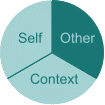
The Infatuated Configuration
Organizations can become infatuated with people, too. Usually, when this happens, the object of the infatuation is the leader. In this form, the organization loses its ability to see the errors or limitations of the leader, sometimes as a direct result of actions of the leader. The price for this particular form of incongruent coping comes as a result of a constriction in the range of options for interpreting the world — the organization sees only those interpretations that preserve its evaluation of the leader. When the leader of an infatuated organization errs, healthy criticism of the leader is unavailable, and the organization follows the leader into disaster. The fable of the Emperor's New Clothes is one of organizational infatuation, possibly on several levels, but especially of the infatuation of the Emperor's subjects with their Emperor.
In project work, infatuation with high-status team members can cause a project team to take on faith the judgments of these team members. If there are errors in these judgments, the project might suffer, especially if these errors are compounded by a delayed acceptance of the fallibility of some especially high-status team members.
Infatuated vignette
How would the emergency project situation unfold in a Infatuated organization? We might hear questions and comments such as:
- We have to go on line by March 10th, because unless this project succeeds, it will be the end of client/server technology at this hospital. (technology infatuation)
- Well, we'll just have to find a way to make the original date — it's as simple as that. We've already slipped once, and the engineers at MegaCouch will be sunk if we have to tell them we can't make that date. (customer infatuation)
- We can't let Phil (VP Engineering) down — we just can't. What if we work 65 hours instead of 55? Can anyone not do that? (leader infatuation)
- Well, then we'll be late, that's all. I'm not going to allow them to cut out the new controller technology just because it's a few months behind. (technology infatuation)
From Infatuation to Congruence
In the Infatuated stance, two elements are missing — Self and Context. The organization is
failing to take into full account both its Self and the Context. To reintroduce these elements,
ask what-if questions about consequences, to move the organization to consider issues that
emphasize its Self and the Context. For example, you might wonder "What exactly will happen if
our project doesn't go on line by March 10th? How exactly will that kill client/server
technology at this hospital?" Ask you questions as if presuming the conjectures that are in the
air. Don't question the conjectures themselves, but do ask for more information about how
exactly they will work. This will help the organization to consider in detail how they reached
their conclusions, which creates a circumstance that compels consideration of Self and Context.
 Top
Top
Back to "Organizational Coping Patterns"
Are you a writer, editor or publisher on deadline? Are you looking for an article that will get people talking and get compliments flying your way? You can have 500-1000 words in your inbox in one hour. License any article from this Web site. More info
Follow Rick


Send an email message to a friend
rbrenIyeJIiAfnGdKlUXrner@ChacsxirZwZlENmHUNHioCanyon.comSend a message to Rick
A Tip A Day feed
Point Lookout weekly feed
 My blog, Technical Debt for Policymakers, offers
resources, insights, and conversations of interest to policymakers who are concerned with managing
technical debt within their organizations. Get the millstone of technical debt off the neck of your
organization!
My blog, Technical Debt for Policymakers, offers
resources, insights, and conversations of interest to policymakers who are concerned with managing
technical debt within their organizations. Get the millstone of technical debt off the neck of your
organization!Point Lookout by
starting your Amazon search here

 Bad boss, long commute, troubling ethical questions, hateful colleague? Learn what we can do when we
love the work but not the job.Are your project teams plagued by turnover, burnout, and high defect rates? Turn your culture around.Fed up with tense, explosive meetings? Are you the target of a bully? Learn how to make peace with conflict.Learn how to make meetings more productive — and more rare.
Bad boss, long commute, troubling ethical questions, hateful colleague? Learn what we can do when we
love the work but not the job.Are your project teams plagued by turnover, burnout, and high defect rates? Turn your culture around.Fed up with tense, explosive meetings? Are you the target of a bully? Learn how to make peace with conflict.Learn how to make meetings more productive — and more rare.