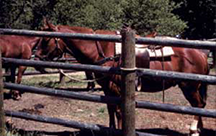
A classic wood corral. Photo courtesy U.S. Department of Transportation.
At the ranger station midway on a hike through Boston's Blue Hills, I stop to relax and take some water. Two large horses belonging to the Metro Boston mounted police stand in the shady corner of a small corral. I notice that the fence that contains them is so flimsy that they could smash through it easily if they wanted to. I'm not a horse mind reader, and it could be that they know how weak the fence is, but in my imagination, they don't realize that they can break out. That thought reminds me of my own mental corrals, and how many of us have them.
Mental corrals prevent us from doing what we're otherwise able to do. When we don't ask for a promotion because we think we won't get it, we're in a mental corral. Mental corrals keep us from exercising choices we have, and they can even keep us from seeing them. They prevent us from reaching our potential.
A few kinds of mental corrals:
- OK Corral
- When things are OK, we sometimes can't see how much better things could be. We tolerate what we need not. The OK Corral kept IBM from introducing the PC until after Apple showed it could be done, and the delay may have cost IBM dominance of the desktop.
- Terror Corral
- When terror grips us, we believe that the only sensible choice is to stay inside the corral. Either we imagine the threat, or someone else induces it. The Terror Corral kept European sailors from crossing the Atlantic, even when the Polynesians were crossing the Pacific — with inferior technology, and centuries earlier.
- Example Corral
- When something bad happens to someone else, we sometimes fear that it will happen to us if we try something similar — even after the situation changes. Bullies can control a social group much more powerful than they are by making examples of a few of its members.
- Rationalization Corral
- Mental corrals prevent us
from doing what we're
otherwise able to do - When we don't want to take risks, we invent reasons for staying put. "It costs too much," "It'll never work," "If it were that easy, someone would have done it already." The Rationalization Corral often acts as a "second fence." It prevents us from seeing the outer corral — the more powerful reason we choose not to act.
Can you remember a time when there was a mental corral that you had to break through to achieve a goal? Make a collection of the corrals you've escaped. Is there a pattern? What would happen if, instead of breaking out of your mental corrals, you just stopped building them?  Top
Top  Next Issue
Love the work but not the job? Bad boss, long commute, troubling ethical questions, hateful colleague? This ebook looks at what we can do to get more out of life at work. It helps you get moving again! Read Go For It! Sometimes It's Easier If You Run, filled with tips and techniques for putting zing into your work life. Order Now!
As a costs savings measure, the Commonwealth of Massachusetts decided in 2004 to close these stables. Park rangers in Boston's Blue Hills Reservations began patrolling on foot. The stable's residents — King Arthur, King Pellinore, Sir Dillidon, Turk, Merlin, and Lady Guinevere — have been reassigned to other duty around Massachusetts. Seems like the Commonwealth is in a Mental Corral of its own.
For more on achieving and inspiring goals, see "Commitment Makes It Easier," Point Lookout for October 16, 2002; "Beyond WIIFM," Point Lookout for August 13, 2003; "Your Wishing Wand," Point Lookout for October 8, 2003; "Give It Your All," Point Lookout for May 19, 2004; "Knowing Where You're Going," Point Lookout for April 20, 2005; "Workplace Myths: Motivating People," Point Lookout for July 19, 2006; "Astonishing Successes," Point Lookout for January 31, 2007; and "Achieving Goals: Inspiring Passion and Action," Point Lookout for February 14, 2007.
Your comments are welcome
Would you like to see your comments posted here? rbrendPtoGuFOkTSMQOzxner@ChacEgGqaylUnkmwIkkwoCanyon.comSend me your comments by email, or by Web form.About Point Lookout
 Thank you for reading this article. I hope you enjoyed it and
found it useful, and that you'll consider recommending it to a friend.
Thank you for reading this article. I hope you enjoyed it and
found it useful, and that you'll consider recommending it to a friend.
This article in its entirety was written by a human being. No machine intelligence was involved in any way.
Point Lookout is a free weekly email newsletter. Browse the archive of past issues. Subscribe for free.
Support Point Lookout by joining the Friends of Point Lookout, as an individual or as an organization.
Do you face a complex interpersonal situation? Send it in, anonymously if you like, and I'll give you my two cents.
Related articles
More articles on Personal, Team, and Organizational Effectiveness:
 Learn from the Mastodon
- Not long ago, Mastodons roamed North America in large numbers. Cousins to the elephant, they thrived
in the cool, sub-glacial climate. But the climate warmed, and human hunters arrived. The Mastodon couldn't
adapt, and now it's extinct. Change is now coming to your profession. Can you adapt?
 Virtual Communications: I
- Participating in or managing a virtual team presents special communications challenges. Here are some
guidelines for communicating with members of virtual teams.
 Using the Parking Lot
- In meetings, keeping a list we call the "parking lot" is a fairly standard practice. As the
discussion unfolds, we "park" there any items that arise that aren't on the agenda, but which
we believe could be important someday soon. Here are some tips for making your parking lot process more
effective.
 Meets Expectations
- Many performance management systems include ratings such as "meets expectations," "exceeds
expectations," and "needs improvement." Many find the "meets" rating demoralizing.
Why?
 Entry Intimidation
- Feeling intimidated about entering a new work situation can affect performance for both the new entrant
and for the group as a whole. Four trouble patterns related to entry intimidation are inadvertent subversion,
bullying, hat hanging, and defenses and sabotage.
See also Personal, Team, and Organizational Effectiveness for more related articles.
Forthcoming issues of Point Lookout
 Coming April 17: How to Answer When You Don't Know How to Answer
- People engaged in knowledge work must often respond to questions that test the limits of their knowledge, or the limits of everyone's knowledge. Responding effectively to such questions advances us all. Available here and by RSS on April 17.
 And on April 24: Antipatterns for Time-Constrained Communication: 1
- Knowing how to recognize just a few patterns that can lead to miscommunication can be helpful in reducing the incidence of problems. Here is Part 1 of a collection of communication antipatterns that arise in technical communication under time pressure. Available here and by RSS on April 24.
Coaching services
I offer email and telephone coaching at both corporate and individual rates. Contact Rick for details at rbrendPtoGuFOkTSMQOzxner@ChacEgGqaylUnkmwIkkwoCanyon.com or (650) 787-6475, or toll-free in the continental US at (866) 378-5470.
Get the ebook!
Past issues of Point Lookout are available in six ebooks:
- Get 2001-2 in Geese Don't Land on Twigs (PDF, )
- Get 2003-4 in Why Dogs Wag (PDF, )
- Get 2005-6 in Loopy Things We Do (PDF, )
- Get 2007-8 in Things We Believe That Maybe Aren't So True (PDF, )
- Get 2009-10 in The Questions Not Asked (PDF, )
- Get all of the first twelve years (2001-2012) in The Collected Issues of Point Lookout (PDF, )
Are you a writer, editor or publisher on deadline? Are you looking for an article that will get people talking and get compliments flying your way? You can have 500-1000 words in your inbox in one hour. License any article from this Web site. More info
Follow Rick


Recommend this issue to a friend
Send an email message to a friend
rbrendPtoGuFOkTSMQOzxner@ChacEgGqaylUnkmwIkkwoCanyon.comSend a message to Rick
A Tip A Day feed
Point Lookout weekly feed
 My blog, Technical Debt for Policymakers, offers
resources, insights, and conversations of interest to policymakers who are concerned with managing
technical debt within their organizations. Get the millstone of technical debt off the neck of your
organization!
My blog, Technical Debt for Policymakers, offers
resources, insights, and conversations of interest to policymakers who are concerned with managing
technical debt within their organizations. Get the millstone of technical debt off the neck of your
organization! Are your project teams plagued by turnover, burnout, and high defect rates? Turn your culture around.Bad boss, long commute, troubling ethical questions, hateful colleague? Learn what we can do when we
love the work but not the job.
Are your project teams plagued by turnover, burnout, and high defect rates? Turn your culture around.Bad boss, long commute, troubling ethical questions, hateful colleague? Learn what we can do when we
love the work but not the job.- Your stuff is brilliant! Thank you!
- You and Scott Adams both secretly work here, right?
- I really enjoy my weekly newsletters. I appreciate the quick read.
- A sort of Dr. Phil for Management!
- …extremely accurate, inspiring and applicable to day-to-day … invaluable.
- More
Fed up with tense, explosive meetings? Are you the target of a bully? Learn how to make peace with conflict.Save a bundle and even more important save time! Order the Combo Package and download all ebooks
and tips books at once.