Ginny was getting pretty steamed. "We tried code inspections back in Release 5, and you know what happened then. Everything slowed down, we got nothing done, everyone got into fights, and Morgan left the group. If we have to do inspections, you can count me out." Ginny's argument, in essence, was that since some unpleasant events happened shortly after inspections began, the code inspections caused them.
Arguments based on the
Fallacy of the False Cause
lead organizations
to make costly errorsAlthough her argument is convincing to many, it doesn't prove her case. It's an example of a rhetorical fallacy called post hoc ergo propter hoc — Latin for "after this, therefore because of this." Ginny argues that since the unpleasant events followed the adoption of code inspections, the code inspections caused the problems, and therefore all code inspections, of any kind whatever, are bad.
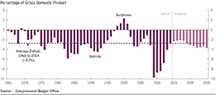
U.S. budget deficits, 1965-2025. Note the sudden expansion of deficits in 2009, coincident with the beginning of the Obama administration. Those opposed to President Obama's policies point to this phenomenon as evidence of his unsuitability for office. However, according to general consensus among economics experts, the sudden expansion of deficits in 2009, and their lingering at high levels, is due instead to the efforts to repair the U.S. economy following the onset of the Great Recession in 2008, though one might argue that alternatives to his policies might have had a marginal advantage. Nevertheless, it is certain that among those criticizing President Obama for his budgetary performance are many who know well that the sudden increase of deficits is not a result of his decisions. Image courtesy the U.S. Congressional Budget Office.
The Post Hoc fallacy is a special case of a more general type of fallacy — the fallacy of the false cause. In Post Hoc, the apparent causal connection relates to the timing of the two events. But connections can also be unrelated to timing:
All of the projects Gerhard has managed in the past few years have been late and over budget. Since people now believe that Gerhard was the cause of the overruns, he can no longer get assignments as a project lead. Nobody seems to remember that each of Gerhard's project sponsors had either reduced his budget or expanded requirements so many times that no project manager would have had much of a chance to perform well.
Gerhard's management skill was the most obvious factor common to the failed projects, but it wasn't the cause. In this case, faulty reasoning damages a career and deprives the company of a skilled manager.
How can you spot this kind of error in the heat of debate? The fallacy of the false cause might be lurking if the argument states that:
Since A was present when B occurred, then A was the cause. Or Since A preceded B, A caused B.
To respond to arguments that use this fallacy, use examples in which A was present, but B wasn't. Your debate partner might not be convinced, but it's your best shot.
Educate your colleagues about the Fallacy of the False Cause. When we understand how much it can cost, and when we understand how to avoid it, we can save much pain and frustration. Perhaps Will Rogers said it best (though the thought has been attributed to many others as well):
It's not what we don't know that hurts; it's what we know that ain't so.


The article you've been reading is an archived issue of Point Lookout, my weekly newsletter. I've been publishing it since January, 2001, free to all subscribers, over the Web, and via RSS. You can help keep it free by donating either as an individual or as an organization. You'll receive in return my sincere thanks — and the comfort of knowing that you've helped to propagate insights and perspectives that can help make our workplaces a little more human-friendly. More
Your comments are welcome
Would you like to see your comments posted here? rbrendPtoGuFOkTSMQOzxner@ChacEgGqaylUnkmwIkkwoCanyon.comSend me your comments by email, or by Web form.About Point Lookout
 Thank you for reading this article. I hope you enjoyed it and
found it useful, and that you'll consider recommending it to a friend.
Thank you for reading this article. I hope you enjoyed it and
found it useful, and that you'll consider recommending it to a friend.
This article in its entirety was written by a human being. No machine intelligence was involved in any way.
Point Lookout is a free weekly email newsletter. Browse the archive of past issues. Subscribe for free.
Support Point Lookout by joining the Friends of Point Lookout, as an individual or as an organization.
Do you face a complex interpersonal situation? Send it in, anonymously if you like, and I'll give you my two cents.
Related articles
More articles on Emotions at Work:
 Working Out on Your Dreadmill
- Many of us are experts in risk analysis and risk management. Even the nonspecialists among us have developed
considerable skill in anticipating troubles and preparing plans for dealing with them. When these habits
of thought leak into our personal lives, we pay a high price.
 The Problem of Work Life Balance
- When we consider the problem of work life balance, we're at a disadvantage from the start. The term
itself is part of the problem.
 First Aid for Wounded Conversations
- Groups that meet regularly sometimes develop patterns of tense conversations that become obstacles to
forward progress. Here are some ideas for releasing the tension.
 Not Really Part of the Team: I
- Some team members hang back. They show little initiative and have little social contact with other team
members. How does this come about?
 Why Scope Expands: I
- Scope creep is depressingly familiar. Its anti-partner, spontaneous and stealthy scope contraction,
has no accepted name, and is rarely seen. Why?
See also Emotions at Work, Critical Thinking at Work and Rhetorical Fallacies for more related articles.
Forthcoming issues of Point Lookout
 Coming April 24: Antipatterns for Time-Constrained Communication: 1
- Knowing how to recognize just a few patterns that can lead to miscommunication can be helpful in reducing the incidence of problems. Here is Part 1 of a collection of communication antipatterns that arise in technical communication under time pressure. Available here and by RSS on April 24.
 And on May 1: Antipatterns for Time-Constrained Communication: 2
- Recognizing just a few patterns that can lead to miscommunication can reduce the incidence of problems. Here is Part 2 of a collection of antipatterns that arise in technical communication under time pressure, emphasizing those that depend on content. Available here and by RSS on May 1.
Coaching services
I offer email and telephone coaching at both corporate and individual rates. Contact Rick for details at rbrendPtoGuFOkTSMQOzxner@ChacEgGqaylUnkmwIkkwoCanyon.com or (650) 787-6475, or toll-free in the continental US at (866) 378-5470.
Get the ebook!
Past issues of Point Lookout are available in six ebooks:
- Get 2001-2 in Geese Don't Land on Twigs (PDF, )
- Get 2003-4 in Why Dogs Wag (PDF, )
- Get 2005-6 in Loopy Things We Do (PDF, )
- Get 2007-8 in Things We Believe That Maybe Aren't So True (PDF, )
- Get 2009-10 in The Questions Not Asked (PDF, )
- Get all of the first twelve years (2001-2012) in The Collected Issues of Point Lookout (PDF, )
Are you a writer, editor or publisher on deadline? Are you looking for an article that will get people talking and get compliments flying your way? You can have 500-1000 words in your inbox in one hour. License any article from this Web site. More info
Follow Rick


Recommend this issue to a friend
Send an email message to a friend
rbrendPtoGuFOkTSMQOzxner@ChacEgGqaylUnkmwIkkwoCanyon.comSend a message to Rick
A Tip A Day feed
Point Lookout weekly feed
 My blog, Technical Debt for Policymakers, offers
resources, insights, and conversations of interest to policymakers who are concerned with managing
technical debt within their organizations. Get the millstone of technical debt off the neck of your
organization!
My blog, Technical Debt for Policymakers, offers
resources, insights, and conversations of interest to policymakers who are concerned with managing
technical debt within their organizations. Get the millstone of technical debt off the neck of your
organization! Are your project teams plagued by turnover, burnout, and high defect rates? Turn your culture around.Bad boss, long commute, troubling ethical questions, hateful colleague? Learn what we can do when we
love the work but not the job.
Are your project teams plagued by turnover, burnout, and high defect rates? Turn your culture around.Bad boss, long commute, troubling ethical questions, hateful colleague? Learn what we can do when we
love the work but not the job.- Your stuff is brilliant! Thank you!
- You and Scott Adams both secretly work here, right?
- I really enjoy my weekly newsletters. I appreciate the quick read.
- A sort of Dr. Phil for Management!
- …extremely accurate, inspiring and applicable to day-to-day … invaluable.
- More
Fed up with tense, explosive meetings? Are you the target of a bully? Learn how to make peace with conflict.Save a bundle and even more important save time! Order the Combo Package and download all ebooks
and tips books at once.