At work, especially in the project context, we rely on each other's Word. When someone tells you something, you need to know that you're hearing what the speaker believes to be true. We can each help to create a more Truth-Full working environment by telling the Truth ourselves, especially when the prospect of telling the whole truth seems scary.
If you tell the truth
it's harder to gossip.
(This is a good thing.)Mark Twain wrote, "If you tell the truth you don't have to remember anything." This is one of many advantages of telling the truth. Here's a list of the advantages of telling the truth over spinning, shading, stretching, misleading, or even lying.
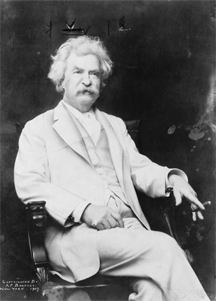
Mark Twain in 1907. Photo by A.F. Bradley, courtesy U.S. Library of Congress.
Telling the truth requires less creativity because you don't have to make anything up.
Telling the truth reduces medical expenses by keeping your blood pressure in the normal range.
If you tell the truth you don't have to worry whether what you're saying now is consistent enough — or too consistent — with what you've said in the past.
If you tell the truth it's less likely (though not impossible) that anyone will accuse you of not telling the truth.
If you tell the truth you have to do much less record-keeping — it's easier to remember what you told to whom and when.
You hardly ever feel guilty about telling the truth.
If you tell the truth you don't have to worry as much about whether what you're saying is working.
If you tell the truth you don't have to worry about what to say when you get caught.
If you tell the truth you don't have to learn any fancy ambiguous words to mislead people.
The plain truth is usually shorter than anything else.
If you tell the truth you get practice telling the truth, which can pay off when telling the truth is really hard.
If you tell the truth it's more likely (though not certain) that others will tell you the truth.
If you tell the truth your nose won't grow much beyond its current length.
If you tell the truth it's harder to gossip. (This is a good thing.)
If you tell the truth you don't have to worry about keeping a straight face.
If you tell the truth you have less need to explain to yourself — or your kids — why it's sometimes OK not to tell the truth.
If you tell the truth, people have a chance to find out about problems while there's still time to do something about them.
If you tell the truth it's easier to sleep at night.
If you're known as a straight shooter, fewer people will ask you to shoot crooked.
If you tell the truth often enough, when you say something, people are more likely to actually believe you.
I'm sure you can add a few more of your own. If you wonder what they are, you can find out.  Top
Top  Next Issue
The article you've been reading is an archived issue of Point Lookout, my weekly newsletter. I've been publishing it since January, 2001, free to all subscribers, over the Web, and via RSS. You can help keep it free by donating either as an individual or as an organization. You'll receive in return my sincere thanks — and the comfort of knowing that you've helped to propagate insights and perspectives that can help make our workplaces a little more human-friendly. More
Your comments are welcome
Would you like to see your comments posted here? rbrendPtoGuFOkTSMQOzxner@ChacEgGqaylUnkmwIkkwoCanyon.comSend me your comments by email, or by Web form.About Point Lookout
 Thank you for reading this article. I hope you enjoyed it and
found it useful, and that you'll consider recommending it to a friend.
Thank you for reading this article. I hope you enjoyed it and
found it useful, and that you'll consider recommending it to a friend.
This article in its entirety was written by a human being. No machine intelligence was involved in any way.
Point Lookout is a free weekly email newsletter. Browse the archive of past issues. Subscribe for free.
Support Point Lookout by joining the Friends of Point Lookout, as an individual or as an organization.
Do you face a complex interpersonal situation? Send it in, anonymously if you like, and I'll give you my two cents.
Related articles
More articles on Ethics at Work:
 It Might Be Legal, but It's Unethical
- Now that CEOs will be held personally accountable for statements they make about their organizations,
we can all expect to be held to higher standards of professional ethics. Some professions have formal
codes of ethics, but most don't. What ethical principles guide you?
 Budget Shenanigans: Swaps
- When projects run over budget, managers face a temptation to use creative accounting to address the
problem. The budget swap is one technique for making ends meet. It distorts organizational data, and
it's just plain unethical.
 Some Truths About Lies: I
- However ethical you might be, you can't control the ethics of others. Can you tell when someone knowingly
tries to mislead you? Here's Part I of a catalog of techniques misleaders use.
 Approval Ploys
- If you approve or evaluate proposals or requests made by others, you've probably noticed patterns approval
seekers use to enhance their success rates. Here are some tactics approval seekers use.
 More Things I've Learned Along the Way: V
- When I gain an important insight, or when I learn a lesson, I make a note. Example: If you're interested
in changing how a social construct operates, knowing how it came to be the way it is can be much less
useful than knowing what keeps it the way it is.
See also Ethics at Work for more related articles.
Forthcoming issues of Point Lookout
 Coming April 24: Antipatterns for Time-Constrained Communication: 1
- Knowing how to recognize just a few patterns that can lead to miscommunication can be helpful in reducing the incidence of problems. Here is Part 1 of a collection of communication antipatterns that arise in technical communication under time pressure. Available here and by RSS on April 24.
 And on May 1: Antipatterns for Time-Constrained Communication: 2
- Recognizing just a few patterns that can lead to miscommunication can reduce the incidence of problems. Here is Part 2 of a collection of antipatterns that arise in technical communication under time pressure, emphasizing those that depend on content. Available here and by RSS on May 1.
Coaching services
I offer email and telephone coaching at both corporate and individual rates. Contact Rick for details at rbrendPtoGuFOkTSMQOzxner@ChacEgGqaylUnkmwIkkwoCanyon.com or (650) 787-6475, or toll-free in the continental US at (866) 378-5470.
Get the ebook!
Past issues of Point Lookout are available in six ebooks:
- Get 2001-2 in Geese Don't Land on Twigs (PDF, )
- Get 2003-4 in Why Dogs Wag (PDF, )
- Get 2005-6 in Loopy Things We Do (PDF, )
- Get 2007-8 in Things We Believe That Maybe Aren't So True (PDF, )
- Get 2009-10 in The Questions Not Asked (PDF, )
- Get all of the first twelve years (2001-2012) in The Collected Issues of Point Lookout (PDF, )
Are you a writer, editor or publisher on deadline? Are you looking for an article that will get people talking and get compliments flying your way? You can have 500-1000 words in your inbox in one hour. License any article from this Web site. More info
Follow Rick


Recommend this issue to a friend
Send an email message to a friend
rbrendPtoGuFOkTSMQOzxner@ChacEgGqaylUnkmwIkkwoCanyon.comSend a message to Rick
A Tip A Day feed
Point Lookout weekly feed
 My blog, Technical Debt for Policymakers, offers
resources, insights, and conversations of interest to policymakers who are concerned with managing
technical debt within their organizations. Get the millstone of technical debt off the neck of your
organization!
My blog, Technical Debt for Policymakers, offers
resources, insights, and conversations of interest to policymakers who are concerned with managing
technical debt within their organizations. Get the millstone of technical debt off the neck of your
organization! Are your project teams plagued by turnover, burnout, and high defect rates? Turn your culture around.
- Your stuff is brilliant! Thank you!
- You and Scott Adams both secretly work here, right?
- I really enjoy my weekly newsletters. I appreciate the quick read.
- A sort of Dr. Phil for Management!
- …extremely accurate, inspiring and applicable to day-to-day … invaluable.
- More
Fed up with tense, explosive meetings? Are you the target of a bully? Learn how to make peace with conflict.Save a bundle and even more important save time! Order the Combo Package and download all ebooks
and tips books at once.