Since they were now officially stuck, Suzanne suggested they take a ten-minute break, and everyone agreed. Lynn left the conference room immediately, and the others went to the back kitchen area to get coffee. That left Matt and Suzanne.
Suzanne had an idea. "I'm wondering," she began, "if maybe the problem isn't someplace else."
 Matt, puzzled, tilted his head and said, "By that you mean…"
"I mean, maybe we disagree because we're making different assumptions about something we don't know we're making different assumptions about."
Matt smiled. "I'm sorry, but tortured grammar is my specialty." They both chuckled. "But OK, tell me what you mean."
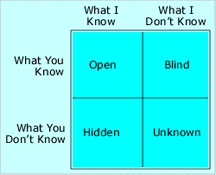
Suzanne obliged. "I remember something called the Johari window." She went on to show him how they could use the Johari window to expose differing assumptions, and it went something like this.
The Johari window is a four-pane window in which each pane represents a category of our joint knowledge. The panes are Open, Blind, Hidden, and Unknown. Open: I'm aware of this knowledge, and so are you. Blind: You're aware of this knowledge, but I'm not. Hidden: I'm aware of this knowledge, but you're not. And Unknown: Both of us are clueless about this.
When we disagree, the sources of our disagreement can often be outside our mutual awareness. Using the Johari window to classify our assumptions, we can surface them using techniques that are best for each of the Johari window's four categories.
When we disagree,the sources of our
disagreement can often
be outside our
mutual awareness
- Open assumptions
- Open assumptions are those I know I'm making, and you do too. If we agree about them, then these assumptions are unlikely to spark destructive conflict. But even if we disagree about an open assumption, it's relatively less likely to create trouble, because we can discuss it, and we might even resolve or suspend our differences.
- When you inventory assumptions to explore the sources of disagreements, start with open assumptions — they're relatively safe, even when there's disagreement about them.
- My blind assumptions
- Blind assumptions are those that I make, but which I'm unaware of, while they're evident to you. Typical are the assumptions about who's responsible for what in a marital relationship, or assumptions based on professional, factional, demographic, or ethnic stereotypes.
- Blind assumptions are hard to find, because the assumer doesn't know they're there [Brenner 2006]. To search for them, propose candidates of your own — assumptions you think someone like you might make without being aware of them. This approach is relatively safe, because identifying the assumptions someone else might be making can seem like blaming — when we uncover a blind assumption, the assumer is more likely to have difficulty than is the assumer's partner.
These two kinds of assumptions are the easiest to find and discuss. In the issue after next, we'll look at two more that are somewhat more problematic. Next in this series  Top
Top  Next Issue
Are you fed up with tense, explosive meetings? Are you or a colleague the target of a bully? Destructive conflict can ruin organizations. But if we believe that all conflict is destructive, and that we can somehow eliminate conflict, or that conflict is an enemy of productivity, then we're in conflict with Conflict itself. Read 101 Tips for Managing Conflict to learn how to make peace with conflict and make it an organizational asset. Order Now!
The Johari Window was developed by Joseph Luft and Harry Ingham (Joe and Harry) in the 1960s. There's no better work on the topic than their own: Luft, Joseph. Of Human Interaction: The Johari Model. Palo Alto, CA: Mayfield Publishing Co., 1969. It's out of print, so check the library.
Footnotes
Your comments are welcome
Would you like to see your comments posted here? rbrendPtoGuFOkTSMQOzxner@ChacEgGqaylUnkmwIkkwoCanyon.comSend me your comments by email, or by Web form.About Point Lookout
 Thank you for reading this article. I hope you enjoyed it and
found it useful, and that you'll consider recommending it to a friend.
Thank you for reading this article. I hope you enjoyed it and
found it useful, and that you'll consider recommending it to a friend.
This article in its entirety was written by a human being. No machine intelligence was involved in any way.
Point Lookout is a free weekly email newsletter. Browse the archive of past issues. Subscribe for free.
Support Point Lookout by joining the Friends of Point Lookout, as an individual or as an organization.
Do you face a complex interpersonal situation? Send it in, anonymously if you like, and I'll give you my two cents.
Related articles
More articles on Personal, Team, and Organizational Effectiveness:
 The Paradox of Confidence
- Most of us interpret a confident manner as evidence of competence, and a hesitant manner as evidence
of lesser ability. Recent research suggests that confidence and competence are inversely correlated.
If so, our assessments of credibility and competence are thrown into question.
 Be With the Real
- When the stream of unimportant events and concerns reaches a high enough tempo, we can become so transfixed
that we lose awareness of the real and the important. Here are some suggestions for being with the Real.
 Preventing Sidebars
- Sidebar conversations between meeting participants waste time and reduce meeting effectiveness. How
can we prevent them?
 Risk Creep: I
- Risk creep is a term that describes the insidious and unrecognized increase in risk that occurs despite
our every effort to mitigate risk or avoid it altogether. What are the dominant sources of risk creep?
 Getting Value from Involuntary Seminars
- Whatever your organizational role, from time to time you might find yourself attending seminars or presentations
involuntarily. The value you derive from these "opportunities" depends as much on you as on
the presenter.
See also Personal, Team, and Organizational Effectiveness, Problem Solving and Creativity and Conflict Management for more related articles.
Forthcoming issues of Point Lookout
 Coming April 17: How to Answer When You Don't Know How to Answer
- People engaged in knowledge work must often respond to questions that test the limits of their knowledge, or the limits of everyone's knowledge. Responding effectively to such questions advances us all. Available here and by RSS on April 17.
 And on April 24: Antipatterns for Time-Constrained Communication: 1
- Knowing how to recognize just a few patterns that can lead to miscommunication can be helpful in reducing the incidence of problems. Here is Part 1 of a collection of communication antipatterns that arise in technical communication under time pressure. Available here and by RSS on April 24.
Coaching services
I offer email and telephone coaching at both corporate and individual rates. Contact Rick for details at rbrendPtoGuFOkTSMQOzxner@ChacEgGqaylUnkmwIkkwoCanyon.com or (650) 787-6475, or toll-free in the continental US at (866) 378-5470.
Get the ebook!
Past issues of Point Lookout are available in six ebooks:
- Get 2001-2 in Geese Don't Land on Twigs (PDF, )
- Get 2003-4 in Why Dogs Wag (PDF, )
- Get 2005-6 in Loopy Things We Do (PDF, )
- Get 2007-8 in Things We Believe That Maybe Aren't So True (PDF, )
- Get 2009-10 in The Questions Not Asked (PDF, )
- Get all of the first twelve years (2001-2012) in The Collected Issues of Point Lookout (PDF, )
Are you a writer, editor or publisher on deadline? Are you looking for an article that will get people talking and get compliments flying your way? You can have 500-1000 words in your inbox in one hour. License any article from this Web site. More info
Follow Rick


Recommend this issue to a friend
Send an email message to a friend
rbrendPtoGuFOkTSMQOzxner@ChacEgGqaylUnkmwIkkwoCanyon.comSend a message to Rick
A Tip A Day feed
Point Lookout weekly feed
 My blog, Technical Debt for Policymakers, offers
resources, insights, and conversations of interest to policymakers who are concerned with managing
technical debt within their organizations. Get the millstone of technical debt off the neck of your
organization!
My blog, Technical Debt for Policymakers, offers
resources, insights, and conversations of interest to policymakers who are concerned with managing
technical debt within their organizations. Get the millstone of technical debt off the neck of your
organization! Bad boss, long commute, troubling ethical questions, hateful colleague? Learn what we can do when we
love the work but not the job.Learn how to make your virtual global team sing.Are you managing a change effort that faces rampant cynicism, passive non-cooperation, or
maybe even outright revolt?Learn how to make meetings more productive — and more rare.
Bad boss, long commute, troubling ethical questions, hateful colleague? Learn what we can do when we
love the work but not the job.Learn how to make your virtual global team sing.Are you managing a change effort that faces rampant cynicism, passive non-cooperation, or
maybe even outright revolt?Learn how to make meetings more productive — and more rare.