When we insult each other, we damage relationships and make achieving our shared goals more difficult. We recognize this, and that's one reason why we accept constraints on direct verbal insults. Yet, sometimes the urge to insult does prevail, and we've created or learned numerous ways to hurt each other without words.
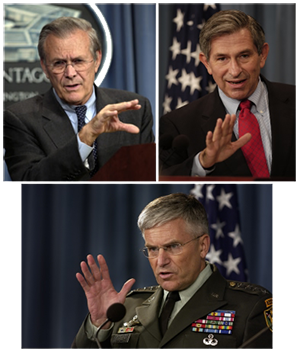
Then Secretary of Defense Donald Rumsfeld, then Deputy Secretary of Defense Paul Wolfowitz, and General George Casey, all at respective news conferences. The photos are unremarkable except for the similarity of their gestures, which could be experienced as, "Hold it right there, pal." Photos courtesy U.S. Department of Defense.
Like language, humor, and most customs, dismissive gestures vary from culture to culture. While the meanings of various gestures are intuitively clear in your own culture, they can be mysteriously unfathomable in the cultures of others. And they slowly evolve with time. So beware — the items below are based on my own observations in the mainstream US in this first decade of the 21st century.
By examining these tactics, we can take some of the sting out of them, and at the same time reduce the urge to use them ourselves. To that end I offer Part I of my little collection of dismissive gestures. See "Dismissive Gestures: II," Point Lookout for March 28, 2007, for more.
- Tossing the document
- In a meeting, tossing your copy of the handout, agenda, or report onto the conference table can communicate disdain, especially if you give it a little spin as you toss.
- Walking out
- Walking out of a meeting, abruptly and without any serious attempt to appear invisible, can communicate anger or disgust.
- Heavy-lidded glances to a third party
- When one listener looks at another with a heavy-lidded glance, and possibly a tilt of the head, the message is, "Gimme a break," or "She's gotta be kidding."
- Heavy sighing
- A heavy sigh, sometimes combined with an exaggerated lift of the shoulders, can mean, "I've had enough of this trash."
- Eye rolling
- Understanding the mechanics
of dismissive gestures
can take some of the
sting out of them - Typically, eye rolling is executed out of the awareness of the target, and that's bad enough. But sometimes we do it face-to-face, and then it's especially stinging.
- Distracted self-grooming
- Distracted grooming can be flicking or brushing off tiny particles from your own clothing, or from a male's clothing (by a female). The flicking or brushing-off is a rejection gesture, which adds a metaphorical boost.
- Looking at your watch
- Checking the time can be interpreted as "I wish this boring fool would give it a rest."
- Shrugging
- A shrug communicates, "I don't care." For extra punch, combine with a facial expression of boredom or disdain.
- Disgusted laughing
- There are laughs-with, and laughs-at. The disgusted laugh is a laugh-at, and there's nothing funny about it.
- Using a mobile device instead of paying attention
- At a meeting, this action can communicate, "I have something much more worthwhile to do than to listen to this (drivel)." It's deniable, of course.
Carry an index card with you for a couple of days, and note any dismissive gestures you see. You might need a couple of index cards. I hope you don't need more than that. Next in this series  Top
Top  Next Issue
Are you fed up with tense, explosive meetings? Are you or a colleague the target of a bully? Destructive conflict can ruin organizations. But if we believe that all conflict is destructive, and that we can somehow eliminate conflict, or that conflict is an enemy of productivity, then we're in conflict with Conflict itself. Read 101 Tips for Managing Conflict to learn how to make peace with conflict and make it an organizational asset. Order Now!
For more on gestures of all kinds, take a look at Field Guide to Gestures: How to Identify and Interpret Virtually Every Gesture Known to Man, by Nancy Armstrong and Melissa Wagner. It's complete with full-color illustrations. Order from Amazon.com
Your comments are welcome
Would you like to see your comments posted here? rbrendPtoGuFOkTSMQOzxner@ChacEgGqaylUnkmwIkkwoCanyon.comSend me your comments by email, or by Web form.About Point Lookout
 Thank you for reading this article. I hope you enjoyed it and
found it useful, and that you'll consider recommending it to a friend.
Thank you for reading this article. I hope you enjoyed it and
found it useful, and that you'll consider recommending it to a friend.
This article in its entirety was written by a human being. No machine intelligence was involved in any way.
Point Lookout is a free weekly email newsletter. Browse the archive of past issues. Subscribe for free.
Support Point Lookout by joining the Friends of Point Lookout, as an individual or as an organization.
Do you face a complex interpersonal situation? Send it in, anonymously if you like, and I'll give you my two cents.
Related articles
More articles on Workplace Politics:
 Projection Errors at Work
- Often, at work, we make interpretations of the behavior of others. Sometimes we base these interpretations
not on actual facts, but on our perceptions of facts. And our perceptions are sometimes erroneous.
 Stonewalling: II
- Stonewalling is a tactic of obstruction. Some less sophisticated tactics rely on misrepresentation to
gum up the works. Those that employ bureaucratic methods are more devious. What can you do about stonewalling?
 Confronting the Workplace Bully: I
- When a bully targets you, you have three options: accept the abuse; avoid the bully or escape; and confront
or fight back. Confrontation is a better choice than many believe — if you know what you're doing.
 Allocating Airtime: I
- The problem of people who dominate meetings is so serious that we've even devised processes intended
to more fairly allocate speaking time. What's happening here?
 Exploiting Functional Fixedness: II
- A cognitive bias called functional fixedness causes difficulty in recognizing new uses for
familiar things. It also makes for difficulty in recognizing devious uses of everyday behaviors. Here's
Part II of a catalog of deviousness based on functional fixedness.
See also Workplace Politics, Effective Communication at Work and Conflict Management for more related articles.
Forthcoming issues of Point Lookout
 Coming April 24: Antipatterns for Time-Constrained Communication: 1
- Knowing how to recognize just a few patterns that can lead to miscommunication can be helpful in reducing the incidence of problems. Here is Part 1 of a collection of communication antipatterns that arise in technical communication under time pressure. Available here and by RSS on April 24.
 And on May 1: Antipatterns for Time-Constrained Communication: 2
- Recognizing just a few patterns that can lead to miscommunication can reduce the incidence of problems. Here is Part 2 of a collection of antipatterns that arise in technical communication under time pressure, emphasizing those that depend on content. Available here and by RSS on May 1.
Coaching services
I offer email and telephone coaching at both corporate and individual rates. Contact Rick for details at rbrendPtoGuFOkTSMQOzxner@ChacEgGqaylUnkmwIkkwoCanyon.com or (650) 787-6475, or toll-free in the continental US at (866) 378-5470.
Get the ebook!
Past issues of Point Lookout are available in six ebooks:
- Get 2001-2 in Geese Don't Land on Twigs (PDF, )
- Get 2003-4 in Why Dogs Wag (PDF, )
- Get 2005-6 in Loopy Things We Do (PDF, )
- Get 2007-8 in Things We Believe That Maybe Aren't So True (PDF, )
- Get 2009-10 in The Questions Not Asked (PDF, )
- Get all of the first twelve years (2001-2012) in The Collected Issues of Point Lookout (PDF, )
Are you a writer, editor or publisher on deadline? Are you looking for an article that will get people talking and get compliments flying your way? You can have 500-1000 words in your inbox in one hour. License any article from this Web site. More info
Follow Rick


Recommend this issue to a friend
Send an email message to a friend
rbrendPtoGuFOkTSMQOzxner@ChacEgGqaylUnkmwIkkwoCanyon.comSend a message to Rick
A Tip A Day feed
Point Lookout weekly feed
 The message of Point Lookout is unique. Help get the message out. Please donate to help keep Point Lookout available for free to everyone.
 My blog, Technical Debt for Policymakers, offers
resources, insights, and conversations of interest to policymakers who are concerned with managing
technical debt within their organizations. Get the millstone of technical debt off the neck of your
organization!
My blog, Technical Debt for Policymakers, offers
resources, insights, and conversations of interest to policymakers who are concerned with managing
technical debt within their organizations. Get the millstone of technical debt off the neck of your
organization!Beware any resource that speaks of "winning" at workplace politics or "defeating" it. You can benefit or not, but there is no score-keeping, and it isn't a game.
- Wikipedia has a nice article with a list of additional resources
- Some public libraries offer collections. Here's an example from Saskatoon.
- Check my own links collection
- LinkedIn's Office Politics discussion group
 Is every other day a tense, anxious, angry misery as you watch people around you, who couldn't even
think their way through a game of Jacks, win at workplace politics and steal the credit and glory
for just about everyone's best work including yours? Read 303 Secrets of Workplace Politics!Learn how to make your virtual global team sing.A Tip a Day arrives by email, or by RSS Feed, each business day. It's 20 to 30 words at most, and gives
you a new perspective on the hassles and rewards of work life. Most tips also contain links to
related articles. Free!Learn how to make meetings more productive — and more rare.
Is every other day a tense, anxious, angry misery as you watch people around you, who couldn't even
think their way through a game of Jacks, win at workplace politics and steal the credit and glory
for just about everyone's best work including yours? Read 303 Secrets of Workplace Politics!Learn how to make your virtual global team sing.A Tip a Day arrives by email, or by RSS Feed, each business day. It's 20 to 30 words at most, and gives
you a new perspective on the hassles and rewards of work life. Most tips also contain links to
related articles. Free!Learn how to make meetings more productive — and more rare.