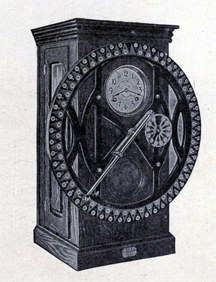
An old-fashioned punch clock, described by Halbert Powers Gillette (1869-1958), an American engineer, in a 1909 book. The distinction between personal time and work time is still debated. In a recent case before the US Supreme Court, IBP v. Alvarez, workers won the right to be paid for "donning and doffing" time — the time spent putting on and removing special garments required by the employer. IBP had claimed that they needn't pay workers for this time, nor for time spent walking from the locker room to their workstations. Photo courtesy Wikipedia.
General rules are usually helpful, because they simplify life. But when we accept them uncritically, and apply them unquestioningly, we risk eliminating valuable choices that, if exercised, could transform our lives for the better. Here's a small collection of workplace maxims that too many of us are a little too willing to accept as true.
- If it worked there, it will work here.
- If it didn't work here, we did something wrong when we tried it.
- If you read it in a book, it must be true.
- The value of a consultant's advice is proportional to the consultant's fee.
- If it's logical, and internally consistent, it will work.
- People always pad their estimates. Never give them what they ask for.
- Working smarter is easy. That's why we tell people to work smarter not harder.
- Managers are people who couldn't hack it doing real work.
- Executives are people who couldn't hack it as managers.
- The cure for our financial problems isn't better products, or more revenue, or new investment, or training people, or listening to customers — it's reducing expenses.
- Making people compete for bonuses, raises, perks, honors, or promotions won't hurt our efforts to create high-performance teams.
- How we dress is at least as important as what we do.
- Anyone's total output is proportional to the hours they work.
- To increase productivity, don't let people use company facilities for private purposes.
- Much of what we accept
uncritically as true,
just isn'tI have a right to appropriate company resources for my own ends. - With the right technology, we can go paperless.
- We don't need people to deliver training — computer based training works just fine.
- The cause of our problems is (pick your favorite): incompetent managers, overpaid consultants, government regulation, foreign competition, unions, lazy workforce, …
- Eliminating theft is so important that the cost of controlling it doesn't matter.
- The typical female executive and the typical male executive manage altogether differently.
- Male (female) executives are more ruthless than female (male) executives.
- Workplace violence will never happen here.
- People who play politics don't really have anything of value to offer.
- The best person to hire for this job is someone who has done it before.
- People can get so angry that they "snap," like twigs bent too far.
- Meetings are almost always a waste.
- The only way to keep us all up to date is a weekly meeting.
- Organized people are more effective.
- Messy desk, messy mind.
- Share price is a valid measure of the company's health.
- Significant innovation always requires a visionary champion.
If you have some more like these, write them down on a piece of paper and tear it up.  Top
Top  Next Issue
Are your projects always (or almost always) late and over budget? Are your project teams plagued by turnover, burnout, and high defect rates? Turn your culture around. Read 52 Tips for Leaders of Project-Oriented Organizations, filled with tips and techniques for organizational leaders. Order Now!
Your comments are welcome
Would you like to see your comments posted here? rbrendPtoGuFOkTSMQOzxner@ChacEgGqaylUnkmwIkkwoCanyon.comSend me your comments by email, or by Web form.About Point Lookout
 Thank you for reading this article. I hope you enjoyed it and
found it useful, and that you'll consider recommending it to a friend.
Thank you for reading this article. I hope you enjoyed it and
found it useful, and that you'll consider recommending it to a friend.
This article in its entirety was written by a human being. No machine intelligence was involved in any way.
Point Lookout is a free weekly email newsletter. Browse the archive of past issues. Subscribe for free.
Support Point Lookout by joining the Friends of Point Lookout, as an individual or as an organization.
Do you face a complex interpersonal situation? Send it in, anonymously if you like, and I'll give you my two cents.
Related articles
More articles on Workplace Politics:
 About Workplace Hugs
- In the past twenty years in the United States, we've changed from a relatively hug-free workplace culture
to one that, in some quarters, seems to be experiencing a hugging tsunami. Knowing how to deal with
hugging is now a valuable skill.
 Why Don't They Believe Me?
- When we want people to believe us, and they don't, it just might be a result of our own actions or demeanor.
How does this happen?
 The Perils of Limited Agreement
- When a group member agrees to a proposal, even with conditions, the group can move forward. Such agreement
is constructive, but there are risks. What are those risks and what can we do about them?
 Congruent Decision Making: I
- Decision makers who rely on incomplete or biased information are more likely to make faulty decisions.
Congruent decision making can limit the incidence of bad decisions.
 Time to Go to Plan B
- We had a plan, and it was a good one. Plan A actually seemed to work for a while, but then troubles
began. And now things look very bleak. We have a Plan B, but people don't want to go to it. Why not?
See also Workplace Politics, Critical Thinking at Work and Managing Your Boss for more related articles.
Forthcoming issues of Point Lookout
 Coming April 24: Antipatterns for Time-Constrained Communication: 1
- Knowing how to recognize just a few patterns that can lead to miscommunication can be helpful in reducing the incidence of problems. Here is Part 1 of a collection of communication antipatterns that arise in technical communication under time pressure. Available here and by RSS on April 24.
 And on May 1: Antipatterns for Time-Constrained Communication: 2
- Recognizing just a few patterns that can lead to miscommunication can reduce the incidence of problems. Here is Part 2 of a collection of antipatterns that arise in technical communication under time pressure, emphasizing those that depend on content. Available here and by RSS on May 1.
Coaching services
I offer email and telephone coaching at both corporate and individual rates. Contact Rick for details at rbrendPtoGuFOkTSMQOzxner@ChacEgGqaylUnkmwIkkwoCanyon.com or (650) 787-6475, or toll-free in the continental US at (866) 378-5470.
Get the ebook!
Past issues of Point Lookout are available in six ebooks:
- Get 2001-2 in Geese Don't Land on Twigs (PDF, )
- Get 2003-4 in Why Dogs Wag (PDF, )
- Get 2005-6 in Loopy Things We Do (PDF, )
- Get 2007-8 in Things We Believe That Maybe Aren't So True (PDF, )
- Get 2009-10 in The Questions Not Asked (PDF, )
- Get all of the first twelve years (2001-2012) in The Collected Issues of Point Lookout (PDF, )
Are you a writer, editor or publisher on deadline? Are you looking for an article that will get people talking and get compliments flying your way? You can have 500-1000 words in your inbox in one hour. License any article from this Web site. More info
Follow Rick


Recommend this issue to a friend
Send an email message to a friend
rbrendPtoGuFOkTSMQOzxner@ChacEgGqaylUnkmwIkkwoCanyon.comSend a message to Rick
A Tip A Day feed
Point Lookout weekly feed
 The message of Point Lookout is unique. Help get the message out. Please donate to help keep Point Lookout available for free to everyone.
 My blog, Technical Debt for Policymakers, offers
resources, insights, and conversations of interest to policymakers who are concerned with managing
technical debt within their organizations. Get the millstone of technical debt off the neck of your
organization!
My blog, Technical Debt for Policymakers, offers
resources, insights, and conversations of interest to policymakers who are concerned with managing
technical debt within their organizations. Get the millstone of technical debt off the neck of your
organization!Beware any resource that speaks of "winning" at workplace politics or "defeating" it. You can benefit or not, but there is no score-keeping, and it isn't a game.
- Wikipedia has a nice article with a list of additional resources
- Some public libraries offer collections. Here's an example from Saskatoon.
- Check my own links collection
- LinkedIn's Office Politics discussion group
 Is every other day a tense, anxious, angry misery as you watch people around you, who couldn't even
think their way through a game of Jacks, win at workplace politics and steal the credit and glory
for just about everyone's best work including yours? Read 303 Secrets of Workplace Politics!Learn how to make your virtual global team sing.A Tip a Day arrives by email, or by RSS Feed, each business day. It's 20 to 30 words at most, and gives
you a new perspective on the hassles and rewards of work life. Most tips also contain links to
related articles. Free!Learn how to make meetings more productive — and more rare.
Is every other day a tense, anxious, angry misery as you watch people around you, who couldn't even
think their way through a game of Jacks, win at workplace politics and steal the credit and glory
for just about everyone's best work including yours? Read 303 Secrets of Workplace Politics!Learn how to make your virtual global team sing.A Tip a Day arrives by email, or by RSS Feed, each business day. It's 20 to 30 words at most, and gives
you a new perspective on the hassles and rewards of work life. Most tips also contain links to
related articles. Free!Learn how to make meetings more productive — and more rare.