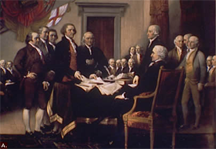
A portion of the painting, "The Declaration of Independence," by John Trumbull. If ever there was an opportunity for too many cooks to spoil the broth, the crafting of the US Declaration of Independence was certainly one of them. In fact, a committee had been formed to write it, but after some attempts, eventually the job went to Thomas Jefferson, who had arranged to get it. Read Jefferson's own account of how he came to write the Declaration. View an interactive version of the painting to identify the people in it. The scene in the painting never actually happened, but it does appear on the back of the US two-dollar bill. In the painting, Jefferson is standing, the tallest man in the center in front of the table. John Adams, our leftmost of that group, is standing on Jefferson's foot. On the two-dollar bill, he isn't. The man behind Jefferson and to his right is Robert Livingston, who, as Jefferson's minister to France, negotiated the Louisiana Purchase. Painting photographed by Theodor Horydczak, ca. 1920-1950. Photo courtesy U.S. Library of Congress.
An aphorism is a concise statement widely believed to be valid, and often quoted. Aphorisms are a little more credible than adages, probably less widely quoted, and usually less clever. But the two are only subtly different, and one person's adage might well be another's aphorism.
Aphorism or adage, though, they're probably all wrong if you think carefully enough. Here are a few examples that cause mischief at work.
- There's an exception to every rule
- Let's assume this one is true. Then, since the statement itself is a rule, an exception must exist, and therefore there exists a rule that has no exceptions. Since that contradicts the original rule, the statement must be false.
- What goes around comes around
- The idea here is that there is absolute justice in the world — that if you do right (wrong), then right (wrong) will eventually come back to you. This is simply wishful thinking. The world is way more random than that, and bad guys often go unpunished. There is some justice, but it's imperfect.
- Too many cooks spoil the broth
- This one is the basis of a belief that beyond a certain maximum number of "decision makers," failure is inevitable. Even allowing that the maximum number might be task-dependent, this belief is often used to exclude the powerless from decisions. That's tragic, because in the real world, from science to banking to politics, people outside the dominant group are often the greatest innovators.
- Many hands make light work
- Maybe this is true when we're haying or cleaning dairy barns or picking apples, but it probably isn't true when we're writing software or designing a political campaign or performing brain surgery. Knowledge work is different.
- If it ain't broke, don't fix it
- Aphorism or adage — they're
probably all wrong if you
think carefully enough - The problem here is the definition of "broke." In the modern workplace, most products, processes, and policies do function well, and most also have defects. The acceptability of their performance is subjective. The question is whether the likely benefits of improvement are worth the risk.
- You can't teach an old dog new tricks
- We use this belief to justify exclusion or termination of older, more experienced employees — if we want to. But when we're looking for a high-value executive or key contributor, we insist on hiring only the most experienced people who have done something similar before. You can't have it both ways.
- Never trouble trouble 'til trouble troubles you
- This piece of advice is a cousin of "Ain't Broke," but it's more specific. It allows that some things are broken, but if they don't harm you directly, it's best to let them go. In this modern, tightly networked world, waiting for trouble to trouble you directly could be a losing strategy.
Perhaps a true aphorism exists, and I just haven't run into it yet. I never say never.  Top
Top  Next Issue
Are your projects always (or almost always) late and over budget? Are your project teams plagued by turnover, burnout, and high defect rates? Turn your culture around. Read 52 Tips for Leaders of Project-Oriented Organizations, filled with tips and techniques for organizational leaders. Order Now!
For more about the painting, Declaration of Independence, see the article by David McCullough, "An Icon's Secret: How John Trumbull's revered depiction of July 4, 1776, mixes fiction and fact." In The Wall Street Journal, June 30, 2007; Page P1.
Your comments are welcome
Would you like to see your comments posted here? rbrendPtoGuFOkTSMQOzxner@ChacEgGqaylUnkmwIkkwoCanyon.comSend me your comments by email, or by Web form.About Point Lookout
 Thank you for reading this article. I hope you enjoyed it and
found it useful, and that you'll consider recommending it to a friend.
Thank you for reading this article. I hope you enjoyed it and
found it useful, and that you'll consider recommending it to a friend.
This article in its entirety was written by a human being. No machine intelligence was involved in any way.
Point Lookout is a free weekly email newsletter. Browse the archive of past issues. Subscribe for free.
Support Point Lookout by joining the Friends of Point Lookout, as an individual or as an organization.
Do you face a complex interpersonal situation? Send it in, anonymously if you like, and I'll give you my two cents.
Related articles
More articles on Workplace Politics:
 Devious Political Tactics: Cutouts
- Cutouts are people or procedures that enable political operators to communicate in safety. Using cutouts,
operators can manipulate their environments while limiting their personal risk. How can you detect cutouts?
And what can you do about them?
 OODA at Work
- OODA is a model of decision making that's especially useful in rapidly evolving environments, such as
combat, marketing, politics, and emergency management. Here's a brief overview.
 Impasses in Group Decision Making: II
- When groups can't reach agreement on all aspects of an issue, the tactics of some members can actually
exacerbate disagreement. Here's Part II of an exploration of impasses, emphasizing two of the more toxic
tactics.
 That Was a Yes-or-No Question: I
- In tense situations, one person might question another. As the respondent replies, the questioner interjects,
"That was a yes-or-no question." The intent is to trap the respondent. How does this work,
and how can the respondent escape the trap?
 Asymmetric Group Debate
- Group debates at work can be difficult when the domains of expertise of participants don't overlap by
much. Communicating is possible, though, if we believe in our shared goals and if we tackle the hard
parts without an audience.
See also Workplace Politics, Critical Thinking at Work and Managing Your Boss for more related articles.
Forthcoming issues of Point Lookout
 Coming April 24: Antipatterns for Time-Constrained Communication: 1
- Knowing how to recognize just a few patterns that can lead to miscommunication can be helpful in reducing the incidence of problems. Here is Part 1 of a collection of communication antipatterns that arise in technical communication under time pressure. Available here and by RSS on April 24.
 And on May 1: Antipatterns for Time-Constrained Communication: 2
- Recognizing just a few patterns that can lead to miscommunication can reduce the incidence of problems. Here is Part 2 of a collection of antipatterns that arise in technical communication under time pressure, emphasizing those that depend on content. Available here and by RSS on May 1.
Coaching services
I offer email and telephone coaching at both corporate and individual rates. Contact Rick for details at rbrendPtoGuFOkTSMQOzxner@ChacEgGqaylUnkmwIkkwoCanyon.com or (650) 787-6475, or toll-free in the continental US at (866) 378-5470.
Get the ebook!
Past issues of Point Lookout are available in six ebooks:
- Get 2001-2 in Geese Don't Land on Twigs (PDF, )
- Get 2003-4 in Why Dogs Wag (PDF, )
- Get 2005-6 in Loopy Things We Do (PDF, )
- Get 2007-8 in Things We Believe That Maybe Aren't So True (PDF, )
- Get 2009-10 in The Questions Not Asked (PDF, )
- Get all of the first twelve years (2001-2012) in The Collected Issues of Point Lookout (PDF, )
Are you a writer, editor or publisher on deadline? Are you looking for an article that will get people talking and get compliments flying your way? You can have 500-1000 words in your inbox in one hour. License any article from this Web site. More info
Follow Rick


Recommend this issue to a friend
Send an email message to a friend
rbrendPtoGuFOkTSMQOzxner@ChacEgGqaylUnkmwIkkwoCanyon.comSend a message to Rick
A Tip A Day feed
Point Lookout weekly feed
 The message of Point Lookout is unique. Help get the message out. Please donate to help keep Point Lookout available for free to everyone.
 My blog, Technical Debt for Policymakers, offers
resources, insights, and conversations of interest to policymakers who are concerned with managing
technical debt within their organizations. Get the millstone of technical debt off the neck of your
organization!
My blog, Technical Debt for Policymakers, offers
resources, insights, and conversations of interest to policymakers who are concerned with managing
technical debt within their organizations. Get the millstone of technical debt off the neck of your
organization!Beware any resource that speaks of "winning" at workplace politics or "defeating" it. You can benefit or not, but there is no score-keeping, and it isn't a game.
- Wikipedia has a nice article with a list of additional resources
- Some public libraries offer collections. Here's an example from Saskatoon.
- Check my own links collection
- LinkedIn's Office Politics discussion group
 Is every other day a tense, anxious, angry misery as you watch people around you, who couldn't even
think their way through a game of Jacks, win at workplace politics and steal the credit and glory
for just about everyone's best work including yours? Read 303 Secrets of Workplace Politics!Learn how to make your virtual global team sing.A Tip a Day arrives by email, or by RSS Feed, each business day. It's 20 to 30 words at most, and gives
you a new perspective on the hassles and rewards of work life. Most tips also contain links to
related articles. Free!Learn how to make meetings more productive — and more rare.
Is every other day a tense, anxious, angry misery as you watch people around you, who couldn't even
think their way through a game of Jacks, win at workplace politics and steal the credit and glory
for just about everyone's best work including yours? Read 303 Secrets of Workplace Politics!Learn how to make your virtual global team sing.A Tip a Day arrives by email, or by RSS Feed, each business day. It's 20 to 30 words at most, and gives
you a new perspective on the hassles and rewards of work life. Most tips also contain links to
related articles. Free!Learn how to make meetings more productive — and more rare.