To manage risks properly, we must allocate resources to implement a risk management plan. Some resources must be allocated in advance of anticipated risk events, and some must be held in reserve "just in case."
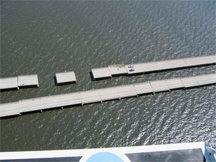
Damage to one of the low causeway sections of the Interstate 10 Twin Bridge across Lake Pontchartrain, following Hurricane Katrina in 2005. The storm surge brought by the hurricane raised the water level high enough to trap air beneath the concrete causeway's spans, causing them to float off the bridge pier caps. (See Chen, et al., Analysis of the Interstate 10 Twin Bridge's Collapse During Hurricane Katrina). The bridge was built in 1963, when the effects of hurricane storm surge were already understood, though not as well as they are now. Two other nearby bridges, a railroad bridge and the US 11 bridge, withstood the storm with only minor damage. The U.S. 11 bridge opened February 18, 1928. It survived, in part, because its concrete girders are arched, and therefore trapped a smaller volume of air under its spans, reducing their effective buoyancy during the storm surge.
Back in 2001, the exposure of New Orleans to hurricane risk was so well known that it was the subject of a superb article in Scientific American (See M. Fischetti, Drowning New Orleans). Moreover, the storm's effects on the bridges were entirely predictable — explaining them entailed no new engineering discoveries. One can easily speculate about how the outcome of Katrina might have differed if resources for risk study and mitigation had been made available, but one also wonders what disasters elsewhere are yet preventable. Photo by Commander Mark Moran, Lt. Phil Eastman and Lt. Dave Demers, NOAA. Courtesy U.S. National Oceanic and Atmospheric Administration.
Many organizations have difficulty allocating these resources, especially when resources are thin and risks haven't yet materialized. The temptation to hope that all will go well can lead some to attempt projects with insufficient reserves for risks. And it can lead others to deny that specific risks can ever occur.
For example, despite decades of widely accepted predictions, the U.S. government failed to provide adequate resources to New Orleans for hurricane-induced flood risk mitigation and planning.
In the project environment, at best, project managers or risk officers identify risks and propose resources to mitigate them. Project sponsors and organizational management then review these proposals for sufficiency and reasonableness. They negotiate with the project staff as necessary, and then they allocate appropriate resources for risk mitigation and management.
In many organizations, things rarely work that way. Organizations commit themselves to risk plans that amount to little more than naïve hopes and wishes for the best. How does this happen?
In some cases, the available resources cannot cover all identified risks unless everything breaks favorably. When someone identifies a risk that's expensive to manage, risk revision, exclusion, or denial enables those involved to commit to the effort despite resource shortages. When this happens, risks that do materialize can threaten the project — or worse, threaten the enterprise.
What can organizations do to manage risk revision?
One approach involves adding to the project plan an Appendix of Revised or Excluded Risks — risks that someone proposed, but which were edited before inclusion in the risk plan, or excluded altogether. For each revised risk, the appendix includes the original proposed risk, a revision history with dates, the arguments in favor of and against such revisions, and the names of all involved in each revision decision. The Appendix of Revised or Excluded Risks serves several purposes.
- Audit trail
- If the organization someday decides how particular risk types are to be addressed, the Appendix becomes a useful tool to help project teams bring their projects into compliance.
- Deterrence
- When available resources
can't cover all identified
risks, we sometimes
revise the risks - To whatever extent organizational politics or intimidation play any role in risk revision or exclusion, the knowledge that revision decisions will be recorded in the Appendix might deter some intimidators or some who abuse political power to achieve their ends.
- Support for organizational learning
- The Appendix could provide useful data for project retrospectives, or even earlier, if trouble does appear during the project's execution.
If you think risk revision and denial aren't happening in your organization, you might want to add that observation to your Appendix of Revised or Excluded Risks.  Top
Top  Next Issue
Projects never go quite as planned. We expect that, but we don't expect disaster. How can we get better at spotting disaster when there's still time to prevent it? How to Spot a Troubled Project Before the Trouble Starts is filled with tips for executives, senior managers, managers of project managers, and sponsors of projects in project-oriented organizations. It helps readers learn the subtle cues that indicate that a project is at risk for wreckage in time to do something about it. It's an ebook, but it's about 15% larger than "Who Moved My Cheese?" Just . Order Now! .
Your comments are welcome
Would you like to see your comments posted here? rbrendPtoGuFOkTSMQOzxner@ChacEgGqaylUnkmwIkkwoCanyon.comSend me your comments by email, or by Web form.About Point Lookout
 Thank you for reading this article. I hope you enjoyed it and
found it useful, and that you'll consider recommending it to a friend.
Thank you for reading this article. I hope you enjoyed it and
found it useful, and that you'll consider recommending it to a friend.
This article in its entirety was written by a human being. No machine intelligence was involved in any way.
Point Lookout is a free weekly email newsletter. Browse the archive of past issues. Subscribe for free.
Support Point Lookout by joining the Friends of Point Lookout, as an individual or as an organization.
Do you face a complex interpersonal situation? Send it in, anonymously if you like, and I'll give you my two cents.
Related articles
More articles on Project Management:
 Some Causes of Scope Creep
- When we suddenly realize that our project's scope has expanded far beyond its initial boundaries —
when we have that how-did-we-ever-get-here feeling — we're experiencing the downside of scope
creep. Preventing scope creep starts with understanding how it happens.
 Resuming Projects: Team Morale
- Sometimes we cancel a project because of budgetary constraints. We reallocate its resources and scatter
its people, and we tell ourselves that the project is on hold. But resuming is often riskier, more difficult
and more expensive than we hoped. Here are some reasons why.
 TINOs: Teams in Name Only
- Perhaps the most significant difference between face-to-face teams and virtual or distributed teams
is their potential to develop from workgroups into true teams — an area in which virtual or distributed
teams are at a decided disadvantage. Often, virtual and distributed teams are teams in name only.
 Scope Creep, Hot Hands, and the Illusion of Control
- Despite our awareness of scope creep's dangerous effects on projects and other efforts, we seem unable
to prevent it. Two cognitive biases — the "hot hand fallacy" and "the illusion
of control" — might provide explanations.
 Risk Creep: I
- Risk creep is a term that describes the insidious and unrecognized increase in risk that occurs despite
our every effort to mitigate risk or avoid it altogether. What are the dominant sources of risk creep?
See also Project Management and Workplace Politics for more related articles.
Forthcoming issues of Point Lookout
 Coming April 24: Antipatterns for Time-Constrained Communication: 1
- Knowing how to recognize just a few patterns that can lead to miscommunication can be helpful in reducing the incidence of problems. Here is Part 1 of a collection of communication antipatterns that arise in technical communication under time pressure. Available here and by RSS on April 24.
 And on May 1: Antipatterns for Time-Constrained Communication: 2
- Recognizing just a few patterns that can lead to miscommunication can reduce the incidence of problems. Here is Part 2 of a collection of antipatterns that arise in technical communication under time pressure, emphasizing those that depend on content. Available here and by RSS on May 1.
Coaching services
I offer email and telephone coaching at both corporate and individual rates. Contact Rick for details at rbrendPtoGuFOkTSMQOzxner@ChacEgGqaylUnkmwIkkwoCanyon.com or (650) 787-6475, or toll-free in the continental US at (866) 378-5470.
Get the ebook!
Past issues of Point Lookout are available in six ebooks:
- Get 2001-2 in Geese Don't Land on Twigs (PDF, )
- Get 2003-4 in Why Dogs Wag (PDF, )
- Get 2005-6 in Loopy Things We Do (PDF, )
- Get 2007-8 in Things We Believe That Maybe Aren't So True (PDF, )
- Get 2009-10 in The Questions Not Asked (PDF, )
- Get all of the first twelve years (2001-2012) in The Collected Issues of Point Lookout (PDF, )
Are you a writer, editor or publisher on deadline? Are you looking for an article that will get people talking and get compliments flying your way? You can have 500-1000 words in your inbox in one hour. License any article from this Web site. More info
Follow Rick


Recommend this issue to a friend
Send an email message to a friend
rbrendPtoGuFOkTSMQOzxner@ChacEgGqaylUnkmwIkkwoCanyon.comSend a message to Rick
A Tip A Day feed
Point Lookout weekly feed
 My blog, Technical Debt for Policymakers, offers
resources, insights, and conversations of interest to policymakers who are concerned with managing
technical debt within their organizations. Get the millstone of technical debt off the neck of your
organization!
My blog, Technical Debt for Policymakers, offers
resources, insights, and conversations of interest to policymakers who are concerned with managing
technical debt within their organizations. Get the millstone of technical debt off the neck of your
organization! Join the Office Politics, Workplace Politics and Organizational
Politics discussion group at LinkedIn.com, the premier professional
networking Web site.
Join the Office Politics, Workplace Politics and Organizational
Politics discussion group at LinkedIn.com, the premier professional
networking Web site. Bad boss, long commute, troubling ethical questions, hateful colleague? Learn what we can do when we
love the work but not the job.Learn how to make your virtual global team sing.Are you managing a change effort that faces rampant cynicism, passive non-cooperation, or
maybe even outright revolt?Learn how to make meetings more productive — and more rare.
Bad boss, long commute, troubling ethical questions, hateful colleague? Learn what we can do when we
love the work but not the job.Learn how to make your virtual global team sing.Are you managing a change effort that faces rampant cynicism, passive non-cooperation, or
maybe even outright revolt?Learn how to make meetings more productive — and more rare.