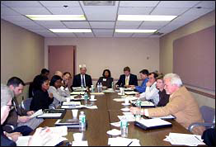
Freight Peer Exchange participants discuss freight business opportunities. Have you ever attended a two-hour or all-day meeting that looked sort of like this? How much of it did you consider truly worthwhile? Photo courtesy U.S. Department of Transportation.
Meetings are a pain in the neck for everybody with a neck. And they cost money too, which annoys shareholders. Clearly, we need to eliminate meetings, or at least reduce them to the point where they only bother shareholders.
I've conducted extensive research to solve the problem of meetings. Although I collected tons of survey data, I must admit that like many corporate surveys, I never actually analyzed the data, because I knew exactly what conclusions I wanted to reach, after thinking deeply for several minutes. Actually, I never even conducted the survey, because it seemed like such a waste since I had already decided not to analyze the data.
So here are six sure-fire ways to eliminate meetings, according to the survey I would have conducted, if I had actually done the survey and then actually analyzed the data.
- Get rid of half your conference rooms
- Conference rooms are without a doubt the leading cause of meetings. According to my calculations, removing 50% of the conference rooms will reduce meetings by approximately 50%.
- Forbid meetings on even-numbered dates
- Since getting rid of half the conference rooms eliminates half the meetings, we can painlessly eliminate the half of the meetings that would normally be scheduled on even-numbered dates. Um, wait. That won't work. Never mind.
- Eliminate any meeting whose main agenda item contains the words "review," "strategy," or "status"
- This includes items like Contract Review, Strategy Review, Project Status, and the dreaded Contract Strategy Project Status Review. These are usually the most painful drug-out affairs, and getting rid of them produces substantial economies that go straight to the bottom line, strategy-wise.
- Meetings are a
pain in the neck
for everybody
with a neck - Ban anyone with the title "director" (or above) from "sitting in"
- Banning these people not only saves them time, but also saves time for the people whose meetings into which they're sitting on, because as everybody knows, high-level sitters-in are the main cause of PowerPoint.
- Make four-wheel drive illegal
- A key element of meetings is the attendees. Making four-wheel drive illegal will keep many of them from attending in bad winter weather. In places where snow is rare, I advocate making automobile air conditioning illegal, just to be fair.
- Change daylight savings time
- Have daylight savings time only in months that contain either M, J but not R, or E but not T. Meeting attendance would fall rapidly, because studies I haven't done indicate that less than 30% of us could figure out which months, if any, would have daylight savings time. And no software company I know of could implement this algorithm without crashing Windows.
I have one final idea for the meetings we can't eliminate. They would be much shorter if we could all agree to agree with each other more often. So get everyone else to agree with you. Or maybe you can just agree with them. Whatever.  Top
Top  Next Issue
Do you spend your days scurrying from meeting to meeting? Do you ever wonder if all these meetings are really necessary? (They aren't) Or whether there isn't some better way to get this work done? (There is) Read 101 Tips for Effective Meetings to learn how to make meetings much more productive and less stressful — and a lot more rare. Order Now!
Want more portable humor? Load up your MP3 player with Stephen Colbert, Tom Lehrer, Elayne Boosler, or Garrison Keillor. Pick up a new MP3 player from Amazon.com.
Your comments are welcome
Would you like to see your comments posted here? rbrendPtoGuFOkTSMQOzxner@ChacEgGqaylUnkmwIkkwoCanyon.comSend me your comments by email, or by Web form.About Point Lookout
 Thank you for reading this article. I hope you enjoyed it and
found it useful, and that you'll consider recommending it to a friend.
Thank you for reading this article. I hope you enjoyed it and
found it useful, and that you'll consider recommending it to a friend.
This article in its entirety was written by a human being. No machine intelligence was involved in any way.
Point Lookout is a free weekly email newsletter. Browse the archive of past issues. Subscribe for free.
Support Point Lookout by joining the Friends of Point Lookout, as an individual or as an organization.
Do you face a complex interpersonal situation? Send it in, anonymously if you like, and I'll give you my two cents.
Related articles
More articles on Effective Meetings:
 Overtalking: II
- Overtalking is a tactic for dominating a conversation by talking to stop others from talking. When it
happens, what can we do about it?
 Favor Symmetric Virtual Meetings
- Virtual meetings are notorious for generating more frustration than useful output. One cause of the
difficulties is asymmetry in the way we connect to virtual meetings.
 Dealing with Meeting Hijackings
- When you haven't prevented a meeting hijacking, and you believe a hijacking is underway, what can you
do? How can you regain control?
 Issues-Only Team Meetings
- Time spent in regular meetings is productive to the extent that it moves the team closer to its objectives.
Because uncovering and clarifying issues is more productive than distributing information or listening
to status reports, issues-only team meetings focus energy where it will help most.
 Exhibitionism and Conversational Narcissism at Work: II
- Exhibitionism is one of four themes of conversational narcissism. Here are six patterns of behavior
that are exhibitionistic in the sense that they're intended not to advance the conversation, but rather
to call the attention of others to the abuser.
See also Effective Meetings and Effective Communication at Work for more related articles.
Forthcoming issues of Point Lookout
 Coming April 24: Antipatterns for Time-Constrained Communication: 1
- Knowing how to recognize just a few patterns that can lead to miscommunication can be helpful in reducing the incidence of problems. Here is Part 1 of a collection of communication antipatterns that arise in technical communication under time pressure. Available here and by RSS on April 24.
 And on May 1: Antipatterns for Time-Constrained Communication: 2
- Recognizing just a few patterns that can lead to miscommunication can reduce the incidence of problems. Here is Part 2 of a collection of antipatterns that arise in technical communication under time pressure, emphasizing those that depend on content. Available here and by RSS on May 1.
Coaching services
I offer email and telephone coaching at both corporate and individual rates. Contact Rick for details at rbrendPtoGuFOkTSMQOzxner@ChacEgGqaylUnkmwIkkwoCanyon.com or (650) 787-6475, or toll-free in the continental US at (866) 378-5470.
Get the ebook!
Past issues of Point Lookout are available in six ebooks:
- Get 2001-2 in Geese Don't Land on Twigs (PDF, )
- Get 2003-4 in Why Dogs Wag (PDF, )
- Get 2005-6 in Loopy Things We Do (PDF, )
- Get 2007-8 in Things We Believe That Maybe Aren't So True (PDF, )
- Get 2009-10 in The Questions Not Asked (PDF, )
- Get all of the first twelve years (2001-2012) in The Collected Issues of Point Lookout (PDF, )
Are you a writer, editor or publisher on deadline? Are you looking for an article that will get people talking and get compliments flying your way? You can have 500-1000 words in your inbox in one hour. License any article from this Web site. More info
Follow Rick


Recommend this issue to a friend
Send an email message to a friend
rbrendPtoGuFOkTSMQOzxner@ChacEgGqaylUnkmwIkkwoCanyon.comSend a message to Rick
A Tip A Day feed
Point Lookout weekly feed
 My blog, Technical Debt for Policymakers, offers
resources, insights, and conversations of interest to policymakers who are concerned with managing
technical debt within their organizations. Get the millstone of technical debt off the neck of your
organization!
My blog, Technical Debt for Policymakers, offers
resources, insights, and conversations of interest to policymakers who are concerned with managing
technical debt within their organizations. Get the millstone of technical debt off the neck of your
organization! Bad boss, long commute, troubling ethical questions, hateful colleague? Learn what we can do when we
love the work but not the job.Learn how to make your virtual global team sing.Are you managing a change effort that faces rampant cynicism, passive non-cooperation, or
maybe even outright revolt?Learn how to make meetings more productive — and more rare.
Bad boss, long commute, troubling ethical questions, hateful colleague? Learn what we can do when we
love the work but not the job.Learn how to make your virtual global team sing.Are you managing a change effort that faces rampant cynicism, passive non-cooperation, or
maybe even outright revolt?Learn how to make meetings more productive — and more rare.