You're in a meeting, with eight other anxious souls, discussing the latest burning issue. Dale has just presented a proposal that's innovative, elegant, and creative. One by one, people raise questions about the idea. Well, not questions…they're more like objections. "What if X happens?" or "Does it deal with the Y problem?" or "Is it compatible with Z?" or "Can we can get budget approval?" And so on.
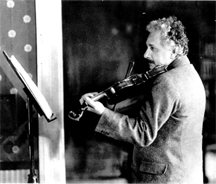
Albert Einstein playing his violin on his 50th birthday in 1929. In 1935, he published a paper with two of his research associates, Boris Podolsky and Nathan Rosen. The paper posed a problem in quantum mechanics which has become known as the EPR Paradox, and which has been debated ever since (though most physicists now believe the matter is settled). The debate of this question, much like most scientific debates, has been fairly symmetric, in that all participants contributed both proposals and objections with more or less similar intensity and formality. Science has little tolerance for the asymmetry we see in piecemeal analysis, which leads so often to incorrect conclusions. Photo courtesy Town Topics, community newspaper of Princeton, New Jersey. Read more about the EPR Paradox.
Some objections have immediate answers. Most don't. Since the details are unknown, nobody has all the answers. Unanswered objections are added to a growing Issues List.
Eventually the list becomes intimidating enough that some lose faith, and the initial optimism starts to fade. With momentum dissipating, someone suggests another approach, and promises to have a proposal tomorrow. Dale's idea is abandoned.
Sometimes the opposite happens: we find answers to all the questions we can think of, and we think all is well when it isn't.
I call this pattern of group discussion piecemeal analysis. It can mean the end for perfectly fine proposals, and it can lead to a "go" for some truly dumb proposals. Why? In this first part, we approach the question from a content perspective. In the second part, we examine the group dynamics of piecemeal analysis. Here are five ways in which the reasoning of piecemeal analysis might go astray.
- Objectors have an advantage
- Since we see the objections as independent of each other, responding effectively to one objection leaves the credibility of the other objections intact. By contrast, because of the halo effect, flaws in one part of the proposal degrade the credibility of the whole.
- Objections might not be logically consistent
- Since objections are independent, they and their implications need not be mutually consistent. Moreover, some objections, taken together, might have subtly inconsistent implications that we miss in a fast-paced discussion. What might seem to be flaws in the proposal might not be, because the conditions of the objections cannot all be met.
- Some objections are invalid
- Some objections seem plausible, but their conditions cannot actually occur. Yet, in error, we add them to the Issues List. They become part of the case against the proposal, almost as if they were demonstrably valid.
- Some of our answers to objections are incorrect
- As the defenders of the proposal respond to the objections, the group assesses the validity of their responses. Sometimes both the response and the assessment are incorrect. The proposal moves ahead when it should not.Some objections might
seem plausible, but
cannot actually occur - We overlook some valid objections
- When we rely only on the open discussion to analyze the proposal, we might overlook some material issues that are truly problematic, or we might reject them incorrectly. This is most likely when things are going well for the proposal.
But even if we could address these content issues of piecemeal analysis, issues related to the dynamics of the group remain. We'll look at that side of the question in two weeks. Next in this series  Top
Top  Next Issue
Are your projects always (or almost always) late and over budget? Are your project teams plagued by turnover, burnout, and high defect rates? Turn your culture around. Read 52 Tips for Leaders of Project-Oriented Organizations, filled with tips and techniques for organizational leaders. Order Now!
Your comments are welcome
Would you like to see your comments posted here? rbrendPtoGuFOkTSMQOzxner@ChacEgGqaylUnkmwIkkwoCanyon.comSend me your comments by email, or by Web form.About Point Lookout
 Thank you for reading this article. I hope you enjoyed it and
found it useful, and that you'll consider recommending it to a friend.
Thank you for reading this article. I hope you enjoyed it and
found it useful, and that you'll consider recommending it to a friend.
This article in its entirety was written by a human being. No machine intelligence was involved in any way.
Point Lookout is a free weekly email newsletter. Browse the archive of past issues. Subscribe for free.
Support Point Lookout by joining the Friends of Point Lookout, as an individual or as an organization.
Do you face a complex interpersonal situation? Send it in, anonymously if you like, and I'll give you my two cents.
Related articles
More articles on Personal, Team, and Organizational Effectiveness:
 An Emergency Toolkit
- You've just had some bad news at work, and you're angry or really upset. Maybe you feel like the target
of a vicious insult or the victim of a serious injustice. You have work to do, and you want to respond,
but you must first regain your composure. What can you do to calm down and start feeling better?
 The Good, the Bad, and the Complicated
- In fiction and movies, the world is often simple. There's a protagonist, a goal, and a series of obstacles.
The protagonists and goals are good, and the obstacles are bad. Real life is more complicated.
 Just-In-Time Hoop-Jumping
- Securing approvals for projects, proposals, or other efforts is often called "jumping through hoops."
Hoop-jumping can be time-consuming and frustrating. Here are some suggestions for jumping through hoops
efficiently.
 Paradoxical Policies: I
- Although most organizational policies are constructive, many are outdated or nonsensical, and some are
actually counterproductive. Here's a collection of policies that would be funny if they weren't real.
 Subject Lines for Intra-Team Messages
- When teams communicate internally using messaging systems like email, poorly formed subject lines of
messages can limit the effectiveness of the exchanges. Subject lines therefore provide a powerful means
of increasing real-time productivity of the team.
See also Personal, Team, and Organizational Effectiveness, Problem Solving and Creativity and Effective Meetings for more related articles.
Forthcoming issues of Point Lookout
 Coming April 24: Antipatterns for Time-Constrained Communication: 1
- Knowing how to recognize just a few patterns that can lead to miscommunication can be helpful in reducing the incidence of problems. Here is Part 1 of a collection of communication antipatterns that arise in technical communication under time pressure. Available here and by RSS on April 24.
 And on May 1: Antipatterns for Time-Constrained Communication: 2
- Recognizing just a few patterns that can lead to miscommunication can reduce the incidence of problems. Here is Part 2 of a collection of antipatterns that arise in technical communication under time pressure, emphasizing those that depend on content. Available here and by RSS on May 1.
Coaching services
I offer email and telephone coaching at both corporate and individual rates. Contact Rick for details at rbrendPtoGuFOkTSMQOzxner@ChacEgGqaylUnkmwIkkwoCanyon.com or (650) 787-6475, or toll-free in the continental US at (866) 378-5470.
Get the ebook!
Past issues of Point Lookout are available in six ebooks:
- Get 2001-2 in Geese Don't Land on Twigs (PDF, )
- Get 2003-4 in Why Dogs Wag (PDF, )
- Get 2005-6 in Loopy Things We Do (PDF, )
- Get 2007-8 in Things We Believe That Maybe Aren't So True (PDF, )
- Get 2009-10 in The Questions Not Asked (PDF, )
- Get all of the first twelve years (2001-2012) in The Collected Issues of Point Lookout (PDF, )
Are you a writer, editor or publisher on deadline? Are you looking for an article that will get people talking and get compliments flying your way? You can have 500-1000 words in your inbox in one hour. License any article from this Web site. More info
Follow Rick


Recommend this issue to a friend
Send an email message to a friend
rbrendPtoGuFOkTSMQOzxner@ChacEgGqaylUnkmwIkkwoCanyon.comSend a message to Rick
A Tip A Day feed
Point Lookout weekly feed
 My blog, Technical Debt for Policymakers, offers
resources, insights, and conversations of interest to policymakers who are concerned with managing
technical debt within their organizations. Get the millstone of technical debt off the neck of your
organization!
My blog, Technical Debt for Policymakers, offers
resources, insights, and conversations of interest to policymakers who are concerned with managing
technical debt within their organizations. Get the millstone of technical debt off the neck of your
organization! Bad boss, long commute, troubling ethical questions, hateful colleague? Learn what we can do when we
love the work but not the job.Learn how to make your virtual global team sing.Are you managing a change effort that faces rampant cynicism, passive non-cooperation, or
maybe even outright revolt?Learn how to make meetings more productive — and more rare.
Bad boss, long commute, troubling ethical questions, hateful colleague? Learn what we can do when we
love the work but not the job.Learn how to make your virtual global team sing.Are you managing a change effort that faces rampant cynicism, passive non-cooperation, or
maybe even outright revolt?Learn how to make meetings more productive — and more rare.