In 1940s street parlance, to frame is to ensnare or catch: "I was set up!"; "He was innocent, but the police framed him." In framing, someone creates evidence to project the appearance that the target carried out an illegal act. For instance, a framer might plant at a crime scene a drinking glass with the target's fingerprints.
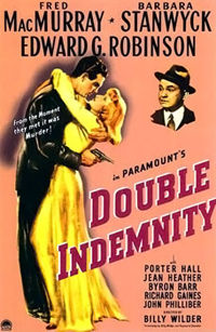
Theatrical poster for the 1944 film, Double Indemnity, directed by Billy Wilder. The film tells the story of a plot to murder the husband of the seductive character Phyllis Dietrichson, played by Barbara Stanwyck. Her co-conspirator is Walter Neff, played by Fred MacMurray. Although the plot itself doesn't involve a frame, as the story unfolds, a threatened frame does become part of the complex tale.
Image courtesy Wikipedia.

In organizational politics, frames need not meet the standards of evidence that a court of law requires. Political frames often consist of interpretations, innuendos, privately voiced assertions and vague accusations. Moreover, political framing isn't necessarily carried out before the fact. The innuendos and accusations usually occur after an incident, as the framer provides an alternate interpretation of that incident to disparage the target.
Here are some of the communication techniques of political framers, and a few suggested counter tactics.
- Requests for information
- To further an appearance of probity and reason, the framer can make innocent-sounding requests for information. Phrases like "help me understand," or "can you clarify" might appear. The questions themselves provide the framer opportunities to add to the frame. For instance, the framer might ask, "I've been told that you assassinated President Lincoln. Can you confirm that this is a simple misunderstanding?" The accusation is nested in a seemingly reasonable request for a denial, but the request itself gives the framer a chance to spread the accusation.
- When this occurs, the damage is already done. Although it's tempting to say nothing at all, remember that silence can be interpreted in many ways. A response is required, but if it's anything more than a simple, straight, and serious denial, you risk making the problem worse.
- Multi-channel communication
- Believing that they know everything the framer has said is a common mistake of targets of framers. When targets learn of some new charges, usually indirectly, they tend to focus on those charges, ignoring the possibility that other communications are happening In organizational politics,
frames need not meet the
standards of evidence that
a court of law requiresor might already have happened. For instance, the framer might make an accusation directly to the target, having already prepared the audience by making that same charge — and more — in a more private venue, excluding the target. Targets, believing that they know the full scope of the problem, then address the charges they know about. The framer is then free to fall back on already-prepared ground, leaving the target's carefully prepared defense unanswered and effectively deflected. - As a target, it's wise to assume that the framer has had more communication with others than you know, and that some of those others are convinced that you've done and said what the framer claims. When you hear of new charges, try to draw out more, to get everything on the table before trying to turn things around. To avoid further spreading falsehoods, privacy is best, but privacy is not always possible.
We'll examine strategies for political framing next time.  Top
Top  Next Issue
Is every other day a tense, anxious, angry misery as you watch people around you, who couldn't even think their way through a game of Jacks, win at workplace politics and steal the credit and glory for just about everyone's best work including yours? Read 303 Secrets of Workplace Politics, filled with tips and techniques for succeeding in workplace politics. More info
Double Indemnity is over 60 years old, but still
entertaining. Get some popcorn and make an evening of it. As a film, it has served as a template for many more recent screen tales, including — possibly — Body Heat. Students of film will certainly enjoy Double Indemnity. Order from Amazon.com
Your comments are welcome
Would you like to see your comments posted here? rbrendPtoGuFOkTSMQOzxner@ChacEgGqaylUnkmwIkkwoCanyon.comSend me your comments by email, or by Web form.About Point Lookout
 Thank you for reading this article. I hope you enjoyed it and
found it useful, and that you'll consider recommending it to a friend.
Thank you for reading this article. I hope you enjoyed it and
found it useful, and that you'll consider recommending it to a friend.
This article in its entirety was written by a human being. No machine intelligence was involved in any way.
Point Lookout is a free weekly email newsletter. Browse the archive of past issues. Subscribe for free.
Support Point Lookout by joining the Friends of Point Lookout, as an individual or as an organization.
Do you face a complex interpersonal situation? Send it in, anonymously if you like, and I'll give you my two cents.
Related articles
More articles on Workplace Politics:
 When Power Attends the Meeting
- When the boss or supervisor of the chair of a regular meeting "sits in," disruption almost
inevitably results, and it's usually invisible to the visitor. Here are some of the risks of sitting
in on the meetings of your subordinates.
 Devious Political Tactics: Divide and Conquer, Part II
- While most leaders try to achieve organizational unity, some do use divisive tactics to maintain control,
or to elevate performance by fostering competition. Here's Part II of a series exploring the risks of
these tactics.
 Lateral Micromanagement
- Lateral micromanagement is the unwelcome intrusion by one co-worker into the responsibilities of another.
Far more than run-of-the-mill bossiness, it's often a concerted attempt to gain organizational power
and rank, and it is toxic to teams.
 Some Hidden Costs of Business Fads
- Adopting business fads is an expensive organizational pattern, with costs that extend beyond what can
be measured by the chart of accounts most organizations use. Here are some examples of the hidden costs
of business fads.
 Some Hazards of Skip-Level Interviews: III
- Skip-level interviews — dialogs between a subordinate and the subordinate's supervisor's supervisor
— can be hazardous. Here's Part III of a little catalog of the hazards, emphasizing subordinate-initiated
skip-level interviews.
See also Workplace Politics and Conflict Management for more related articles.
Forthcoming issues of Point Lookout
 Coming April 24: Antipatterns for Time-Constrained Communication: 1
- Knowing how to recognize just a few patterns that can lead to miscommunication can be helpful in reducing the incidence of problems. Here is Part 1 of a collection of communication antipatterns that arise in technical communication under time pressure. Available here and by RSS on April 24.
 And on May 1: Antipatterns for Time-Constrained Communication: 2
- Recognizing just a few patterns that can lead to miscommunication can reduce the incidence of problems. Here is Part 2 of a collection of antipatterns that arise in technical communication under time pressure, emphasizing those that depend on content. Available here and by RSS on May 1.
Coaching services
I offer email and telephone coaching at both corporate and individual rates. Contact Rick for details at rbrendPtoGuFOkTSMQOzxner@ChacEgGqaylUnkmwIkkwoCanyon.com or (650) 787-6475, or toll-free in the continental US at (866) 378-5470.
Get the ebook!
Past issues of Point Lookout are available in six ebooks:
- Get 2001-2 in Geese Don't Land on Twigs (PDF, )
- Get 2003-4 in Why Dogs Wag (PDF, )
- Get 2005-6 in Loopy Things We Do (PDF, )
- Get 2007-8 in Things We Believe That Maybe Aren't So True (PDF, )
- Get 2009-10 in The Questions Not Asked (PDF, )
- Get all of the first twelve years (2001-2012) in The Collected Issues of Point Lookout (PDF, )
Are you a writer, editor or publisher on deadline? Are you looking for an article that will get people talking and get compliments flying your way? You can have 500-1000 words in your inbox in one hour. License any article from this Web site. More info
Follow Rick


Recommend this issue to a friend
Send an email message to a friend
rbrendPtoGuFOkTSMQOzxner@ChacEgGqaylUnkmwIkkwoCanyon.comSend a message to Rick
A Tip A Day feed
Point Lookout weekly feed
 The message of Point Lookout is unique. Help get the message out. Please donate to help keep Point Lookout available for free to everyone.
 My blog, Technical Debt for Policymakers, offers
resources, insights, and conversations of interest to policymakers who are concerned with managing
technical debt within their organizations. Get the millstone of technical debt off the neck of your
organization!
My blog, Technical Debt for Policymakers, offers
resources, insights, and conversations of interest to policymakers who are concerned with managing
technical debt within their organizations. Get the millstone of technical debt off the neck of your
organization!Beware any resource that speaks of "winning" at workplace politics or "defeating" it. You can benefit or not, but there is no score-keeping, and it isn't a game.
- Wikipedia has a nice article with a list of additional resources
- Some public libraries offer collections. Here's an example from Saskatoon.
- Check my own links collection
- LinkedIn's Office Politics discussion group
 Is every other day a tense, anxious, angry misery as you watch people around you, who couldn't even
think their way through a game of Jacks, win at workplace politics and steal the credit and glory
for just about everyone's best work including yours? Read 303 Secrets of Workplace Politics!Learn how to make your virtual global team sing.A Tip a Day arrives by email, or by RSS Feed, each business day. It's 20 to 30 words at most, and gives
you a new perspective on the hassles and rewards of work life. Most tips also contain links to
related articles. Free!Learn how to make meetings more productive — and more rare.
Is every other day a tense, anxious, angry misery as you watch people around you, who couldn't even
think their way through a game of Jacks, win at workplace politics and steal the credit and glory
for just about everyone's best work including yours? Read 303 Secrets of Workplace Politics!Learn how to make your virtual global team sing.A Tip a Day arrives by email, or by RSS Feed, each business day. It's 20 to 30 words at most, and gives
you a new perspective on the hassles and rewards of work life. Most tips also contain links to
related articles. Free!Learn how to make meetings more productive — and more rare.