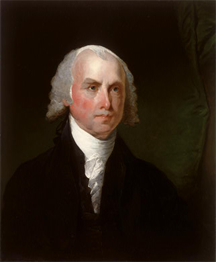
James Madison, author of the Bill of Rights, the first ten amendments to the U.S. Constitution. The debates leading to the ratification of the United States Constitution emphasized two fundamental perspectives. The Federalists advocated adoption of the draft document in toto. The Anti-Federalists disagreed — they wanted changes that specified the rights of citizens, and reserved to citizens all rights not specifically granted to the government. Madison was a leading Anti-Federalist. He formulated a set of twelve amendments limiting the rights of the government. After constitutional ratification, the First Congress adopted ten of these. An eleventh was ratified in 1992. The first ten, now called the Bill of Rights, include the freedom of speech, the freedom of religion, and the freedom from unwarranted search and seizure. They are now so central that to many, they are the most important part of the Constitution. Clearly the conflict between the Federalists and the Anti-Federalists was constructive — it produced a superior result. Photo of a painting of Madison ca. 1821 by Gilbert Stuart, oil on wood. The painting is at the National Gallery of Art.
The first in this series about teamwork myths explored erroneous beliefs about forming teams. In this second installment, we examine three myths about team conflict.
- Team cohesion is determined by personal chemistry
- Some believe that all members of high performance teams like each other. They attribute interpersonal trouble on teams to so-called "personality clashes." They believe that team troubles are always due to misbehavior by individual team members. This conveniently exonerates everyone and everything else, including policy, customers, layoffs, pressure, culture, and management.
- This erroneous belief is often used to justify individual-oriented corrective actions that include reassignment, discipline, and termination, but when the causes of poor team cohesion aren't personal, these actions are ineffective. Moreover, in misguided efforts to form high performance teams, we sometimes staff teams according to personal chemistry rather than knowledge, skill, or capability.
- When team members believe that chemistry drives cohesion, toxic conflicts erupt unnecessarily, because members believe that honest differences are driven not by professional judgments but by personal agendas. Adherence to the myth validates the myth.
- Conflict undermines performance
- Many believe that conflict is always bad and destructive, that disagreements always threaten team goals, and that those who disagree aren't team players. To disagree is to be disagreeable. This is a particularly destructive myth.
- Many don't know how to disagree agreeably, or how to engage in substantive debate while avoiding personal attacks. Many experience disagreement as personal attack. For all these people, disagreement often leads to toxic conflict. This might explain some of the popularity of this myth.
- If disagreement Some attribute interpersonal
trouble on teams to
so-called "personality
clashes," which conveniently
exonerates everyone and
everything but the clashersis disallowed, how can we ever perfect group decisions? All positions would remain unquestioned until their advocates moved on. Indeed, this is what happens in dictatorships — and in groups that don't tolerate disagreement. - Conflict usually entails disagreement, but conflict can be either destructive or constructive. Constructive conflict is essential to high performance.
- Team trouble is always due to bad apples
- The bad-apple myth holds that team trouble is always due to a few "bad apples," and after we find the bad apples, and eliminate them or modify their behavior, the trouble ends. Rarely does this actually work. At best, everyone else learns that quiet compliance and currying favor is the safest course. High performance remains elusive.
- Usually, the people we identify as bad apples are just the visible manifestation of systemic problems. If that's the case, eliminating the bad apples just drives the symptoms underground. To achieve high performance we must actually address problems, and that requires people who are willing to speak up. If we teach the team that speaking up is dangerous, we close off the only path to achieving high performance. You can't fix what you can't talk about.
Some readers no doubt subscribe to one or more of what I am here calling myths. I guess, for now, we'll have to agree to disagree. First in this series Next in this series  Top
Top  Next Issue
Are you fed up with tense, explosive meetings? Are you or a colleague the target of a bully? Destructive conflict can ruin organizations. But if we believe that all conflict is destructive, and that we can somehow eliminate conflict, or that conflict is an enemy of productivity, then we're in conflict with Conflict itself. Read 101 Tips for Managing Conflict to learn how to make peace with conflict and make it an organizational asset. Order Now!
For more teamwork myths, see "Teamwork Myths: Formation," Point Lookout for May 27, 2009, and "Teamwork Myths: I vs. We," Point Lookout for July 1, 2009.
Your comments are welcome
Would you like to see your comments posted here? rbrendPtoGuFOkTSMQOzxner@ChacEgGqaylUnkmwIkkwoCanyon.comSend me your comments by email, or by Web form.About Point Lookout
 Thank you for reading this article. I hope you enjoyed it and
found it useful, and that you'll consider recommending it to a friend.
Thank you for reading this article. I hope you enjoyed it and
found it useful, and that you'll consider recommending it to a friend.
This article in its entirety was written by a human being. No machine intelligence was involved in any way.
Point Lookout is a free weekly email newsletter. Browse the archive of past issues. Subscribe for free.
Support Point Lookout by joining the Friends of Point Lookout, as an individual or as an organization.
Do you face a complex interpersonal situation? Send it in, anonymously if you like, and I'll give you my two cents.
Related articles
More articles on Conflict Management:
 Can You Hear Me Now?
- Not feeling heard can feel like an attack, even when there was no attack, and then conversation can
quickly turn to war. Here are some tips for hearing your conversation partner and for conveying the
message that you actually did hear.
 Workplace Bullying and Workplace Conflict: II
- Of the tools we use to address toxic conflict, many are ineffective for ending bullying. Here's a review
of some of the tools that don't work well and why.
 Handling Heat: II
- Heated exchanges in meetings can compromise both the organizational mission and the careers of the meeting's
participants. Here are some tactics for people who aren't chairing the meeting.
 Agenda Despots: II
- Some meeting chairs crave complete or near-complete control of their meeting agendas. In this Part II
of our exploration of their techniques, we emphasize methods for managing unwanted topic contributions
from attendees.
 Three Levels of Deception at Work
- Deception in workplace politics is probably less common than many believe. Still, being ensnared in
a deception can be a costly and upsetting experience. A valuable skill is recognizing the three types
of deceptions: strategic, operational, and tactical.
See also Conflict Management and Problem Solving and Creativity for more related articles.
Forthcoming issues of Point Lookout
 Coming April 24: Antipatterns for Time-Constrained Communication: 1
- Knowing how to recognize just a few patterns that can lead to miscommunication can be helpful in reducing the incidence of problems. Here is Part 1 of a collection of communication antipatterns that arise in technical communication under time pressure. Available here and by RSS on April 24.
 And on May 1: Antipatterns for Time-Constrained Communication: 2
- Recognizing just a few patterns that can lead to miscommunication can reduce the incidence of problems. Here is Part 2 of a collection of antipatterns that arise in technical communication under time pressure, emphasizing those that depend on content. Available here and by RSS on May 1.
Coaching services
I offer email and telephone coaching at both corporate and individual rates. Contact Rick for details at rbrendPtoGuFOkTSMQOzxner@ChacEgGqaylUnkmwIkkwoCanyon.com or (650) 787-6475, or toll-free in the continental US at (866) 378-5470.
Get the ebook!
Past issues of Point Lookout are available in six ebooks:
- Get 2001-2 in Geese Don't Land on Twigs (PDF, )
- Get 2003-4 in Why Dogs Wag (PDF, )
- Get 2005-6 in Loopy Things We Do (PDF, )
- Get 2007-8 in Things We Believe That Maybe Aren't So True (PDF, )
- Get 2009-10 in The Questions Not Asked (PDF, )
- Get all of the first twelve years (2001-2012) in The Collected Issues of Point Lookout (PDF, )
Are you a writer, editor or publisher on deadline? Are you looking for an article that will get people talking and get compliments flying your way? You can have 500-1000 words in your inbox in one hour. License any article from this Web site. More info
Follow Rick


Recommend this issue to a friend
Send an email message to a friend
rbrendPtoGuFOkTSMQOzxner@ChacEgGqaylUnkmwIkkwoCanyon.comSend a message to Rick
A Tip A Day feed
Point Lookout weekly feed
 My blog, Technical Debt for Policymakers, offers
resources, insights, and conversations of interest to policymakers who are concerned with managing
technical debt within their organizations. Get the millstone of technical debt off the neck of your
organization!
My blog, Technical Debt for Policymakers, offers
resources, insights, and conversations of interest to policymakers who are concerned with managing
technical debt within their organizations. Get the millstone of technical debt off the neck of your
organization! Bad boss, long commute, troubling ethical questions, hateful colleague? Learn what we can do when we
love the work but not the job.Learn how to make your virtual global team sing.Are you managing a change effort that faces rampant cynicism, passive non-cooperation, or
maybe even outright revolt?Learn how to make meetings more productive — and more rare.
Bad boss, long commute, troubling ethical questions, hateful colleague? Learn what we can do when we
love the work but not the job.Learn how to make your virtual global team sing.Are you managing a change effort that faces rampant cynicism, passive non-cooperation, or
maybe even outright revolt?Learn how to make meetings more productive — and more rare.