You're out of work. Perhaps you were laid off, or maybe the company folded. You've been looking for work, and it's discouraging. The situation is serious and news reports are saying that things will probably keep getting worse for a while. It's now difficult to stay energized about looking for work.
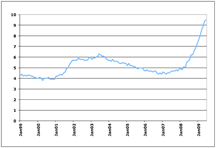
U.S. Unemployment Rate in percent, from January 1999 through June, 2009. Notice that the curve is still rising. Although the latest month shows a decrease in the rate of rise, it's premature to call that a trend. Source: U.S. Bureau of Labor Statistics, Current Population Survey.
One day you noticed you were grateful for a "no thanks" response to one of your job inquiries, because at least it was a response. Some days, your heart isn't really in it. Other days, you don't do much at all.
The challenge of this environment is both a curse and a blessing. It's a curse because the challenge can sap motivation, and that can lengthen the period of unemployment. It's a blessing because working hard at finding work despite the challenging environment makes you stand out, and that enhances the probability of landing a good job.
To help you decide to give this task everything you have, I've compiled a collection of strategies for shortening your path to your next job. In weeks to come, we'll look at ideas for setting up and managing your infrastructure, tactics and strategy for marketing yourself, and sharpening your communications skills. But let's begin with overall strategy.
- Looking for a job is a full-time job
- Think of yourself as having a job, and report to work each day. Keep office hours. Dress your part. Decide whether it's a five-day-per-week job or six; rarely more, never less. Observe national holidays. Take sick days and allotted vacation days when needed. Make a plan for the month, day, and week, and report status each morning to your boss — you. Self-supervision can be a bit tricky because you have an inherent conflict of interest, but do your best.
- Know what employers are looking for
- Imagine that you're an employer looking for someone like you. What do you want in a candidate? What don't you want? Make lists of these assets and liabilities. Know where you stand relative to these assets and liabilities. Make plans for promoting those assets, and for addressing those liabilities.
- Set a schedule
- Schedule your appointments, of course. But also schedule your projects, such as resume customization, training (on-line or in person), shopping for a desk lamp, or computing your run rate.
- Get additional certifications
- If having the right Looking for a job is a
full-time job. Think of
yourself as having a
job, and report to
work each day.certifications would make you more marketable, get them. If you have several different certifications, don't be concerned about looking like you're unfocused — disclose only those that are relevant to each particular position. - Enroll in continuing education classes
- Classes that support relevant certifications are a great idea. Classes that help you acquire relevant skills even without certifications are great, too. Institutional prestige is less important for certificates than it is for degrees. Often overlooked: business writing, public speaking, etiquette, and languages.
Certainly some of these strategies don't apply to you. Which do and which don't? And there might be others that do apply to you. Find them. They're important. Next in this series  Top
Top  Next Issue
Love the work but not the job? Bad boss, long commute, troubling ethical questions, hateful colleague? This ebook looks at what we can do to get more out of life at work. It helps you get moving again! Read Go For It! Sometimes It's Easier If You Run, filled with tips and techniques for putting zing into your work life. Order Now!
For more on finding work in tough times, see "Finding Work in Tough Times: Infrastructure," Point Lookout for July 15, 2009; "Finding Work in Tough Times: Marketing," Point Lookout for July 22, 2009; and "Finding Work in Tough Times: Communications," Point Lookout for July 29, 2009.
Your comments are welcome
Would you like to see your comments posted here? rbrendPtoGuFOkTSMQOzxner@ChacEgGqaylUnkmwIkkwoCanyon.comSend me your comments by email, or by Web form.About Point Lookout
 Thank you for reading this article. I hope you enjoyed it and
found it useful, and that you'll consider recommending it to a friend.
Thank you for reading this article. I hope you enjoyed it and
found it useful, and that you'll consider recommending it to a friend.
This article in its entirety was written by a human being. No machine intelligence was involved in any way.
Point Lookout is a free weekly email newsletter. Browse the archive of past issues. Subscribe for free.
Support Point Lookout by joining the Friends of Point Lookout, as an individual or as an organization.
Do you face a complex interpersonal situation? Send it in, anonymously if you like, and I'll give you my two cents.
Related articles
More articles on Personal, Team, and Organizational Effectiveness:
 Critical Thinking and Midnight Pizza
- When we notice patterns or coincidences, we draw conclusions about things we can't or didn't directly
observe. Sometimes the conclusions are right, and sometimes not. When they're not, organizations, careers,
and people can suffer. To be right more often, we must master critical thinking.
 Dealing with Deadlock
- At times it seems that nothing works. Whenever we try to get moving, we encounter obstacles. If we try
to go around them, we find more obstacles. How do we get stuck? And how can we get unstuck?
 Wacky Words of Wisdom: III
- Adages are so elegantly stated that we have difficulty doubting them. Here's Part III of a collection
of often-misapplied adages.
 Bottlenecks: I
- Some people take on so much work that they become "bottlenecks." The people around them repeatedly
find themselves stuck, awaiting responses or decisions. Why does this happen and what are the costs?
 Anticipating Absence: Quarantine and Isolation
- When the pandemic compels some knowledge workers to quarantine or isolate, we tend to treat them as
if they were totally unavailable. But if they're willing and able to work, even part-time, they might
be able to continue to contribute. To make this happen, work out conditions in advance.
See also Personal, Team, and Organizational Effectiveness for more related articles.
Forthcoming issues of Point Lookout
 Coming April 24: Antipatterns for Time-Constrained Communication: 1
- Knowing how to recognize just a few patterns that can lead to miscommunication can be helpful in reducing the incidence of problems. Here is Part 1 of a collection of communication antipatterns that arise in technical communication under time pressure. Available here and by RSS on April 24.
 And on May 1: Antipatterns for Time-Constrained Communication: 2
- Recognizing just a few patterns that can lead to miscommunication can reduce the incidence of problems. Here is Part 2 of a collection of antipatterns that arise in technical communication under time pressure, emphasizing those that depend on content. Available here and by RSS on May 1.
Coaching services
I offer email and telephone coaching at both corporate and individual rates. Contact Rick for details at rbrendPtoGuFOkTSMQOzxner@ChacEgGqaylUnkmwIkkwoCanyon.com or (650) 787-6475, or toll-free in the continental US at (866) 378-5470.
Get the ebook!
Past issues of Point Lookout are available in six ebooks:
- Get 2001-2 in Geese Don't Land on Twigs (PDF, )
- Get 2003-4 in Why Dogs Wag (PDF, )
- Get 2005-6 in Loopy Things We Do (PDF, )
- Get 2007-8 in Things We Believe That Maybe Aren't So True (PDF, )
- Get 2009-10 in The Questions Not Asked (PDF, )
- Get all of the first twelve years (2001-2012) in The Collected Issues of Point Lookout (PDF, )
Are you a writer, editor or publisher on deadline? Are you looking for an article that will get people talking and get compliments flying your way? You can have 500-1000 words in your inbox in one hour. License any article from this Web site. More info
Follow Rick


Recommend this issue to a friend
Send an email message to a friend
rbrendPtoGuFOkTSMQOzxner@ChacEgGqaylUnkmwIkkwoCanyon.comSend a message to Rick
A Tip A Day feed
Point Lookout weekly feed
 My blog, Technical Debt for Policymakers, offers
resources, insights, and conversations of interest to policymakers who are concerned with managing
technical debt within their organizations. Get the millstone of technical debt off the neck of your
organization!
My blog, Technical Debt for Policymakers, offers
resources, insights, and conversations of interest to policymakers who are concerned with managing
technical debt within their organizations. Get the millstone of technical debt off the neck of your
organization! Bad boss, long commute, troubling ethical questions, hateful colleague? Learn what we can do when we
love the work but not the job.Learn how to make your virtual global team sing.Are you managing a change effort that faces rampant cynicism, passive non-cooperation, or
maybe even outright revolt?Learn how to make meetings more productive — and more rare.
Bad boss, long commute, troubling ethical questions, hateful colleague? Learn what we can do when we
love the work but not the job.Learn how to make your virtual global team sing.Are you managing a change effort that faces rampant cynicism, passive non-cooperation, or
maybe even outright revolt?Learn how to make meetings more productive — and more rare.