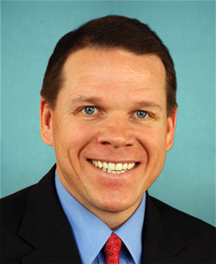
Representative Sam Graves, Republican of Missouri. Rep. Graves was the subject of an investigation by the independent, nonpartisan Office of Congressional Ethics, with regard to a Small Business Committee hearing that occurred on March 4, 2009. Rep. Graves had arranged for Brooks Hurst, a business associate of his wife's, to testify before the small business committee, of which Graves was at the time the ranking member. Mrs. Graves and Hurst had a joint interest in renewable-fuel facilities in Missouri, and Graves and Hurst also jointly owned several small aircraft and flew together. (Read the complete report of the OCE.) To some, these financial entanglements, together with Graves' rather uncooperative approach to the OCE investigation, raised questions of improper exercise by Graves of his official authority.
But there's much more to this story. The OCE was created, in part, to address widespread concerns that over decades, the House Ethics Committee had not been functioning with appropriate aggressiveness. Thus, there was tension between the OCE and the Ethics Committee, which had recently cleared Graves of any wrongdoing. Open acknowledgment by the OCE and the committee of this larger agenda — the conflict between the two bodies — had probably been insufficient in this case. This political struggle, it seems to me, could have affected the proceedings of both bodies, and could have presented at least the appearance of impropriety in itself, because it could have created a conflict of interest for both bodies as they weighed the Graves case. Photo courtesy U.S. House of Representatives.
Most of us recognize that ethical standards are more stringent than legal ones. Sometimes, though, even the ethical standard isn't tight enough — we must also avoid the appearance of impropriety. Although some find it frustrating, it's essential in complex societies.
Here's an example.
You're selecting a vendor. Familiar, Inc., has often worked with your firm, but they're expensive. New Guys, Inc., a recent entry in the market, has low prices, fresh ideas and great references. Since executives from Familiar founded New Guys, you're sure they know their stuff. For many, New Guys would be a tempting option — daring, but probably worth the risk. A reasonable choice.
Let's consider a slightly different situation. Suppose that the New Guys sales rep is your boss's sister. What's your choice now?
Without the sister factor, choosing New Guys is probably a good business decision. But if you're concerned about the appearance of impropriety, and possible accusations of nepotism, the sister factor makes New Guys an impossible choice, no matter how good they are.
Concerns about appearances can require us to forgo what otherwise would be excellent business decisions. Sometimes we must make choices that yield results inferior to other options because they could create appearances of impropriety, even when nothing improper is involved. This can be frustrating, and some are tempted to ignore appearances, especially when accounting for appearances is expensive.
Why must we be concerned with appearances? We live in societies in which we transact business with people we don't know well. Our relationships often lack the intimate familiarity of a village or small town. In effect, we've traded away that familiarity for the benefits of the complexity of our large societies.
In place of familiarity, we need something else to ensure that the people we interact with are behaving ethically. The standard of appearance provides this. When we meet the standard of avoiding even the appearance of impropriety, others can be more certain that we're behaving ethically.
But appearance is hard to define. Although some have put forward concise definitions of the appearance of impropriety, none is universally accepted. Reasonable people can disagree about whether a particular action appears improper.
To understand Although some have put forward
concise definitions of the
appearance of impropriety,
none is universally acceptedappearance, we must be willing to see things from the vantage points of others, including those who lack full knowledge of our decision processes. We must abandon our personal judgment of the appearance, and accept, however temporarily, the perspectives of others, including those with whom we disagree.
My personal approach is to take positions that I believe will be acceptable to a wide array of people, recognizing that from time to time, there will be some who are perturbed or even incensed about my choices. Sometimes I get it right, sometimes I have to backtrack, and always I am human.  Top
Top  Next Issue
Is every other day a tense, anxious, angry misery as you watch people around you, who couldn't even think their way through a game of Jacks, win at workplace politics and steal the credit and glory for just about everyone's best work including yours? Read 303 Secrets of Workplace Politics, filled with tips and techniques for succeeding in workplace politics. More info
See "It Might Be Legal, but It's Unethical," Point Lookout for August 14, 2002, for a bit more on the appearance of impropriety.
Your comments are welcome
Would you like to see your comments posted here? rbrendPtoGuFOkTSMQOzxner@ChacEgGqaylUnkmwIkkwoCanyon.comSend me your comments by email, or by Web form.About Point Lookout
 Thank you for reading this article. I hope you enjoyed it and
found it useful, and that you'll consider recommending it to a friend.
Thank you for reading this article. I hope you enjoyed it and
found it useful, and that you'll consider recommending it to a friend.
This article in its entirety was written by a human being. No machine intelligence was involved in any way.
Point Lookout is a free weekly email newsletter. Browse the archive of past issues. Subscribe for free.
Support Point Lookout by joining the Friends of Point Lookout, as an individual or as an organization.
Do you face a complex interpersonal situation? Send it in, anonymously if you like, and I'll give you my two cents.
Related articles
More articles on Ethics at Work:
 It Might Be Legal, but It's Unethical
- Now that CEOs will be held personally accountable for statements they make about their organizations,
we can all expect to be held to higher standards of professional ethics. Some professions have formal
codes of ethics, but most don't. What ethical principles guide you?
 Tornado Warning
- When organizations go astray ethically, and their misdeeds come to light, people feel shocked, as if
they've been swept up by a tornado. But ethical storms do have warning signs. Can you recognize them?
 Some Truths About Lies: II
- Knowing when someone else is lying doesn't make you a more ethical person, but it sure can be an advantage
if you want to stay out of trouble. Here's Part II of a catalog of techniques misleaders use.
 More Things I've Learned Along the Way
- Some entries from my personal collection of useful insights.
- More Things I've Learned Along the Way: IV
- When I gain an important insight, or when I learn a lesson, I write it down. Here's Part IV from my
personal collection. Example: When it comes to disputes and confusion, one person is enough.
See also Ethics at Work and Workplace Politics for more related articles.
Forthcoming issues of Point Lookout
 Coming April 24: Antipatterns for Time-Constrained Communication: 1
- Knowing how to recognize just a few patterns that can lead to miscommunication can be helpful in reducing the incidence of problems. Here is Part 1 of a collection of communication antipatterns that arise in technical communication under time pressure. Available here and by RSS on April 24.
 And on May 1: Antipatterns for Time-Constrained Communication: 2
- Recognizing just a few patterns that can lead to miscommunication can reduce the incidence of problems. Here is Part 2 of a collection of antipatterns that arise in technical communication under time pressure, emphasizing those that depend on content. Available here and by RSS on May 1.
Coaching services
I offer email and telephone coaching at both corporate and individual rates. Contact Rick for details at rbrendPtoGuFOkTSMQOzxner@ChacEgGqaylUnkmwIkkwoCanyon.com or (650) 787-6475, or toll-free in the continental US at (866) 378-5470.
Get the ebook!
Past issues of Point Lookout are available in six ebooks:
- Get 2001-2 in Geese Don't Land on Twigs (PDF, )
- Get 2003-4 in Why Dogs Wag (PDF, )
- Get 2005-6 in Loopy Things We Do (PDF, )
- Get 2007-8 in Things We Believe That Maybe Aren't So True (PDF, )
- Get 2009-10 in The Questions Not Asked (PDF, )
- Get all of the first twelve years (2001-2012) in The Collected Issues of Point Lookout (PDF, )
Are you a writer, editor or publisher on deadline? Are you looking for an article that will get people talking and get compliments flying your way? You can have 500-1000 words in your inbox in one hour. License any article from this Web site. More info
Follow Rick


Recommend this issue to a friend
Send an email message to a friend
rbrendPtoGuFOkTSMQOzxner@ChacEgGqaylUnkmwIkkwoCanyon.comSend a message to Rick
A Tip A Day feed
Point Lookout weekly feed
 My blog, Technical Debt for Policymakers, offers
resources, insights, and conversations of interest to policymakers who are concerned with managing
technical debt within their organizations. Get the millstone of technical debt off the neck of your
organization!
My blog, Technical Debt for Policymakers, offers
resources, insights, and conversations of interest to policymakers who are concerned with managing
technical debt within their organizations. Get the millstone of technical debt off the neck of your
organization! Bad boss, long commute, troubling ethical questions, hateful colleague? Learn what we can do when we
love the work but not the job.Learn how to make your virtual global team sing.Are you managing a change effort that faces rampant cynicism, passive non-cooperation, or
maybe even outright revolt?Learn how to make meetings more productive — and more rare.
Bad boss, long commute, troubling ethical questions, hateful colleague? Learn what we can do when we
love the work but not the job.Learn how to make your virtual global team sing.Are you managing a change effort that faces rampant cynicism, passive non-cooperation, or
maybe even outright revolt?Learn how to make meetings more productive — and more rare.