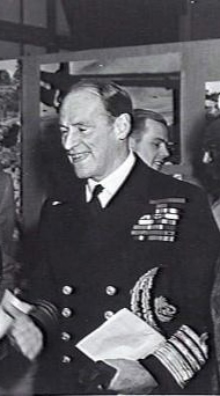
Admiral Edward Ratcliffe Garth Russell Evans, 1st Baron Mountevans of Chelsea. Earlier in his career, he was second in command of the British Antarctic Expedition 1910 (also known as the Terra Nova expedition). He was in command of the Terra Nova from Cardiff to Capetown, where the expedition leader, Capt. Robert F. Scott, caught up with the Terra Nova by fast mail boat. The plan had been for then Lt. Evans to be in command until the ship reached Melbourne, where Capt. Scott would be waiting and then assume command. But having caught up with the Terra Nova early, in Capetown, Capt. Scott assumed command there, thus infringing — or rescinding without cause — previously delegated authority. Lt. Evans hid his feelings, but he nevertheless took this change of plan as a slur, and thus the tension between the two leaders began to take hold and bloom into a serious problem of leadership. For more, see Roland Huntford's history, The Last Place on Earth. Photo obtained from Wikipedia.

Delegating is the investing of responsibility and authority from you to your subordinates. It creates reserves for you and gives your subordinates a chance to grow. Too often, though, troubles arise because we don't have a clear understanding of how to delegate effectively. Here are some guidelines you might find helpful.
- You can't delegate your own accountability
- Even though you might have delegated something, you remain accountable for it. Your subordinate is accountable to you, but you are still accountable for whatever you delegated.
- Be prepared to rescind
- Sometimes, things don't work out. You might have delegated inappropriately, or your subordinate might fail for some reason. Since you always retain the responsibility to revisit your decision, be prepared to do so, but never rescind without cause.
- Your subordinate has final say
- Even if you believe that your delegation decisions were correct, your subordinates control their own levels of passion and commitment. They might agree to accept what you delegate, but unless they're truly committed, delegation can create trouble.
- Keep your promises
- When what you delegate is unappealing, there's a temptation to promise something in exchange. If you do promise something, keep that promise. If you can't keep the promise, don't make the promise.
- The greater the risk, the more important is delegation
- In risky situations, emergencies can occur, because when things go wrong, they sometimes go wrong in herds. To create reserves to manage these emergencies, delegate.
- Delegate fully
- When you delegate something, delegate it fully. You remain accountable for it, but it's no longer yours. Get out of the way.
- Delegate authority, not just work
- Delegating the work of a task, and not the authority to determine the manner of accomplishing it, can be demoralizing for the subordinate. This is particularly true of tasks requiring creativity, insight, or commitment.
- Never infringe delegated authority
- Infringing delegated You can't delegate
your own accountabilityauthority is demoralizing and creates problems for future delegation. If you feel the need to infringe, but you don't see a need to rescind the delegation, you're probably over the line. - Have an inform-as-soon-as-you-know norm
- Make an agreement that each of you will inform the other as soon as you learn anything that changes the risk profile of whatever you delegated. Your subordinate agrees to alert you when trouble looms, and you agree to tell your subordinate about any enhanced risks. It's a trusting partnership.
- Establish checkpoint expectations
- Since you remain accountable for whatever you delegated, you have a right to reasonable monitoring of progress. Work out with your subordinate a mutually acceptable set of checkpoints, and stick to them, asking for status reporting neither more frequently nor less frequently than you agreed.
Most important is clear, two-way communication between you and your subordinate. Mutual understanding of your mutual agreement is essential to a successful delegation experience. OK, now. You can take it from here.  Top
Top  Next Issue
Is every other day a tense, anxious, angry misery as you watch people around you, who couldn't even think their way through a game of Jacks, win at workplace politics and steal the credit and glory for just about everyone's best work including yours? Read 303 Secrets of Workplace Politics, filled with tips and techniques for succeeding in workplace politics. More info
Your comments are welcome
Would you like to see your comments posted here? rbrendPtoGuFOkTSMQOzxner@ChacEgGqaylUnkmwIkkwoCanyon.comSend me your comments by email, or by Web form.About Point Lookout
 Thank you for reading this article. I hope you enjoyed it and
found it useful, and that you'll consider recommending it to a friend.
Thank you for reading this article. I hope you enjoyed it and
found it useful, and that you'll consider recommending it to a friend.
This article in its entirety was written by a human being. No machine intelligence was involved in any way.
Point Lookout is a free weekly email newsletter. Browse the archive of past issues. Subscribe for free.
Support Point Lookout by joining the Friends of Point Lookout, as an individual or as an organization.
Do you face a complex interpersonal situation? Send it in, anonymously if you like, and I'll give you my two cents.
Related articles
More articles on Workplace Politics:
 Managing Risk Revision
- Prudent risk management begins by accepting the possibility that unpleasant events might actually happen.
But when organizations try to achieve goals that are a bit out of reach, they're often tempted to stretch
resources by revising or denying risks. Here's a tactic for managing risk revision.
 Political Framing: Communications
- In organizational politics, one class of toxic tactics is framing — accusing a group or individual
by offering interpretations of their actions to knowingly and falsely make them seem responsible for
reprehensible or negligent acts. Here are some communications tactics framers use.
 Social Entry Strategies: I
- Much more than work happens in the workplace. We also engage in social behaviors, including one sometimes
called social entry. We use social entry strategies to make places for ourselves in social groups at work.
 Career Opportunity or Career Trap: I
- When we're presented with an opportunity that seems too good to be true, as the saying goes, it probably
is. Although it's easy to decline free vacations, declining career opportunities is another matter.
Here's a look at indicators that a career opportunity might be a career trap.
 More Things I've Learned Along the Way: VI
- When I gain an important insight, or when I learn a lesson, I make a note. Example: If you're interested
in changing how a social construct operates, knowing how it came to be the way it is can be much less
useful than knowing what keeps it the way it is.
See also Workplace Politics and Personal, Team, and Organizational Effectiveness for more related articles.
Forthcoming issues of Point Lookout
 Coming May 1: Antipatterns for Time-Constrained Communication: 2
- Recognizing just a few patterns that can lead to miscommunication can reduce the incidence of miscommunications. Here's Part 2 of a collection of antipatterns that arise in communication under time pressure, emphasizing those that depend on content. Available here and by RSS on May 1.
- And on May 8: Antipatterns for Time-Constrained Communication: 3
- Recognizing just a few patterns that can lead to miscommunication can reduce the incidence of problems. Here is Part 3 of a collection of antipatterns that arise in technical communication under time pressure, emphasizing past experiences of participants. Available here and by RSS on May 8.
Coaching services
I offer email and telephone coaching at both corporate and individual rates. Contact Rick for details at rbrendPtoGuFOkTSMQOzxner@ChacEgGqaylUnkmwIkkwoCanyon.com or (650) 787-6475, or toll-free in the continental US at (866) 378-5470.
Get the ebook!
Past issues of Point Lookout are available in six ebooks:
- Get 2001-2 in Geese Don't Land on Twigs (PDF, )
- Get 2003-4 in Why Dogs Wag (PDF, )
- Get 2005-6 in Loopy Things We Do (PDF, )
- Get 2007-8 in Things We Believe That Maybe Aren't So True (PDF, )
- Get 2009-10 in The Questions Not Asked (PDF, )
- Get all of the first twelve years (2001-2012) in The Collected Issues of Point Lookout (PDF, )
Are you a writer, editor or publisher on deadline? Are you looking for an article that will get people talking and get compliments flying your way? You can have 500-1000 words in your inbox in one hour. License any article from this Web site. More info
Follow Rick


Recommend this issue to a friend
Send an email message to a friend
rbrendPtoGuFOkTSMQOzxner@ChacEgGqaylUnkmwIkkwoCanyon.comSend a message to Rick
A Tip A Day feed
Point Lookout weekly feed
 The message of Point Lookout is unique. Help get the message out. Please donate to help keep Point Lookout available for free to everyone.
 My blog, Technical Debt for Policymakers, offers
resources, insights, and conversations of interest to policymakers who are concerned with managing
technical debt within their organizations. Get the millstone of technical debt off the neck of your
organization!
My blog, Technical Debt for Policymakers, offers
resources, insights, and conversations of interest to policymakers who are concerned with managing
technical debt within their organizations. Get the millstone of technical debt off the neck of your
organization!Beware any resource that speaks of "winning" at workplace politics or "defeating" it. You can benefit or not, but there is no score-keeping, and it isn't a game.
- Wikipedia has a nice article with a list of additional resources
- Some public libraries offer collections. Here's an example from Saskatoon.
- Check my own links collection
- LinkedIn's Office Politics discussion group
 Is every other day a tense, anxious, angry misery as you watch people around you, who couldn't even
think their way through a game of Jacks, win at workplace politics and steal the credit and glory
for just about everyone's best work including yours? Read 303 Secrets of Workplace Politics!Learn how to make your virtual global team sing.A Tip a Day arrives by email, or by RSS Feed, each business day. It's 20 to 30 words at most, and gives
you a new perspective on the hassles and rewards of work life. Most tips also contain links to
related articles. Free!Learn how to make meetings more productive — and more rare.
Is every other day a tense, anxious, angry misery as you watch people around you, who couldn't even
think their way through a game of Jacks, win at workplace politics and steal the credit and glory
for just about everyone's best work including yours? Read 303 Secrets of Workplace Politics!Learn how to make your virtual global team sing.A Tip a Day arrives by email, or by RSS Feed, each business day. It's 20 to 30 words at most, and gives
you a new perspective on the hassles and rewards of work life. Most tips also contain links to
related articles. Free!Learn how to make meetings more productive — and more rare.