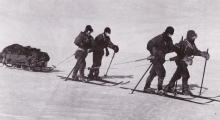
Captain Robert F. Scott and most of his team returning from the South Pole. The photo was taken by Lt. Henry R. "Birdie" Bowers, Royal Indian Marine Service. On the way South, Bowers had been a member of the sledge team of Lt. Evans, whose team was the last to return before the assault on the Pole. Scott had ordered Evans's team to depot their skis a few days before they parted, probably as a result of competition between Evans and Scott. At the last moment, Scott ordered Bowers to accompany the Pole team, making a complement of five, instead of four that had been planned. This factor is often cited as a decision — it was an improvisation, actually — that contributed to the fate of the expedition (all five men died). But the nature of the improvisation might not have been what it seemed. Since Bowers was a navigator, and the expedition needed a navigator in the Pole party, the selection of Bowers was perhaps inevitable. But others in the party were less essential. For instance, one man was selected, in all probability, to represent enlisted men, and another to represent the Army. Thus, Scott's decision had many of the elements of an improvisation driven by factors unrelated to project content. If it had been driven by project content, he could easily have substituted Bowers for someone else.
The improvisational nature of the decision is evidenced by this photo. It shows four men on ski. The photographer, Bowers, was probably on foot at this point, because of Scott's earlier decision to have the last support team depot their ski. The combination of four skiers and one man on foot almost certainly contributed to the fate of the five men.
Photo courtesy National Library of New Zealand
We've already examined the fundamentals of improvisation, and improvisation as a group process. We now examine its impact on risk management. Because improvisation will almost certainly be necessary in most projects, we ought to anticipate it by allocating budget, schedule, and management time to address improvisations. Here are some suggestions for adjusting risk plans once improvisation becomes necessary.
- Directed improvisation is risky
- Sometimes decision makers demand improvisation. Directed improvisation entails unique risks, because the director might not be very familiar with the project, its technology, or its staff. When improvisation is directed, defer as much as possible, until the consequences of the directed improvisation become clear.
- Improvising without content-related cause is risky
- Some improvising happens even when the project plan seems to be working well. On these occasions, the drivers of the decision to improvise are unrelated to the project work itself, and often are related to the use of the deliverables. For instance, the decision maker might seek delivery during a fiscal window earlier than planned. The more sudden the decision is, the riskier it is.
- The need to improvise could be a signal
- Even though projects are inherently difficult to plan, a real need to improvise can result from a poor plan — or no plan. If a truly thoughtful plan does exist, the need to improvise signals nothing more than the inherent difficulties of project management. But if the project plan was developed in haste, perhaps by cloning plans for supposedly similar work, further trouble probably lies ahead.
- Improvisations can create timing risks
- If improvisation is necessary, the project schedule is probably changed or even disrupted. Usually, task schedules slip to later dates. Examine the new schedule to determine whether necessary resources are still available. This is especially tricky when resources are shared with other projects.
- Improvisations tend to transfer risk
- Any work undertaken during improvisation could potentially require resources that were allocated to something else, including other projects. The effects of improvisation can therefore The effects of improvisation
can ripple widely
through the organizationripple widely through the organization. Improvisations in one project kick off improvisations elsewhere, which can sometimes export risk as well. Be alert to improvisations wherever they occur, and address them in your risk plan. - Improvisations enhance creativity risk
- Improvisation requires — and stimulates — creativity. In the project context, a successful improvisation can bring to light new approaches to work already completed, planned, or underway. Sometimes this new thinking is helpful or even necessary, and should be applied. And sometimes it isn't really essential. Apply new ideas where necessary, and manage creativity risk — the temptation to use good ideas to improve what is already good enough.
Whatever the reason for improvisation, an often-neglected set of consequences lies hidden in the project's risk plan. Record carefully the improvised actions undertaken, and when normal activity resumes, immediately revisit the risk plan. If you don't, you might be improvising again before you know it. First in this series  Top
Top  Next Issue
Projects never go quite as planned. We expect that, but we don't expect disaster. How can we get better at spotting disaster when there's still time to prevent it? How to Spot a Troubled Project Before the Trouble Starts is filled with tips for executives, senior managers, managers of project managers, and sponsors of projects in project-oriented organizations. It helps readers learn the subtle cues that indicate that a project is at risk for wreckage in time to do something about it. It's an ebook, but it's about 15% larger than "Who Moved My Cheese?" Just . Order Now! .
Your comments are welcome
Would you like to see your comments posted here? rbrendPtoGuFOkTSMQOzxner@ChacEgGqaylUnkmwIkkwoCanyon.comSend me your comments by email, or by Web form.About Point Lookout
 Thank you for reading this article. I hope you enjoyed it and
found it useful, and that you'll consider recommending it to a friend.
Thank you for reading this article. I hope you enjoyed it and
found it useful, and that you'll consider recommending it to a friend.
This article in its entirety was written by a human being. No machine intelligence was involved in any way.
Point Lookout is a free weekly email newsletter. Browse the archive of past issues. Subscribe for free.
Support Point Lookout by joining the Friends of Point Lookout, as an individual or as an organization.
Do you face a complex interpersonal situation? Send it in, anonymously if you like, and I'll give you my two cents.
Related articles
More articles on Project Management:
 The Cheapest Way to Run a Project Is with Enough Resources
- Cost reduction is so common that nearly every project plan today should include budget and schedule
for several rounds of reductions. Whenever we cut costs, we risk cutting too much, so it pays to ask,
"If we do cut too much, what are the consequences?"
 Dubious Dealings
- Negotiating contracts with outsourcing suppliers can present ethical dilemmas, even when we try to be
as fair as possible. The negotiation itself can present conflicts of interest. What are those conflicts?
 Remote Facilitation in Synchronous Contexts: I
- Whoever facilitates your distributed meetings — whether a dedicated facilitator or the meeting
chair — will discover quickly that remote facilitation presents special problems. Here's a little
catalog of those problems, and some suggestions for addressing them.
 On the Risk of Undetected Issues: I
- In complex projects, things might have gone wrong long before we notice them. Noticing them as early
as possible — and addressing them — is almost always advantageous. How can we reduce the
incidence of undetected issues?
 Planning Disappointments
- When we plan projects, we make estimates of total costs and expected delivery dates. Often these estimates
are so wrong — in the wrong direction — that we might as well be planning disappointments.
Why is this?
See also Project Management and Problem Solving and Creativity for more related articles.
Forthcoming issues of Point Lookout
 Coming April 24: Antipatterns for Time-Constrained Communication: 1
- Knowing how to recognize just a few patterns that can lead to miscommunication can be helpful in reducing the incidence of problems. Here is Part 1 of a collection of communication antipatterns that arise in technical communication under time pressure. Available here and by RSS on April 24.
 And on May 1: Antipatterns for Time-Constrained Communication: 2
- Recognizing just a few patterns that can lead to miscommunication can reduce the incidence of problems. Here is Part 2 of a collection of antipatterns that arise in technical communication under time pressure, emphasizing those that depend on content. Available here and by RSS on May 1.
Coaching services
I offer email and telephone coaching at both corporate and individual rates. Contact Rick for details at rbrendPtoGuFOkTSMQOzxner@ChacEgGqaylUnkmwIkkwoCanyon.com or (650) 787-6475, or toll-free in the continental US at (866) 378-5470.
Get the ebook!
Past issues of Point Lookout are available in six ebooks:
- Get 2001-2 in Geese Don't Land on Twigs (PDF, )
- Get 2003-4 in Why Dogs Wag (PDF, )
- Get 2005-6 in Loopy Things We Do (PDF, )
- Get 2007-8 in Things We Believe That Maybe Aren't So True (PDF, )
- Get 2009-10 in The Questions Not Asked (PDF, )
- Get all of the first twelve years (2001-2012) in The Collected Issues of Point Lookout (PDF, )
Are you a writer, editor or publisher on deadline? Are you looking for an article that will get people talking and get compliments flying your way? You can have 500-1000 words in your inbox in one hour. License any article from this Web site. More info
Follow Rick


Recommend this issue to a friend
Send an email message to a friend
rbrendPtoGuFOkTSMQOzxner@ChacEgGqaylUnkmwIkkwoCanyon.comSend a message to Rick
A Tip A Day feed
Point Lookout weekly feed
 My blog, Technical Debt for Policymakers, offers
resources, insights, and conversations of interest to policymakers who are concerned with managing
technical debt within their organizations. Get the millstone of technical debt off the neck of your
organization!
My blog, Technical Debt for Policymakers, offers
resources, insights, and conversations of interest to policymakers who are concerned with managing
technical debt within their organizations. Get the millstone of technical debt off the neck of your
organization! Bad boss, long commute, troubling ethical questions, hateful colleague? Learn what we can do when we
love the work but not the job.Learn how to make your virtual global team sing.Are you managing a change effort that faces rampant cynicism, passive non-cooperation, or
maybe even outright revolt?Learn how to make meetings more productive — and more rare.
Bad boss, long commute, troubling ethical questions, hateful colleague? Learn what we can do when we
love the work but not the job.Learn how to make your virtual global team sing.Are you managing a change effort that faces rampant cynicism, passive non-cooperation, or
maybe even outright revolt?Learn how to make meetings more productive — and more rare.