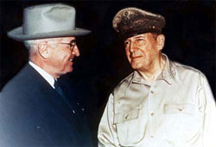
President Harry S. Truman, and Gen. Douglas MacArthur, meeting at Wake Island, 14 October 1950. Six months later, in what was at the time an extremely controversial decision, Truman would replace MacArthur, because of MacArthur's public statements questioning Truman's policies vis-à-vis the Korean War. In an address to the nation, Truman explained his policies, and announced the replacement of Gen. MacArthur with Gen. Ridgway. In his announcement, he praised Gen. MacArthur's work and record, and expressed deep regret about the need for a change.
This speech provides an excellent illustration of Truman's scrupulous avoidance of the tactic of political praise described here. The President could have approached this situation differently. He could have used the tactic to both advance his policy agenda and replace Gen. MacArthur. But he chose instead to defend and explain his policy to the American people, and to praise Gen. MacArthur independently of that policy. Political praise of the general might have been more advantageous to the President, but it would certainly have been an unaccustomed departure from the President's straightforward, the-buck-stops-here approach to everything he did. Read the full text of the President's address. Photo courtesy the Truman Library.
When someone praises you publicly, instead of objectively reporting your praiseworthy deeds, the praise sometimes characterizes them in a particularly self-serving way. If you don't object to the characterization right then and there, you might seem to approve the characterization. If you do object, you risk appearing ungrateful. For the one praised, political praise can be lose-lose.
For example, suppose you had been ordered by your supervisor to cancel a project that you championed, and which you truly believe is essential to organizational success. You argued passionately against cancellation, but you failed. Your supervisor then required you to "explain the cancellation as being in the organization's best long-term interests." Several months later, in a meeting with you, your boss, his peers, and his supervisor, he praises you for your "courageous and selfless" decision to terminate the project voluntarily. You're disgusted by the misrepresentation, but what can you do?
When political praise happens once or rarely, it could be a mistake. But if the praiser has a pattern of doing this, it might be an act of intention. As such, it's unethical, because it's based on a deprivation of personal freedom.
Here's how it works: The praiser counts on the praisee's unwillingness to dispute the characterization, because of the praisee's desire to receive the benefits of the praise, or to avoid appearing petty or insubordinate. Thus, in exchange for meting out some (often grudging) praise, the praiser has an unchallenged opportunity to characterize the deed or decision so as to fit the praiser's agenda, which might be counter to the praisee's agenda. In effect, by praising someone magnanimously, the praiser advances the praiser's agenda.
What can you do?
- As the praisee
- Not much. Most praisee responses intended to dispute the characterization portion of political praise will seem petty and vindictive. The cost of trying to put things right usually exceeds the benefits by a substantial amount.
- As a bystander
- Bystanders have many more options. The more neutral the bystander's position seems relative to the dispute at hand, the more powerful will be any stated objections. Supervisors of political praisers
can deal with political praise
as a performance issueBy disputing any unfair characterization, while affirming the generously offered praise, the bystander will seem — and will actually be — fair and objective. The bystander thus elevates the ethical standard for the organization, and reduces the benefits of political praise. - As a supervisor of a political praiser
- Supervisors of political praisers can deal with political praise as a performance issue. Require the praiser to apologize privately to the praisee, and to make a public statement correcting any unfair characterizations. Require advance approval of both the apology and the correcting statement, and let the praiser know that future incidents will be dealt with more severely.
At your next opportunity to praise someone, think carefully about how you phrase it. If you were the praisee, how would it feel?  Top
Top  Next Issue
Is every other day a tense, anxious, angry misery as you watch people around you, who couldn't even think their way through a game of Jacks, win at workplace politics and steal the credit and glory for just about everyone's best work including yours? Read 303 Secrets of Workplace Politics, filled with tips and techniques for succeeding in workplace politics. More info
For more about scope creep, see "Ground Level Sources of Scope Creep," Point Lookout for July 18, 2012; "More Indicators of Scopemonging," Point Lookout for August 29, 2007; "Scopemonging: When Scope Creep Is Intentional," Point Lookout for August 22, 2007; "Some Causes of Scope Creep," Point Lookout for September 4, 2002; "The Deck Chairs of the Titanic: Strategy," Point Lookout for June 29, 2011; and "The Deck Chairs of the Titanic: Task Duration," Point Lookout for June 22, 2011.
Your comments are welcome
Would you like to see your comments posted here? rbrendPtoGuFOkTSMQOzxner@ChacEgGqaylUnkmwIkkwoCanyon.comSend me your comments by email, or by Web form.About Point Lookout
 Thank you for reading this article. I hope you enjoyed it and
found it useful, and that you'll consider recommending it to a friend.
Thank you for reading this article. I hope you enjoyed it and
found it useful, and that you'll consider recommending it to a friend.
This article in its entirety was written by a human being. No machine intelligence was involved in any way.
Point Lookout is a free weekly email newsletter. Browse the archive of past issues. Subscribe for free.
Support Point Lookout by joining the Friends of Point Lookout, as an individual or as an organization.
Do you face a complex interpersonal situation? Send it in, anonymously if you like, and I'll give you my two cents.
Related articles
More articles on Workplace Politics:
 Devious Political Tactics: The Three-Legged Race
- The Three-Legged Race is a tactic that some managers use to avoid giving one person new authority. Some
of the more cynical among us use it to sabotage projects or even careers. How can you survive a three-legged
race?
 The Power and Hazards of Anecdotes: II
- Anecdotes are powerful tools of persuasion, but with that power comes a risk that we might become persuaded
of false positions. Here is Part II of a set of examples illustrating some hazards of anecdotes.
 Stone-Throwers at Meetings: I
- One class of disruptions in meetings includes the tactics of stone-throwers — people who exploit
low-cost tactics to disrupt the meeting and distract all participants so as to obstruct progress. How
do they do it, and what can the meeting chair do?
 Availability and Self-Assessments
- In many organizations, employees develop self-assessments as a part of the performance review process.
Because of a little-known effect related to the Availability Heuristic, these self-assessments can be
biased against the employee.
 Facts, Opinions, Estimates, and Desires
- One reason why resource allocation debates can become so difficult is confusion about the differences
among facts, opinions, estimates, and desires. Clarifying their differences can reduce the length and
intensity of resource allocation debates.
See also Workplace Politics and Conflict Management for more related articles.
Forthcoming issues of Point Lookout
 Coming April 24: Antipatterns for Time-Constrained Communication: 1
- Knowing how to recognize just a few patterns that can lead to miscommunication can be helpful in reducing the incidence of problems. Here is Part 1 of a collection of communication antipatterns that arise in technical communication under time pressure. Available here and by RSS on April 24.
 And on May 1: Antipatterns for Time-Constrained Communication: 2
- Recognizing just a few patterns that can lead to miscommunication can reduce the incidence of problems. Here is Part 2 of a collection of antipatterns that arise in technical communication under time pressure, emphasizing those that depend on content. Available here and by RSS on May 1.
Coaching services
I offer email and telephone coaching at both corporate and individual rates. Contact Rick for details at rbrendPtoGuFOkTSMQOzxner@ChacEgGqaylUnkmwIkkwoCanyon.com or (650) 787-6475, or toll-free in the continental US at (866) 378-5470.
Get the ebook!
Past issues of Point Lookout are available in six ebooks:
- Get 2001-2 in Geese Don't Land on Twigs (PDF, )
- Get 2003-4 in Why Dogs Wag (PDF, )
- Get 2005-6 in Loopy Things We Do (PDF, )
- Get 2007-8 in Things We Believe That Maybe Aren't So True (PDF, )
- Get 2009-10 in The Questions Not Asked (PDF, )
- Get all of the first twelve years (2001-2012) in The Collected Issues of Point Lookout (PDF, )
Are you a writer, editor or publisher on deadline? Are you looking for an article that will get people talking and get compliments flying your way? You can have 500-1000 words in your inbox in one hour. License any article from this Web site. More info
Follow Rick


Recommend this issue to a friend
Send an email message to a friend
rbrendPtoGuFOkTSMQOzxner@ChacEgGqaylUnkmwIkkwoCanyon.comSend a message to Rick
A Tip A Day feed
Point Lookout weekly feed
 The message of Point Lookout is unique. Help get the message out. Please donate to help keep Point Lookout available for free to everyone.
 My blog, Technical Debt for Policymakers, offers
resources, insights, and conversations of interest to policymakers who are concerned with managing
technical debt within their organizations. Get the millstone of technical debt off the neck of your
organization!
My blog, Technical Debt for Policymakers, offers
resources, insights, and conversations of interest to policymakers who are concerned with managing
technical debt within their organizations. Get the millstone of technical debt off the neck of your
organization!Beware any resource that speaks of "winning" at workplace politics or "defeating" it. You can benefit or not, but there is no score-keeping, and it isn't a game.
- Wikipedia has a nice article with a list of additional resources
- Some public libraries offer collections. Here's an example from Saskatoon.
- Check my own links collection
- LinkedIn's Office Politics discussion group
 Is every other day a tense, anxious, angry misery as you watch people around you, who couldn't even
think their way through a game of Jacks, win at workplace politics and steal the credit and glory
for just about everyone's best work including yours? Read 303 Secrets of Workplace Politics!Learn how to make your virtual global team sing.A Tip a Day arrives by email, or by RSS Feed, each business day. It's 20 to 30 words at most, and gives
you a new perspective on the hassles and rewards of work life. Most tips also contain links to
related articles. Free!Learn how to make meetings more productive — and more rare.
Is every other day a tense, anxious, angry misery as you watch people around you, who couldn't even
think their way through a game of Jacks, win at workplace politics and steal the credit and glory
for just about everyone's best work including yours? Read 303 Secrets of Workplace Politics!Learn how to make your virtual global team sing.A Tip a Day arrives by email, or by RSS Feed, each business day. It's 20 to 30 words at most, and gives
you a new perspective on the hassles and rewards of work life. Most tips also contain links to
related articles. Free!Learn how to make meetings more productive — and more rare.