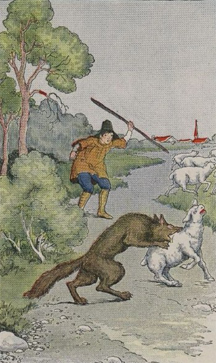
The Boy Who Cried Wolf, illustrated by Milo Winter in a 1919 Aesop anthology. This fable, attributed to Aesop, tells the story of a shepherd boy who repeatedly — and falsely — alerted villagers that a wolf was attacking his flock. He did this as an entertainment. Finally, when a wolf actually did attack his flock, the villagers didn't believe him. He had lost all credibility. In this case, the loss of credibility was due not to any of the behavioral factors described here, but to deliberate disinformation. Disinformation does occur in organizations, but it is much less common than the other factors, and it falls outside the realm of factors that degrade credibility without your actually being wrong. Other similar factors include deceits of various types, baseless accusations, ethical transgressions, and associations with others similarly inclined. Photo courtesy Project Gutenberg.
Whether you want to advance your career, or just keep your job, credibility matters. It's a basis for trust. It determines what assignments come your way. And when things go wrong, credibility can protect you from accusations, real or false.
If you have credibility, it's easy to forget that you do. But after you've lost credibility, you notice its absence almost everywhere you turn.
Sometimes it's easy to understand why you lost credibility. Mistakes, for example, can do it. One or two spectacularly avoidable blunders can pretty much finish you off. But a string of less-than-spectacular errors can erode credibility too, if there are so many of them that they become predictable.
More interesting are the behaviors that erode credibility without your actually being wrong about anything. Here are some attitudes we project that erode credibility.
- Desperation
- Sometimes being believed — about almost anything — becomes so important to us that anxiety and desperation become evident. This can arouse suspicions that being believed is more important than being right. Others believe that we might even lie to ourselves and thus become incapable of knowing the truth.
- Arrogance
- Nobody likes — or more to the point — nobody believes a know-it-all. People generally have difficulty accepting that someone can know it all, perhaps because it reflects on their own limitations. But even if we actually do know it all, others can become determined to demonstrate that there are limits to any one person's knowledge. They can do that through disbelief.
- Nonchalance
- An attitude of disrespect for truth projects a disregard for the difference between truth and fiction. Nonchalance about being mistaken can give others cause to doubt that we care about the truth of what we say.
- Uncertainty
- Uncertainty and confidence are linked to credibility in a paradoxical way. The more uncertain we are, the less credible we are. The more confident, the more credible. This seems only sensible. But paradoxically, the more competent we are, the less confident we seem. The less competent we are, the more confident we seem. Read more about this in "The Paradox of Confidence," Point Lookout for January 7, 2009.
- Ulterior motives
- When others Sometimes being believed
— about almost anything —
becomes so important to us
that anxiety and desperation
become evidentbelieve we have motives other than surfacing Truth, they tend to question our claims even when those claims are true. For example, if we have contempt for some of the people involved in the topic at hand, or if others suspect that we wish them to fail, our questions, skepticism, and words of warning will likely be ineffective, or even anti-effective.
If you think that any of these factors might be limiting your credibility, talking about them with others might help, but it could enhance the risk of appearing desperate, as described above. You have little or no control over what other people believe. Instead, focus on eliminating them from your own behavior. Be the best You that you can be.  Top
Top  Next Issue
Is every other day a tense, anxious, angry misery as you watch people around you, who couldn't even think their way through a game of Jacks, win at workplace politics and steal the credit and glory for just about everyone's best work including yours? Read 303 Secrets of Workplace Politics, filled with tips and techniques for succeeding in workplace politics. More info
Your comments are welcome
Would you like to see your comments posted here? rbrendPtoGuFOkTSMQOzxner@ChacEgGqaylUnkmwIkkwoCanyon.comSend me your comments by email, or by Web form.About Point Lookout
 Thank you for reading this article. I hope you enjoyed it and
found it useful, and that you'll consider recommending it to a friend.
Thank you for reading this article. I hope you enjoyed it and
found it useful, and that you'll consider recommending it to a friend.
This article in its entirety was written by a human being. No machine intelligence was involved in any way.
Point Lookout is a free weekly email newsletter. Browse the archive of past issues. Subscribe for free.
Support Point Lookout by joining the Friends of Point Lookout, as an individual or as an organization.
Do you face a complex interpersonal situation? Send it in, anonymously if you like, and I'll give you my two cents.
Related articles
More articles on Personal, Team, and Organizational Effectiveness:
 Twenty-Three Thoughts
- Sometimes we get so focused on the immediate problem that we lose sight of the larger questions. Here
are twenty-three thoughts to help you focus on what really counts.
 Wacky Words of Wisdom: IV
- Words of wisdom are pithy sayings that can be valuable so often that we believe them absolutely. Although
these sayings are often valuable, they aren't universally valid. Here's Part IV of a growing collection.
 Paradoxical Policies: II
- Because projects are inherently unique, constructing general organizational policies affecting projects
is difficult. The urge to treat projects as if they were operations compounds the difficulty. Here's
a collection of policies for projects that would be funny if they weren't real.
 Virtual Interviews: II
- The pandemic has made face-to-face job interviews less important. And so we must now also master virtual
interviews, and that requires understanding the effects of the attendance list, video presence, and
the technologies of staging, lighting, and makeup.
 Anticipating Absence: Quarantine and Isolation
- When the pandemic compels some knowledge workers to quarantine or isolate, we tend to treat them as
if they were totally unavailable. But if they're willing and able to work, even part-time, they might
be able to continue to contribute. To make this happen, work out conditions in advance.
See also Personal, Team, and Organizational Effectiveness and Workplace Politics for more related articles.
Forthcoming issues of Point Lookout
 Coming April 24: Antipatterns for Time-Constrained Communication: 1
- Knowing how to recognize just a few patterns that can lead to miscommunication can be helpful in reducing the incidence of problems. Here is Part 1 of a collection of communication antipatterns that arise in technical communication under time pressure. Available here and by RSS on April 24.
 And on May 1: Antipatterns for Time-Constrained Communication: 2
- Recognizing just a few patterns that can lead to miscommunication can reduce the incidence of problems. Here is Part 2 of a collection of antipatterns that arise in technical communication under time pressure, emphasizing those that depend on content. Available here and by RSS on May 1.
Coaching services
I offer email and telephone coaching at both corporate and individual rates. Contact Rick for details at rbrendPtoGuFOkTSMQOzxner@ChacEgGqaylUnkmwIkkwoCanyon.com or (650) 787-6475, or toll-free in the continental US at (866) 378-5470.
Get the ebook!
Past issues of Point Lookout are available in six ebooks:
- Get 2001-2 in Geese Don't Land on Twigs (PDF, )
- Get 2003-4 in Why Dogs Wag (PDF, )
- Get 2005-6 in Loopy Things We Do (PDF, )
- Get 2007-8 in Things We Believe That Maybe Aren't So True (PDF, )
- Get 2009-10 in The Questions Not Asked (PDF, )
- Get all of the first twelve years (2001-2012) in The Collected Issues of Point Lookout (PDF, )
Are you a writer, editor or publisher on deadline? Are you looking for an article that will get people talking and get compliments flying your way? You can have 500-1000 words in your inbox in one hour. License any article from this Web site. More info
Follow Rick


Recommend this issue to a friend
Send an email message to a friend
rbrendPtoGuFOkTSMQOzxner@ChacEgGqaylUnkmwIkkwoCanyon.comSend a message to Rick
A Tip A Day feed
Point Lookout weekly feed
 My blog, Technical Debt for Policymakers, offers
resources, insights, and conversations of interest to policymakers who are concerned with managing
technical debt within their organizations. Get the millstone of technical debt off the neck of your
organization!
My blog, Technical Debt for Policymakers, offers
resources, insights, and conversations of interest to policymakers who are concerned with managing
technical debt within their organizations. Get the millstone of technical debt off the neck of your
organization! Bad boss, long commute, troubling ethical questions, hateful colleague? Learn what we can do when we
love the work but not the job.Learn how to make your virtual global team sing.Are you managing a change effort that faces rampant cynicism, passive non-cooperation, or
maybe even outright revolt?Learn how to make meetings more productive — and more rare.
Bad boss, long commute, troubling ethical questions, hateful colleague? Learn what we can do when we
love the work but not the job.Learn how to make your virtual global team sing.Are you managing a change effort that faces rampant cynicism, passive non-cooperation, or
maybe even outright revolt?Learn how to make meetings more productive — and more rare.