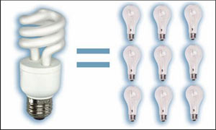
A comparison of energy consumption of compact fluorescent (CFL) bulbs with incandescent bulbs. The ratio is about 9:1 when used identically. Even taking into account the possibility that higher efficiency leads to more profligate use, CFLs are an effective way to reduce energy consumption. Despite the obvious social benefits, it has been politically difficult in the U.S. to outlaw the use of incandescents, even in new installations. Advocates of CFLs would be unwise to view this as anything other than the results of attachment to the status quo, especially by the energy industry, which would suffer some short-term demand constriction if CFL adoption were accelerated. Nevertheless, some CFL advocates do view opposition to mandated adoption as evidence for an energy conspiracy. Similarly, some of those who benefit from elevated energy consumption view CFL advocates as either engaged in a conspiracy against them, or perhaps as unwitting dupes of clever conspirators, who are trying to disrupt the energy industry in the name of energy conservation. Photo courtesy Maryland Department of Natural Resources.
Last time we began exploring why people who don't report to you sometimes decline to cooperate in efforts for which you're legitimately responsible. Our goal is control of our emotions by finding alternative interpretations of uncooperative behavior — alternatives to "He hates me," or other simplistic conjectures. We began with the personal motivations of obstructers.
Let's now examine organizational concerns that might lead to uncooperative behavior. As I did last time, I use C as the name of the person who's championing the effort, and S for the person who's subverting it.
- Objecting to the goal
- Sometimes the subversion is actually objection to the overall goal. To someone who has been frustrated in modifying that goal, or eliminating it from the organizational agenda, being required to contribute to its achievement can be very bitter indeed. Simple noncompliance becomes a tempting tactic.
- If S had previously expressed doubts about the goal, or had issued grave warnings against attempting it, failure might elevate S's status. In such cases, subversive activity isn't so much an attempt to target C as it is an effort to elevate S.
- Attachment to what has been
- If C's task is related to an organizational change effort, S's noncooperation might actually be something often called resistance, which I prefer to call active persistence. See "Is It Really Resistance?," Point Lookout for January 24, 2001, for more.
- It's useful to identify these attachments, because others might be similarly affected. The behavior suggests that the change effort itself is the source of the problem, rather than S.
- Delaying tactics
- Sometimes the goal of noncooperation is simple delay. Delay might prevent exposure of other problems, or it might conceal delays in seemingly unrelated efforts.
- What appears to be sabotage or intentional subversion might actually be a less malevolent attempt to prevent on-time or early completion. Consider not only who might benefit from failure, but also who might benefit from delay.
- Favors and deals
- S's behavior might What appears to be sabotage
or intentional subversion
might actually be a less
malevolent attempt to prevent
on-time or early completionbe less important to S than it is to someone else. That is, S might be acting on behalf of one or more others, as part of a deal or as a favor. This is rare behavior in most organizations, because it requires a relatively toxic political atmosphere where people believe that such behavior is permissible. - Deals have prices attached to them. If you can outbid the person with whom S has struck a deal, you might gain S's cooperation for a time. Remember, though, that political prices come in both positive and negative forms — as incentives and disincentives, and as rewards and punishments. If S's political partner has a bigger budget for deals — that is, if S has more clout than you have — you probably can't compete in the auction.
Next time we'll examine the role of supervisors in noncompliance situations. First in this series Next in this series  Top
Top  Next Issue
Is every other day a tense, anxious, angry misery as you watch people around you, who couldn't even think their way through a game of Jacks, win at workplace politics and steal the credit and glory for just about everyone's best work including yours? Read 303 Secrets of Workplace Politics, filled with tips and techniques for succeeding in workplace politics. More info
Your comments are welcome
Would you like to see your comments posted here? rbrendPtoGuFOkTSMQOzxner@ChacEgGqaylUnkmwIkkwoCanyon.comSend me your comments by email, or by Web form.About Point Lookout
 Thank you for reading this article. I hope you enjoyed it and
found it useful, and that you'll consider recommending it to a friend.
Thank you for reading this article. I hope you enjoyed it and
found it useful, and that you'll consider recommending it to a friend.
This article in its entirety was written by a human being. No machine intelligence was involved in any way.
Point Lookout is a free weekly email newsletter. Browse the archive of past issues. Subscribe for free.
Support Point Lookout by joining the Friends of Point Lookout, as an individual or as an organization.
Do you face a complex interpersonal situation? Send it in, anonymously if you like, and I'll give you my two cents.
Related articles
More articles on Workplace Politics:
 Why Others Do What They Do
- If you're human, you make mistakes. A particularly expensive kind of mistake is guessing incorrectly
why others do what they do. Here are some of the ways we get this wrong.
 Just Make It Happen
- Many idolize the no-nonsense manager who says, "I don't want to hear excuses, just make it happen."
We associate that stance with strong leadership. Sometimes, though, it's little more than abuse motivated
by ambition or ignorance — or both.
 Meets Expectations
- Many performance management systems include ratings such as "meets expectations," "exceeds
expectations," and "needs improvement." Many find the "meets" rating demoralizing.
Why?
 Covert Obstruction in Teams: I
- Some organizational initiatives are funded and progressing, despite opposition. They continue to confront
attempts to deprive them of resources or to limit their progress. When team members covertly obstruct
progress, what techniques do they use?
 Would Anyone Object?
- When groups consider whether to adopt proposals, some elect to poll everyone with a question of the
form, "Would anyone object if X?" It's a risky approach, because it can lead to damaging decisions
that open discussion in meetings can avoid.
See also Workplace Politics and Conflict Management for more related articles.
Forthcoming issues of Point Lookout
 Coming April 24: Antipatterns for Time-Constrained Communication: 1
- Knowing how to recognize just a few patterns that can lead to miscommunication can be helpful in reducing the incidence of problems. Here is Part 1 of a collection of communication antipatterns that arise in technical communication under time pressure. Available here and by RSS on April 24.
 And on May 1: Antipatterns for Time-Constrained Communication: 2
- Recognizing just a few patterns that can lead to miscommunication can reduce the incidence of problems. Here is Part 2 of a collection of antipatterns that arise in technical communication under time pressure, emphasizing those that depend on content. Available here and by RSS on May 1.
Coaching services
I offer email and telephone coaching at both corporate and individual rates. Contact Rick for details at rbrendPtoGuFOkTSMQOzxner@ChacEgGqaylUnkmwIkkwoCanyon.com or (650) 787-6475, or toll-free in the continental US at (866) 378-5470.
Get the ebook!
Past issues of Point Lookout are available in six ebooks:
- Get 2001-2 in Geese Don't Land on Twigs (PDF, )
- Get 2003-4 in Why Dogs Wag (PDF, )
- Get 2005-6 in Loopy Things We Do (PDF, )
- Get 2007-8 in Things We Believe That Maybe Aren't So True (PDF, )
- Get 2009-10 in The Questions Not Asked (PDF, )
- Get all of the first twelve years (2001-2012) in The Collected Issues of Point Lookout (PDF, )
Are you a writer, editor or publisher on deadline? Are you looking for an article that will get people talking and get compliments flying your way? You can have 500-1000 words in your inbox in one hour. License any article from this Web site. More info
Follow Rick


Recommend this issue to a friend
Send an email message to a friend
rbrendPtoGuFOkTSMQOzxner@ChacEgGqaylUnkmwIkkwoCanyon.comSend a message to Rick
A Tip A Day feed
Point Lookout weekly feed
 The message of Point Lookout is unique. Help get the message out. Please donate to help keep Point Lookout available for free to everyone.
 My blog, Technical Debt for Policymakers, offers
resources, insights, and conversations of interest to policymakers who are concerned with managing
technical debt within their organizations. Get the millstone of technical debt off the neck of your
organization!
My blog, Technical Debt for Policymakers, offers
resources, insights, and conversations of interest to policymakers who are concerned with managing
technical debt within their organizations. Get the millstone of technical debt off the neck of your
organization!Beware any resource that speaks of "winning" at workplace politics or "defeating" it. You can benefit or not, but there is no score-keeping, and it isn't a game.
- Wikipedia has a nice article with a list of additional resources
- Some public libraries offer collections. Here's an example from Saskatoon.
- Check my own links collection
- LinkedIn's Office Politics discussion group
 Is every other day a tense, anxious, angry misery as you watch people around you, who couldn't even
think their way through a game of Jacks, win at workplace politics and steal the credit and glory
for just about everyone's best work including yours? Read 303 Secrets of Workplace Politics!Learn how to make your virtual global team sing.A Tip a Day arrives by email, or by RSS Feed, each business day. It's 20 to 30 words at most, and gives
you a new perspective on the hassles and rewards of work life. Most tips also contain links to
related articles. Free!Learn how to make meetings more productive — and more rare.
Is every other day a tense, anxious, angry misery as you watch people around you, who couldn't even
think their way through a game of Jacks, win at workplace politics and steal the credit and glory
for just about everyone's best work including yours? Read 303 Secrets of Workplace Politics!Learn how to make your virtual global team sing.A Tip a Day arrives by email, or by RSS Feed, each business day. It's 20 to 30 words at most, and gives
you a new perspective on the hassles and rewards of work life. Most tips also contain links to
related articles. Free!Learn how to make meetings more productive — and more rare.