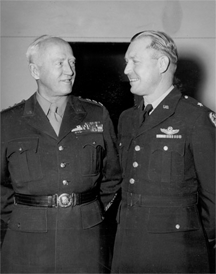
Gen. Patton and Gen. Weyland photographed at Nancy, France, where Third Army Headquarters and XIX Tactical Air Command Advance Headquarters were stationed in the same area. Gen. Weyland commanded XIX TAC beginning in January, 1944. Gen. Patton assumed command of Third Army shortly after the Normandy invasion. Working together, it is fair to say, they advanced the science of close air support. Their joint operations enabled Third Army to advance faster than contemporary doctrine held possible, because they used close air support to control and dominate Third Army's flanks. Gen. Eisenhower, adhering more closely to contemporary doctrine, favored advancing across a broad front. This led him to apply resources relatively more evenly than Gen. Patton favored, and ultimately paused Third Army's advance. Gen. Patton, who had been engaged in a long-running feud with Field Marshall Montgomery, saw this as the result of a purely political attack by the Field Marshall.
Sometimes, what appears to be the result of divide and conquer, or some other political move by one's rivals or superiors, is not that at all. People make decisions for many reasons, and sometimes those reasons include differences in perspective. Gen. Eisenhower's view of the dangers of salients was based on contemporary military doctrine. Gen. Patton and Gen. Weyland had already moved on from there, but it is probable that even they did not yet fully appreciate the degree to which they had done so. What seemed to Gen. Patton as a political decision was, at least in part, due to the difference in how he and Gen. Eisenhower viewed war.
Photo courtesy U.S. Air Force Historical Research Agency.
Recently we've examined the behavior of uncooperative nonsubordinates from the perspective of the nonsubordinate, exploring both internal and organizational reasons for the behavior. We now turn to motivations related to the actions of supervisors.
As before, we'll use C as the name of the person who needs cooperation to carry out his or her responsibilities, and S as the name of the person subverting C. Here are some insights related to the behavior of the supervisors of C and S.
- Strong public support from C's supervisor is essential
- Unless C's supervisor declares to all that C has responsibility for the task in question, the problems C is experiencing could be the result of a misunderstanding. C's supervisor might have been inadvertently ambiguous, or might have chosen ambiguous wording to avoid conflict with one of C's peers.
- When accepting any assignment that could offend others, C can ask for a supervisory commitment to make an unambiguous declaration to everyone whose cooperation C requires.
- C's and S's shared supervisor might be using divide-and-conquer tactics
- Some supervisors believe that competition is an effective tool for managing subordinates, using a technique I call divide and conquer. If S and C share a supervisor, S might be exhibiting behavior encouraged and even sought by their supervisor.
- If so, C didn't create the problem, and C probably can't solve it. If C can't persuade S that the trouble between them is externally caused, C might have to move on.
- C can't control S — only S's supervisor can
- C's best options are asking S respectfully for cooperation, and negotiating with S for cooperation. If they fail, commenting to S about the quality of S's cooperation is a tempting but dangerous course of action. S's resentment and anger are likely outcomes.
- If S's supervisor is C's peer, or of lower rank, C's asking S's supervisor directly for help can be effective. If S's supervisor is of higher rank, C can ask C's own supervisor for help. Some are reluctant to ask for such help, for fear that they might be seen as weak. Such a response by C's supervisor to a request for help is probably out of line, because this kind of help is exactly what supervisors are best able to provide.
- S's supervisor might be targeting C or C's supervisor
- On occasion, Strong public support
from your supervisor
is essentialSs act on behalf of their supervisors, who are targeting C or C's supervisor. Coping with this situation is difficult indeed, especially when S has received deniable direction. - In these cases, the problem is not between C and S. It's between S's supervisor and C or C's supervisor. C would be wise to deal with it as such.
The most effective strategy for C is asking for supervisor support proactively, before trouble develops. If the request is declined, C has the advantage of learning early that support is not available. First in this series  Top
Top  Next Issue
Is every other day a tense, anxious, angry misery as you watch people around you, who couldn't even think their way through a game of Jacks, win at workplace politics and steal the credit and glory for just about everyone's best work including yours? Read 303 Secrets of Workplace Politics, filled with tips and techniques for succeeding in workplace politics. More info
Your comments are welcome
Would you like to see your comments posted here? rbrendPtoGuFOkTSMQOzxner@ChacEgGqaylUnkmwIkkwoCanyon.comSend me your comments by email, or by Web form.About Point Lookout
 Thank you for reading this article. I hope you enjoyed it and
found it useful, and that you'll consider recommending it to a friend.
Thank you for reading this article. I hope you enjoyed it and
found it useful, and that you'll consider recommending it to a friend.
This article in its entirety was written by a human being. No machine intelligence was involved in any way.
Point Lookout is a free weekly email newsletter. Browse the archive of past issues. Subscribe for free.
Support Point Lookout by joining the Friends of Point Lookout, as an individual or as an organization.
Do you face a complex interpersonal situation? Send it in, anonymously if you like, and I'll give you my two cents.
Related articles
More articles on Workplace Politics:
 Empire Building
- Empire builders create bases of power within the larger organization. Typically, they use these domains
to advance personal or provincial agendas. What are the characteristics of empires? How can we navigate
through or around them?
 Is It Blame or Is It Accountability?
- When we seek those accountable for a particular failure, we risk blaming them instead, because many
of us confuse accountability with blame. What's the difference between them? How can we keep blame at bay?
 Using Indirectness at Work
- Although many of us value directness, indirectness does have its place. At times, conveying information
indirectly can be a safe way — sometimes the only safe way — to preserve or restore
well-being and comity within the organization.
 How to Stop Being Overworked: II
- Although many of us are overloaded as a result of our own choices, some are overloaded by abusive supervisors.
If you find yourself in that situation, what can you do?
 Pariah Professions: II
- In some organizations entire professions are regarded as pariahs — outsiders. They're expected
to perform functions that the organization does need, but their relationships with others in the organization
are strained at best. When pariahdom is tolerated, organizational performance suffers.
See also Workplace Politics and Conflict Management for more related articles.
Forthcoming issues of Point Lookout
 Coming April 24: Antipatterns for Time-Constrained Communication: 1
- Knowing how to recognize just a few patterns that can lead to miscommunication can be helpful in reducing the incidence of problems. Here is Part 1 of a collection of communication antipatterns that arise in technical communication under time pressure. Available here and by RSS on April 24.
 And on May 1: Antipatterns for Time-Constrained Communication: 2
- Recognizing just a few patterns that can lead to miscommunication can reduce the incidence of problems. Here is Part 2 of a collection of antipatterns that arise in technical communication under time pressure, emphasizing those that depend on content. Available here and by RSS on May 1.
Coaching services
I offer email and telephone coaching at both corporate and individual rates. Contact Rick for details at rbrendPtoGuFOkTSMQOzxner@ChacEgGqaylUnkmwIkkwoCanyon.com or (650) 787-6475, or toll-free in the continental US at (866) 378-5470.
Get the ebook!
Past issues of Point Lookout are available in six ebooks:
- Get 2001-2 in Geese Don't Land on Twigs (PDF, )
- Get 2003-4 in Why Dogs Wag (PDF, )
- Get 2005-6 in Loopy Things We Do (PDF, )
- Get 2007-8 in Things We Believe That Maybe Aren't So True (PDF, )
- Get 2009-10 in The Questions Not Asked (PDF, )
- Get all of the first twelve years (2001-2012) in The Collected Issues of Point Lookout (PDF, )
Are you a writer, editor or publisher on deadline? Are you looking for an article that will get people talking and get compliments flying your way? You can have 500-1000 words in your inbox in one hour. License any article from this Web site. More info
Follow Rick


Recommend this issue to a friend
Send an email message to a friend
rbrendPtoGuFOkTSMQOzxner@ChacEgGqaylUnkmwIkkwoCanyon.comSend a message to Rick
A Tip A Day feed
Point Lookout weekly feed
 The message of Point Lookout is unique. Help get the message out. Please donate to help keep Point Lookout available for free to everyone.
 My blog, Technical Debt for Policymakers, offers
resources, insights, and conversations of interest to policymakers who are concerned with managing
technical debt within their organizations. Get the millstone of technical debt off the neck of your
organization!
My blog, Technical Debt for Policymakers, offers
resources, insights, and conversations of interest to policymakers who are concerned with managing
technical debt within their organizations. Get the millstone of technical debt off the neck of your
organization!Beware any resource that speaks of "winning" at workplace politics or "defeating" it. You can benefit or not, but there is no score-keeping, and it isn't a game.
- Wikipedia has a nice article with a list of additional resources
- Some public libraries offer collections. Here's an example from Saskatoon.
- Check my own links collection
- LinkedIn's Office Politics discussion group
 Is every other day a tense, anxious, angry misery as you watch people around you, who couldn't even
think their way through a game of Jacks, win at workplace politics and steal the credit and glory
for just about everyone's best work including yours? Read 303 Secrets of Workplace Politics!Learn how to make your virtual global team sing.A Tip a Day arrives by email, or by RSS Feed, each business day. It's 20 to 30 words at most, and gives
you a new perspective on the hassles and rewards of work life. Most tips also contain links to
related articles. Free!Learn how to make meetings more productive — and more rare.
Is every other day a tense, anxious, angry misery as you watch people around you, who couldn't even
think their way through a game of Jacks, win at workplace politics and steal the credit and glory
for just about everyone's best work including yours? Read 303 Secrets of Workplace Politics!Learn how to make your virtual global team sing.A Tip a Day arrives by email, or by RSS Feed, each business day. It's 20 to 30 words at most, and gives
you a new perspective on the hassles and rewards of work life. Most tips also contain links to
related articles. Free!Learn how to make meetings more productive — and more rare.