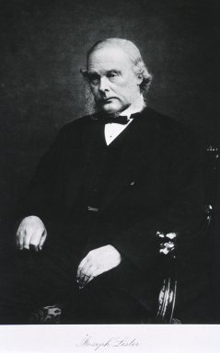
Baron Joseph Lister (1827-1912), who discovered the importance of antiseptic procedures in surgery. Before his innovative work, infections were believed to be caused by airborne agents — "bad air." Surgeons were not required to wash hands or instruments between patients. Meanwhile, midwives, who at the time did wash hands and instruments, had been experiencing infant mortality rates much lower than surgeons. This fact went unexplained until Lister's work. Photo courtesy U.S. National Institutes of Health, from a collection entitled Images from the History of Medicine in the U.S. National Library of Medicine.
On October 14, 2011, the Apple iPhone 4S first became available for sale. Lines formed at Apple stores around the world, and pre-release sales of a million units broke all records for mobile phones. Though no buyers had yet seen it, they felt that the new phone was a welcome change.
On September 21, 1867, the British Medical Journal published a pioneering paper entitled, "On the Antiseptic Principle in the Practice of Surgery," by British surgeon Joseph Lister (1827-1912), in which he advocated sterilization of instruments to prevent infection following surgery. His methods were rapidly adopted throughout Britain. Not so in the United States. The failure of the U.S. medical community to embrace the changes Lister advocated was most unfortunate for President James Garfield, who, on July 2, 1881, was the victim of an assassination attempt in which two bullets struck him. Efforts by surgeons to trace one of the bullets, using their unwashed fingers and unsterilized instruments, led to massive infections. Garfield finally succumbed to a heart attack on September 19.
One change was overwhelmingly welcomed; the other shunned. Why? It's an important question, because our assessments of the net value of changes can be most unreliable. Here's Part I of a catalog of factors that can distort our assessment of changes.
- Inability to grasp circumstantial complexity
- All change involves both losses and gains, but between them there is a fundamental asymmetry. When we experience a loss, it's usually a loss of something we know well. When we experience a gain, it's usually a gain of something we don't yet fully appreciate. Because we don't have it, it's difficult to understand the full scope of its benefits.
- Like all circumstances, the full circumstances of the new status quo are complex. Until we fully adapt to the change, we tend to understand our losses more easily than our gains. That's one reason why our assessment of the net value of a coming change can tend to bias us against it.
- The seductiveness of simplicity
- Some changes appear All change involves both
losses and gains, but
between them there is a
fundamental asymmetrysimple. Whether by design or by happenstance, these changes seem to be minor, or they promise to simplify dramatically some parts of our lives. We tend to welcome these changes even before we understand their full implications. - The error we make here is confusing the change, which seems simple, with the circumstances surrounding the change, which are always complex. This error is responsible for many of the mishaps we call unintended consequences. For most systems, which are far more complex than we appreciate, changing one element can ripple through the system in ways we can understand only after the system demonstrates them to us.
In Part II, we'll examine how social factors can influence our assessment of the goodness of a change. Next in this series  Top
Top  Next Issue
Is your organization embroiled in Change? Are you managing a change effort that faces rampant cynicism, passive non-cooperation, or maybe even outright revolt? Read 101 Tips for Managing Change to learn how to survive, how to plan and how to execute change efforts to inspire real, passionate support. Order Now!
Even though the U.S. medical community spurned Lister's methods, some were convinced. In 1879, Listerine was first formulated. At the time, it was intended as a solution for sterilizing surgical instruments. For more about Joseph Lister, see his biography in Wikipedia. See Wikipedia also for more about Listerine. For the story of James Garfield, see the new book by Candice Millard: Destiny of the Republic: A Tale of Madness, Medicine and the Murder of a President.
Your comments are welcome
Would you like to see your comments posted here? rbrendPtoGuFOkTSMQOzxner@ChacEgGqaylUnkmwIkkwoCanyon.comSend me your comments by email, or by Web form.About Point Lookout
 Thank you for reading this article. I hope you enjoyed it and
found it useful, and that you'll consider recommending it to a friend.
Thank you for reading this article. I hope you enjoyed it and
found it useful, and that you'll consider recommending it to a friend.
This article in its entirety was written by a human being. No machine intelligence was involved in any way.
Point Lookout is a free weekly email newsletter. Browse the archive of past issues. Subscribe for free.
Support Point Lookout by joining the Friends of Point Lookout, as an individual or as an organization.
Do you face a complex interpersonal situation? Send it in, anonymously if you like, and I'll give you my two cents.
Related articles
More articles on Organizational Change:
 Outsourcing Each Other's Kids
- Outsourcing is now so widespread that it has achieved status as a full-fledged management fad. But many
outsourcing decisions lack the justification that a full financial model provides. Here are some of
the factors that such a model should include.
 Letting Go of the Status Quo: the Debate
- Before we can change, we must want to change, or at least accept that we must change. And somewhere
in there, we must let go of some part of what is now in place — the status quo. In organizations,
the decision to let go involves debate.
 When Change Is Hard: I
- Sometimes changing organizations goes smoothly. More often, it doesn't. Whatever methodology we use
— and there are many methodologies available — difficulties can arise. When change is hard,
what's happening? What makes change hard?
 Obstacles to Finding the Reasons Why
- When we investigate what went wrong, we sometimes encounter obstacles. Interviewing witnesses and participants
doesn't always uncover the reasons why. What are these obstacles?
 Deciding to Change: Choosing
- When organizations decide to change what they do, the change sometimes requires that they change how
they make decisions, too. That part of the change is sometimes overlooked, in part, because it affects
most the people who make decisions. What can we do about this?
See also Organizational Change and Emotions at Work for more related articles.
Forthcoming issues of Point Lookout
 Coming April 24: Antipatterns for Time-Constrained Communication: 1
- Knowing how to recognize just a few patterns that can lead to miscommunication can be helpful in reducing the incidence of problems. Here is Part 1 of a collection of communication antipatterns that arise in technical communication under time pressure. Available here and by RSS on April 24.
 And on May 1: Antipatterns for Time-Constrained Communication: 2
- Recognizing just a few patterns that can lead to miscommunication can reduce the incidence of problems. Here is Part 2 of a collection of antipatterns that arise in technical communication under time pressure, emphasizing those that depend on content. Available here and by RSS on May 1.
Coaching services
I offer email and telephone coaching at both corporate and individual rates. Contact Rick for details at rbrendPtoGuFOkTSMQOzxner@ChacEgGqaylUnkmwIkkwoCanyon.com or (650) 787-6475, or toll-free in the continental US at (866) 378-5470.
Get the ebook!
Past issues of Point Lookout are available in six ebooks:
- Get 2001-2 in Geese Don't Land on Twigs (PDF, )
- Get 2003-4 in Why Dogs Wag (PDF, )
- Get 2005-6 in Loopy Things We Do (PDF, )
- Get 2007-8 in Things We Believe That Maybe Aren't So True (PDF, )
- Get 2009-10 in The Questions Not Asked (PDF, )
- Get all of the first twelve years (2001-2012) in The Collected Issues of Point Lookout (PDF, )
Are you a writer, editor or publisher on deadline? Are you looking for an article that will get people talking and get compliments flying your way? You can have 500-1000 words in your inbox in one hour. License any article from this Web site. More info
Follow Rick


Recommend this issue to a friend
Send an email message to a friend
rbrendPtoGuFOkTSMQOzxner@ChacEgGqaylUnkmwIkkwoCanyon.comSend a message to Rick
A Tip A Day feed
Point Lookout weekly feed
 My blog, Technical Debt for Policymakers, offers
resources, insights, and conversations of interest to policymakers who are concerned with managing
technical debt within their organizations. Get the millstone of technical debt off the neck of your
organization!
My blog, Technical Debt for Policymakers, offers
resources, insights, and conversations of interest to policymakers who are concerned with managing
technical debt within their organizations. Get the millstone of technical debt off the neck of your
organization! Bad boss, long commute, troubling ethical questions, hateful colleague? Learn what we can do when we
love the work but not the job.Learn how to make your virtual global team sing.Are you managing a change effort that faces rampant cynicism, passive non-cooperation, or
maybe even outright revolt?Learn how to make meetings more productive — and more rare.
Bad boss, long commute, troubling ethical questions, hateful colleague? Learn what we can do when we
love the work but not the job.Learn how to make your virtual global team sing.Are you managing a change effort that faces rampant cynicism, passive non-cooperation, or
maybe even outright revolt?Learn how to make meetings more productive — and more rare.