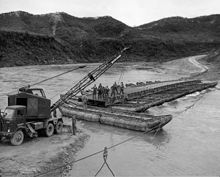
Members of the 1437th Treadway Bridge CO, US 8th Army, erecting a floating bridge during the Korean Conflict on Route #3-D after the flooded roadbed washed out. Temporary bridge building was and is essential to military campaigns. When we think of combat, though, bridge building is not the first activity to come to mind. Nevertheless, without the capability, most campaigns would fail utterly. So it is with organizations undergoing dramatic change. They must take on responsibilities that they don't consider to be in the usual course of events, and they must construct policies and procedures that will not endure. These activities are necessary when we take on the challenge of organizational change. Photo taken July 8, 1952, courtesy U.S. Army Corps of Engineers.
In Part I of this exploration of the challenges of Change, we examined two sources of difficulty — sources internal (our emotions) and source external (outside pressures). This time, we explore issues related to planning. We'll look at three sets of reasons why planning change is so difficult: unexpected linkages, unexpected detours, and the need for temporary bridges.
- Unexpected linkages
- Linkages between organizational elements are often informal and unaccounted for. When an unrecognized linkage exists, changing one of the linked elements requires that we deal with the other linked elements.
- For example, when one group is physically situated close to another, friendships and associations form. Some of those connections might be channels for ongoing knowledge exchange. Separating the two groups by moving one group to a distant location can stress those connections, degrading performance. Relocating them both together might be preferable.
- If we break linkages we don't understand, change can be hard. A plan to move one group might seem perfectly sound, but it can fail if it doesn't recognize the importance of bonds between people. What might seem like resistance could actually be the result of interrupted knowledge flow due to breaking connections.
- Unexpected detours and backtracking
- At times, only after we begin executing a change plan do we recognize some factors we neglected. When this happens, with a little luck, we can make adjustments and continue. But sometimes we have to stop or backtrack, replan, and begin again.
- For example, in an acquisition, if we intend to relocate the acquired IT department, we might find that relocation is impractical because key people would require financial assistance with real estate issues. And keeping those people in place might also incur unsustainable costs. The department relocation plan wasn't defective, though it didn't anticipate real estate market conditions.
- If a plan is incomplete, change can be hard. The people involved might not be resisting change — they might actually have legitimate issues that the plan didn't anticipate.
- Temporary bridges
- When we At times, only after we begin
executing a change plan
do we recognize some
factors we neglectedencounter or anticipate difficulty, we might not be able to change systems directly from their current configurations to the final configurations we seek. Sometimes, we must build temporary bridges. - For example, in the IT relocation problem, the organization might become a lender, investor, or loan facilitator, to enable people who are relocated to secure mortgages for new homes.
- Plans that include interim configurations that we intend later to abandon aren't necessarily defective. And the people whose needs we're accommodating in this way aren't making trouble — they have legitimate needs that we must somehow address. Unless we can be flexible enough to find temporary bridges, change can be hard.
When change is hard, and when the job market is tight, some managers are tempted to communicate the change-or-else message. Resist the temptation. Someday, those who are unhappy will have alternatives. And they will choose them. First in this series  Top
Top  Next Issue
Is your organization embroiled in Change? Are you managing a change effort that faces rampant cynicism, passive non-cooperation, or maybe even outright revolt? Read 101 Tips for Managing Change to learn how to survive, how to plan and how to execute change efforts to inspire real, passionate support. Order Now!
Your comments are welcome
Would you like to see your comments posted here? rbrendPtoGuFOkTSMQOzxner@ChacEgGqaylUnkmwIkkwoCanyon.comSend me your comments by email, or by Web form.About Point Lookout
 Thank you for reading this article. I hope you enjoyed it and
found it useful, and that you'll consider recommending it to a friend.
Thank you for reading this article. I hope you enjoyed it and
found it useful, and that you'll consider recommending it to a friend.
This article in its entirety was written by a human being. No machine intelligence was involved in any way.
Point Lookout is a free weekly email newsletter. Browse the archive of past issues. Subscribe for free.
Support Point Lookout by joining the Friends of Point Lookout, as an individual or as an organization.
Do you face a complex interpersonal situation? Send it in, anonymously if you like, and I'll give you my two cents.
Related articles
More articles on Organizational Change:
 Change How You Change
- In the past two years, your life has probably changed. Do you commute over the same route you did two
years ago? Same transportation? Same job? Same company? Same industry? Change is all around, and you're
probably pretty skilled at it. You can become even more skilled if you change how you change.
 Kinds of Organizational Authority: the Informal
- Understanding Power, Authority, and Influence depends on familiarity with the kinds of authority found
in organizations. Here's Part II of a little catalog of authority, emphasizing informal authority.
 Patching Up the Cracks
- When things repeatedly "fall through the cracks," we're not doing the best we can. How can
we deal with the problem of repeatedly failing to do what we need to do? How can we patch up the cracks?
 Learning-Averse Organizations
- A learning-averse organization is one that seems constitutionally unwilling, if not unable, to learn
new and better ways of conducting its operations. Given the rapid pace of change in modern markets,
one wonders how they survive. Here's how.
 Do My Job
- A popular guideline in modern workplaces is "do your job." The idea is that if we all do our
jobs, success is most likely. But some supervisors demand that subordinates do their own jobs, plus
the jobs of their supervisors. It rarely works out well.
See also Organizational Change and Project Management for more related articles.
Forthcoming issues of Point Lookout
 Coming April 24: Antipatterns for Time-Constrained Communication: 1
- Knowing how to recognize just a few patterns that can lead to miscommunication can be helpful in reducing the incidence of problems. Here is Part 1 of a collection of communication antipatterns that arise in technical communication under time pressure. Available here and by RSS on April 24.
 And on May 1: Antipatterns for Time-Constrained Communication: 2
- Recognizing just a few patterns that can lead to miscommunication can reduce the incidence of problems. Here is Part 2 of a collection of antipatterns that arise in technical communication under time pressure, emphasizing those that depend on content. Available here and by RSS on May 1.
Coaching services
I offer email and telephone coaching at both corporate and individual rates. Contact Rick for details at rbrendPtoGuFOkTSMQOzxner@ChacEgGqaylUnkmwIkkwoCanyon.com or (650) 787-6475, or toll-free in the continental US at (866) 378-5470.
Get the ebook!
Past issues of Point Lookout are available in six ebooks:
- Get 2001-2 in Geese Don't Land on Twigs (PDF, )
- Get 2003-4 in Why Dogs Wag (PDF, )
- Get 2005-6 in Loopy Things We Do (PDF, )
- Get 2007-8 in Things We Believe That Maybe Aren't So True (PDF, )
- Get 2009-10 in The Questions Not Asked (PDF, )
- Get all of the first twelve years (2001-2012) in The Collected Issues of Point Lookout (PDF, )
Are you a writer, editor or publisher on deadline? Are you looking for an article that will get people talking and get compliments flying your way? You can have 500-1000 words in your inbox in one hour. License any article from this Web site. More info
Follow Rick


Recommend this issue to a friend
Send an email message to a friend
rbrendPtoGuFOkTSMQOzxner@ChacEgGqaylUnkmwIkkwoCanyon.comSend a message to Rick
A Tip A Day feed
Point Lookout weekly feed
 My blog, Technical Debt for Policymakers, offers
resources, insights, and conversations of interest to policymakers who are concerned with managing
technical debt within their organizations. Get the millstone of technical debt off the neck of your
organization!
My blog, Technical Debt for Policymakers, offers
resources, insights, and conversations of interest to policymakers who are concerned with managing
technical debt within their organizations. Get the millstone of technical debt off the neck of your
organization! Bad boss, long commute, troubling ethical questions, hateful colleague? Learn what we can do when we
love the work but not the job.Learn how to make your virtual global team sing.Are you managing a change effort that faces rampant cynicism, passive non-cooperation, or
maybe even outright revolt?Learn how to make meetings more productive — and more rare.
Bad boss, long commute, troubling ethical questions, hateful colleague? Learn what we can do when we
love the work but not the job.Learn how to make your virtual global team sing.Are you managing a change effort that faces rampant cynicism, passive non-cooperation, or
maybe even outright revolt?Learn how to make meetings more productive — and more rare.