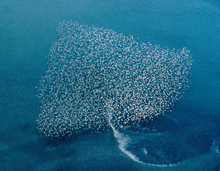
Dunlin flock at Nelson Lagoon, Alaska. Flocks of birds, schools of fish, and swarms of insects, among many other biological groups, exhibit a behavior called swarming. Swarms seem to act in perfect if mysterious coordination. Swarms have no designated leader and no pre-defined global plan. Their behavior is emergent — a group improvisation. As humans, we like to believe that when we act in concert, we usually follow a leader or a plan. My own guess is that much of our group behavior is more like swarming than not. If it is like swarming, then the behavior of projects that seem ungovernable might be a bit less mysterious.
Recent research is beginning to explain how flocks coordinate their behavior. See Biro, et. al., "Hierarchical group dynamics in pigeon flocks", Nature 464, 890-893 (8 April 2010), or listen to the story by National Public Radio, "Backpacked Birds Reveal Who's The Boss". Photo courtesy U.S. Geological Survey.
If we think of a project and its people as a system, we can regard as external inputs the project charter, the project's requirements, and its resources. Changes in these inputs produce changes in the project's outputs. Consternation and frustration arise when changes in the outputs violate our expectations with respect to changes in the inputs.
As we've seen, nonlinear work doesn't always obey the superposition principle. That is, the result of two sets of inputs acting together is not always equal to the sum of the results of each input acting separately. This failure is one reason why our predictions of project results are so wrong so often.
Internal interactions within the project can provide another reason for our frustration. Here are three examples of internal interactions whose effects can dominate the effects of any change in project inputs.
- Discovery
- In the course of development, the project team might discover something that nobody knew or understood before work began. It might be an unanticipated obstacle (bad news), or a wonderful new opportunity (possible good news). Sometimes these discoveries lead to changes in requirements, even though no external agent sought a change in requirements. Whatever the discovery is, it can affect both project performance and project outcomes. And with alarming frequency, these effects can be far larger than the effect of any changes anyone — customer, manager, executive, regulator, marketer — might impose on the project. From this perspective, such changes come from nowhere.
- Emergence
- In complex The only real surprise in any
project would be the
absence of surprisessystems, emergence happens when many small identical elements of the system organize themselves into coherent behavior. For example, the organized movement of a school of fish is emergent behavior. Emergent phenomena are also observable in projects or portfolios of projects. When one task encounters difficulty, the consequences of that difficulty can propagate across the project, with the result that many other tasks find themselves in similar straits, resulting in a form of gridlock. This can happen at any time, in the absence of any external stimulus. - Outputs can change even when inputs don't
- Even when none of the inputs have changed, mistakes, miscommunications, insights, and creativity can cause the outputs to develop along paths that differ from what anyone expected. This happens because the system contains more internal degrees of freedom than those that are specified by the inputs. We tend to call these unexpected changes "surprises," but the only real surprise in any project would be the absence of surprises.
Nonlinear work is frustrating not so much because it is nonlinear, but because we insist on believing that it is linear. We consider a project most successful when it behaves according to our expectations: no discoveries, no emergence, and outputs fully determined by inputs. It's a nice fantasy, but it's a fantasy nonetheless. First in this series  Top
Top  Next Issue
Are your projects always (or almost always) late and over budget? Are your project teams plagued by turnover, burnout, and high defect rates? Turn your culture around. Read 52 Tips for Leaders of Project-Oriented Organizations, filled with tips and techniques for organizational leaders. Order Now!
Your comments are welcome
Would you like to see your comments posted here? rbrendPtoGuFOkTSMQOzxner@ChacEgGqaylUnkmwIkkwoCanyon.comSend me your comments by email, or by Web form.About Point Lookout
 Thank you for reading this article. I hope you enjoyed it and
found it useful, and that you'll consider recommending it to a friend.
Thank you for reading this article. I hope you enjoyed it and
found it useful, and that you'll consider recommending it to a friend.
This article in its entirety was written by a human being. No machine intelligence was involved in any way.
Point Lookout is a free weekly email newsletter. Browse the archive of past issues. Subscribe for free.
Support Point Lookout by joining the Friends of Point Lookout, as an individual or as an organization.
Do you face a complex interpersonal situation? Send it in, anonymously if you like, and I'll give you my two cents.
Related articles
More articles on Project Management:
 Declaring Condition Red
- High-performance teams have customary ways of working together that suit them, their organizations,
and their work. But when emergencies happen, operating in business-as-usual mode damages teams —
and the relationships between their people — permanently. To avoid this, train for emergencies.
 Some Causes of Scope Creep
- When we suddenly realize that our project's scope has expanded far beyond its initial boundaries —
when we have that how-did-we-ever-get-here feeling — we're experiencing the downside of scope
creep. Preventing scope creep starts with understanding how it happens.
 Personnel-Sensitive Risks: I
- Some risks and the plans for managing them are personnel-sensitive in the sense that disclosure can
harm the enterprise or its people. Since most risk management plans are available to a broad internal
audience, personnel-sensitive risks cannot be managed in the customary way. Why not?
 Scope Creep and Confirmation Bias
- As we've seen, some cognitive biases can contribute to the incidence of scope creep in projects and
other efforts. Confirmation bias, which causes us to prefer evidence that bolsters our preconceptions,
is one of these.
 Tuckman's Model and Joint Leadership Teams
- Tuckman's model of the stages of group development, applied to Joint Leadership Teams, reveals characteristics
of these teams that signal performance levels less than we hope for. Knowing what to avoid when we designate
these teams is therefore useful.
See also Project Management for more related articles.
Forthcoming issues of Point Lookout
 Coming April 24: Antipatterns for Time-Constrained Communication: 1
- Knowing how to recognize just a few patterns that can lead to miscommunication can be helpful in reducing the incidence of problems. Here is Part 1 of a collection of communication antipatterns that arise in technical communication under time pressure. Available here and by RSS on April 24.
 And on May 1: Antipatterns for Time-Constrained Communication: 2
- Recognizing just a few patterns that can lead to miscommunication can reduce the incidence of problems. Here is Part 2 of a collection of antipatterns that arise in technical communication under time pressure, emphasizing those that depend on content. Available here and by RSS on May 1.
Coaching services
I offer email and telephone coaching at both corporate and individual rates. Contact Rick for details at rbrendPtoGuFOkTSMQOzxner@ChacEgGqaylUnkmwIkkwoCanyon.com or (650) 787-6475, or toll-free in the continental US at (866) 378-5470.
Get the ebook!
Past issues of Point Lookout are available in six ebooks:
- Get 2001-2 in Geese Don't Land on Twigs (PDF, )
- Get 2003-4 in Why Dogs Wag (PDF, )
- Get 2005-6 in Loopy Things We Do (PDF, )
- Get 2007-8 in Things We Believe That Maybe Aren't So True (PDF, )
- Get 2009-10 in The Questions Not Asked (PDF, )
- Get all of the first twelve years (2001-2012) in The Collected Issues of Point Lookout (PDF, )
Are you a writer, editor or publisher on deadline? Are you looking for an article that will get people talking and get compliments flying your way? You can have 500-1000 words in your inbox in one hour. License any article from this Web site. More info
Follow Rick


Recommend this issue to a friend
Send an email message to a friend
rbrendPtoGuFOkTSMQOzxner@ChacEgGqaylUnkmwIkkwoCanyon.comSend a message to Rick
A Tip A Day feed
Point Lookout weekly feed
 My blog, Technical Debt for Policymakers, offers
resources, insights, and conversations of interest to policymakers who are concerned with managing
technical debt within their organizations. Get the millstone of technical debt off the neck of your
organization!
My blog, Technical Debt for Policymakers, offers
resources, insights, and conversations of interest to policymakers who are concerned with managing
technical debt within their organizations. Get the millstone of technical debt off the neck of your
organization! Bad boss, long commute, troubling ethical questions, hateful colleague? Learn what we can do when we
love the work but not the job.Learn how to make your virtual global team sing.Are you managing a change effort that faces rampant cynicism, passive non-cooperation, or
maybe even outright revolt?Learn how to make meetings more productive — and more rare.
Bad boss, long commute, troubling ethical questions, hateful colleague? Learn what we can do when we
love the work but not the job.Learn how to make your virtual global team sing.Are you managing a change effort that faces rampant cynicism, passive non-cooperation, or
maybe even outright revolt?Learn how to make meetings more productive — and more rare.