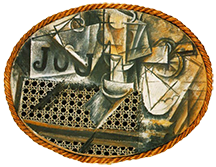
Still Life with Chair-Caning, by Pablo Picasso (1881-1973), "painted" in May, 1912. I put painted in quotes, because this painting is only painted in part. The image of the chair caning is actually printed on a piece of oilcloth, which Picasso bought in a hardware store and glued onto the canvas, before painting over it. This painting is the first to incorporate this technique. Some regarded Picasso's technique as "cheating," because so much of the regard people had for artists at the time was based on their ability to reproduce images of reality. And here was Picasso, exploiting a manufactured image of reality, and asking for credit for his work as fine art.
Problem solvers today still suffer from this same phenomenon. Devising solutions from "scratch" without reference to previous work is more highly esteemed than is combining elements from existing solutions to create something wholly new. The resulting searches for the greater glory that is the reward for wholly new solutions are expensive and wasteful consequences of this attribute of many organizational cultures. We would do well to find ways to honor clever combining of existing work as much as we honor creating wholly new work.
The painting is in oil and oilcloth on canvas, with a rope frame. In size, it is relatively small: 10 5/8 x 13 3/4 in. (27 x 35 cm.). It is at Musee Picasso in Paris, which at this writing is closed for renovations. Photo courtesy Dr. Scott Contreras-Koterbay of East Tennessee University.
Problem solvers often begin by looking for new, innovative solutions, even though many solutions consist of innovative combinations of less-innovative pieces. But innovation can be as much or more in the way pieces are combined, rather than in the pieces themselves. Because this happens with such regularity, setting out to find solutions of this form can make problem-solvers more productive.
Many problem solutions are like found art, which is art created from objects that are not normally considered art. They might be everyday objects, like tires or chair legs. They might even be discarded or broken. By combining them in new ways, possibly with objects or materials that normally are considered art, the artist creates something that clearly is art.
Similarly, problem solutions sometimes consist of familiar elements of other solutions, possibly combined with truly new elements. Often, we come to these solutions only after failing to compose wholly new solutions. Here's a proposal: we might benefit by approaching problems from the beginning by searching for solutions that are hybrids of new and old.
Here are some suggestions for problem-solving using combinations of new and old solutions.
- Generate a catalog of old solutions
- Become a student of old solutions. Gather ideas that worked in the past to solve problems that are now solved. You can use this resource repeatedly for each new problem-solving effort. And the successful results of each new effort can become entries in this catalog.
- Maintain a didn't-work-for-this-problem list
- As you progress You can reuse past ideas
only if you know about
them. Become a student
of old solutions.toward a solution, you'll try ideas that turn out not to work. Add them to the didn't-work-for-this-problem list. Then ask, why didn't it work? If that condition is still in place, address it. Addressing that condition is a slightly different problem — one for which you (or someone else) might already have a solution. - Search for themes in the didn't-work-for-this-problem list
- As you add items to the didn't-work-for-this-problem list, search the list for themes. Sometimes, when something doesn't work, the causes of failure can be hidden in subtle ways. But when you ask what a group of failed solutions have in common, sometimes that hidden cause becomes evident. In this way, failed solutions can lead to success.
- Be zany
- Because intentional zaniness can help you relax constraints that might be keeping you from seeing a solution, search for obviously zany ideas. But not just any zany ideas. Start with an item from your catalog of old solutions, or from your didn't-work-for-this-problem lists. Then "zanify" it. Zanify it again in another way. You might be surprised at what happens.
Most important, we must learn to value the work of those who solve problems by combining cleverly into new solutions elements that others knew about but overlooked.  Top
Top  Next Issue
Are your projects always (or almost always) late and over budget? Are your project teams plagued by turnover, burnout, and high defect rates? Turn your culture around. Read 52 Tips for Leaders of Project-Oriented Organizations, filled with tips and techniques for organizational leaders. Order Now!
Your comments are welcome
Would you like to see your comments posted here? rbrendPtoGuFOkTSMQOzxner@ChacEgGqaylUnkmwIkkwoCanyon.comSend me your comments by email, or by Web form.About Point Lookout
 Thank you for reading this article. I hope you enjoyed it and
found it useful, and that you'll consider recommending it to a friend.
Thank you for reading this article. I hope you enjoyed it and
found it useful, and that you'll consider recommending it to a friend.
This article in its entirety was written by a human being. No machine intelligence was involved in any way.
Point Lookout is a free weekly email newsletter. Browse the archive of past issues. Subscribe for free.
Support Point Lookout by joining the Friends of Point Lookout, as an individual or as an organization.
Do you face a complex interpersonal situation? Send it in, anonymously if you like, and I'll give you my two cents.
Related articles
More articles on Problem Solving and Creativity:
 Emergency Problem Solving
- In emergencies, group problem solving is unusually challenging, especially if lives, careers, or companies
depend on finding a solution immediately. Here are some tips for members of teams that are solving problems
in emergencies.
 Project Improvisation as Group Process
- When project plans contact reality, things tend to get, um, a bit confused. We can sometimes see the
trouble coming in time to replan thoughtfully — if we're nearly clairvoyant. Usually, we have
to improvise. How a group improvises tells us much about the group.
 The Tyranny of Singular Nouns
- When groups try to reach decisions, and the issue in question has a name that suggests a unitary concept,
such as "policy," they sometimes collectively assume that they're required to find a one-size-fits-all
solution. This assumption leads to poor decisions when one-size-fits-all isn't actually required.
 Wishful Thinking and Perception: II
- Continuing our exploration of causes of wishful thinking and what we can do about it, here's Part II
of a little catalog of ways our preferences and wishes affect our perceptions.
 On Assigning Responsibility for Creating Trouble
- When we assign responsibility for troubles that bedevil us, we often make mistakes. We can be misled
by language, stereotypes, and the assumptions we make about others.
See also Problem Solving and Creativity and Personal, Team, and Organizational Effectiveness for more related articles.
Forthcoming issues of Point Lookout
 Coming April 24: Antipatterns for Time-Constrained Communication: 1
- Knowing how to recognize just a few patterns that can lead to miscommunication can be helpful in reducing the incidence of problems. Here is Part 1 of a collection of communication antipatterns that arise in technical communication under time pressure. Available here and by RSS on April 24.
 And on May 1: Antipatterns for Time-Constrained Communication: 2
- Recognizing just a few patterns that can lead to miscommunication can reduce the incidence of problems. Here is Part 2 of a collection of antipatterns that arise in technical communication under time pressure, emphasizing those that depend on content. Available here and by RSS on May 1.
Coaching services
I offer email and telephone coaching at both corporate and individual rates. Contact Rick for details at rbrendPtoGuFOkTSMQOzxner@ChacEgGqaylUnkmwIkkwoCanyon.com or (650) 787-6475, or toll-free in the continental US at (866) 378-5470.
Get the ebook!
Past issues of Point Lookout are available in six ebooks:
- Get 2001-2 in Geese Don't Land on Twigs (PDF, )
- Get 2003-4 in Why Dogs Wag (PDF, )
- Get 2005-6 in Loopy Things We Do (PDF, )
- Get 2007-8 in Things We Believe That Maybe Aren't So True (PDF, )
- Get 2009-10 in The Questions Not Asked (PDF, )
- Get all of the first twelve years (2001-2012) in The Collected Issues of Point Lookout (PDF, )
Are you a writer, editor or publisher on deadline? Are you looking for an article that will get people talking and get compliments flying your way? You can have 500-1000 words in your inbox in one hour. License any article from this Web site. More info
Follow Rick


Recommend this issue to a friend
Send an email message to a friend
rbrendPtoGuFOkTSMQOzxner@ChacEgGqaylUnkmwIkkwoCanyon.comSend a message to Rick
A Tip A Day feed
Point Lookout weekly feed
 My blog, Technical Debt for Policymakers, offers
resources, insights, and conversations of interest to policymakers who are concerned with managing
technical debt within their organizations. Get the millstone of technical debt off the neck of your
organization!
My blog, Technical Debt for Policymakers, offers
resources, insights, and conversations of interest to policymakers who are concerned with managing
technical debt within their organizations. Get the millstone of technical debt off the neck of your
organization! Bad boss, long commute, troubling ethical questions, hateful colleague? Learn what we can do when we
love the work but not the job.Learn how to make your virtual global team sing.Are you managing a change effort that faces rampant cynicism, passive non-cooperation, or
maybe even outright revolt?Learn how to make meetings more productive — and more rare.
Bad boss, long commute, troubling ethical questions, hateful colleague? Learn what we can do when we
love the work but not the job.Learn how to make your virtual global team sing.Are you managing a change effort that faces rampant cynicism, passive non-cooperation, or
maybe even outright revolt?Learn how to make meetings more productive — and more rare.