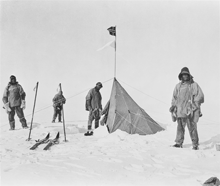
Robert F. Scott and three of his party arrive at a tent left by Roald Amundsen near the South Pole, on Thursday, January 18, 1912. Left to right are Capt. Scott, Capt. Oates, Dr. Wilson, and P.O. Evans. The photographer is Lt. Bowers. To many viewers, the party looks dejected, a hunch that is confirmed by Scott's journal entries. They had hoped to arrive first, and in that they failed. Scott's expedition suffered from several shortcomings, one of the more fundamental of which was a lack of focus. It was to be both a voyage of scientific discovery, and an attempt to be the first to reach the South Pole. Despite their failure to reach the Pole first, the party continued to pursue their scientific objectives. For instance, during the return from the Pole, the party continued to gather and carry rock samples. This activity was indeed unwise, because the effort involved in carrying the rocks was unsustainable, given their physical condition. When the bodies of Scott, Wilson and Bowers were found, their sledge was still encumbered with rock samples. By modern standards, if not contemporary standards, their return trip suffered from misplaced focus. The primary focus must always be preservation of life. By attempting to achieve both scientific and geographical goals, the expedition compromised both.
Risk management of efforts that lack focus or which have misplaced focus is difficult, if not impossible. Photo by Lt. Henry "Birdie" Bowers, British Antarctic Expedition, 1910-13.
When we undertake tasks in organizations, we face risks. The most obvious risks are those that are most closely related to the task at hand. These risks, which we might call content risks include factors such as technological unknowns, resource availability, and competition. But there are other risks, often overlooked, that can dramatically influence our chances for success.
One of these is risk management risk, which is the risk that the risk management process is flawed, due to such factors as organizational political correctness, organizational blind spots, or the risk that political phenomena render certain risks invisible to risk managers.
Here are some examples of non-content risks, with suggestions for managing them. In this Part I, we emphasize risk sources related to perceptions.
- Misplaced or excessive focus
- Typically, organizations have in place processes that maintain focus on what they do well. For example, approvals are required to allocate resources to forward-looking initiatives. But some organizations are excessively zealous about maintaining focus, and some are mistaken about where that focus should be. For instance, organizations that need to undertake efforts to adopt new technologies to serve their existing customers sometimes refrain from doing so because of advocacy by those representing customers most resistant to change.
- Advocates of advanced initiatives would do well to protect their activities from notice until their relevance is evident to all, easily explained, and easily defended. Working demonstrations are especially useful.
- Resentment bred by success
- We rarely consider risks associated with success. But here's one: your effort is so successful and appealing that people seek to join your team. Having to decline these offers because of insufficient resources isn't much of a problem, because people do understand that issue. The more difficult problem is the resentment such success can engender on the part of potential political adversaries.
- When appropriate,Advocates of advanced initiatives
would do well to protect their
activities from notice until their
relevance is evident to all devise plans for dealing with such challenges. One helpful guideline: don't publicize your success internally unless the publicity materially aids the effort and you have political strength sufficient to withstand challenges. - Unsustainable loads
- The term "unsustainable load" usually evokes thoughts of overload and burnout. Certainly, high loads are unsustainable. But low loads can also be unsustainable. Sustainability of a given workload is in part determined by perceived differences between one's own workload and the workloads of colleagues and peers.
- Loads much higher, or much lower, than cultural norms are unsustainable in the long term. High loads cause burnout and bailout; low loads attract those with agendas other than your own, and risk losing people (and stakeholders) from boredom and idleness. Strive for workloads near but slightly above the cultural norm.
Next time, we'll turn our attention to risks arising from organizational politics. Next in this series  Top
Top  Next Issue
Is every other day a tense, anxious, angry misery as you watch people around you, who couldn't even think their way through a game of Jacks, win at workplace politics and steal the credit and glory for just about everyone's best work including yours? Read 303 Secrets of Workplace Politics, filled with tips and techniques for succeeding in workplace politics. More info
Your comments are welcome
Would you like to see your comments posted here? rbrendPtoGuFOkTSMQOzxner@ChacEgGqaylUnkmwIkkwoCanyon.comSend me your comments by email, or by Web form.About Point Lookout
 Thank you for reading this article. I hope you enjoyed it and
found it useful, and that you'll consider recommending it to a friend.
Thank you for reading this article. I hope you enjoyed it and
found it useful, and that you'll consider recommending it to a friend.
This article in its entirety was written by a human being. No machine intelligence was involved in any way.
Point Lookout is a free weekly email newsletter. Browse the archive of past issues. Subscribe for free.
Support Point Lookout by joining the Friends of Point Lookout, as an individual or as an organization.
Do you face a complex interpersonal situation? Send it in, anonymously if you like, and I'll give you my two cents.
Related articles
More articles on Project Management:
 Restarting Projects
- When a project gets off track, we sometimes cancel it. But since canceling projects takes a lot of courage,
we look for ways to save them if we can. Often, things do turn out OK, and at other times they don't.
There's a third choice, between pressing on with a project and canceling it. We can restart.
 Scheduling as Risk Management
- When we schedule a complex project, we balance logical order, resource constraints, and even politics.
Here are some techniques for using scheduling to manage risk and reduce costs.
 Project Improvisation and Risk Management
- When reality trips up our project plans, we improvise or we replan. When we do, we create new risks
and render our old risk plans obsolete. Here are some suggestions for managing risks when we improvise.
 Communication Traps for Virtual Teams: I
- Virtual teams encounter difficulties that rarely confront face-to-face teams. What special challenges
do they face, and what can we do about them?
 How to Get Out of Firefighting Mode: I
- When new problems pop up one after the other, we describe our response as "firefighting."
We move from fire to fire, putting out flames. How can we end the madness?
See also Project Management and Workplace Politics for more related articles.
Forthcoming issues of Point Lookout
 Coming April 24: Antipatterns for Time-Constrained Communication: 1
- Knowing how to recognize just a few patterns that can lead to miscommunication can be helpful in reducing the incidence of problems. Here is Part 1 of a collection of communication antipatterns that arise in technical communication under time pressure. Available here and by RSS on April 24.
 And on May 1: Antipatterns for Time-Constrained Communication: 2
- Recognizing just a few patterns that can lead to miscommunication can reduce the incidence of problems. Here is Part 2 of a collection of antipatterns that arise in technical communication under time pressure, emphasizing those that depend on content. Available here and by RSS on May 1.
Coaching services
I offer email and telephone coaching at both corporate and individual rates. Contact Rick for details at rbrendPtoGuFOkTSMQOzxner@ChacEgGqaylUnkmwIkkwoCanyon.com or (650) 787-6475, or toll-free in the continental US at (866) 378-5470.
Get the ebook!
Past issues of Point Lookout are available in six ebooks:
- Get 2001-2 in Geese Don't Land on Twigs (PDF, )
- Get 2003-4 in Why Dogs Wag (PDF, )
- Get 2005-6 in Loopy Things We Do (PDF, )
- Get 2007-8 in Things We Believe That Maybe Aren't So True (PDF, )
- Get 2009-10 in The Questions Not Asked (PDF, )
- Get all of the first twelve years (2001-2012) in The Collected Issues of Point Lookout (PDF, )
Are you a writer, editor or publisher on deadline? Are you looking for an article that will get people talking and get compliments flying your way? You can have 500-1000 words in your inbox in one hour. License any article from this Web site. More info
Follow Rick


Recommend this issue to a friend
Send an email message to a friend
rbrendPtoGuFOkTSMQOzxner@ChacEgGqaylUnkmwIkkwoCanyon.comSend a message to Rick
A Tip A Day feed
Point Lookout weekly feed
 My blog, Technical Debt for Policymakers, offers
resources, insights, and conversations of interest to policymakers who are concerned with managing
technical debt within their organizations. Get the millstone of technical debt off the neck of your
organization!
My blog, Technical Debt for Policymakers, offers
resources, insights, and conversations of interest to policymakers who are concerned with managing
technical debt within their organizations. Get the millstone of technical debt off the neck of your
organization! Bad boss, long commute, troubling ethical questions, hateful colleague? Learn what we can do when we
love the work but not the job.Learn how to make your virtual global team sing.Are you managing a change effort that faces rampant cynicism, passive non-cooperation, or
maybe even outright revolt?Learn how to make meetings more productive — and more rare.
Bad boss, long commute, troubling ethical questions, hateful colleague? Learn what we can do when we
love the work but not the job.Learn how to make your virtual global team sing.Are you managing a change effort that faces rampant cynicism, passive non-cooperation, or
maybe even outright revolt?Learn how to make meetings more productive — and more rare.