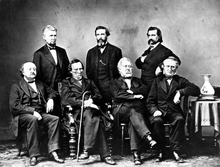
The impeachment managers for the impeachment of U.S. President Andrew Johnson, 1868. View a larger image. Standing are James Falconer Wilson (R-Iowa 1st), George Sewall Boutwell (R-Massachusetts 7th), and John Alexander Logan (R-Illinois at-large). Seated are Benjamin Franklin Butler (R-Massachusetts 5th at the time), Thaddeus Stevens (R-Pennsylvania 9th), Thomas Williams (R-Pennsylvania 23rd), and John Armor Bingham (R-Ohio 16th). Thaddeus Stevens, a Radical Republican, is the character to whom President Lincoln tells the "True North" story in the recent film, Lincoln. Lincoln wanted to persuade Stevens to argue more moderately in favor of the 13th Amendment, because he felt that a more ideological argument would result in failure. Paraphrasing Lincoln's line in the film, "A compass will point you true North. But it won't show you the swamps in between you and there. If you don't avoid the swamps, what's the use of knowing true North?" Essentially, Lincoln is arguing for a pragmatic approach in preference to a more ideological one.
The line is likely invented by the filmmakers. I know of no evidence that Lincoln actually employed such a metaphor. Nevertheless, it is a powerful illustration of the interplay between the objective orientation and the obstacle orientation. Success demands both.
Photo by Mathew Brady, in the United States Signal Corps, War Department, Washington, 1868. Available from Wikipedia.

People have preferences. We have preferences about so many different things that the number of different combinations is enormous. Everyone is unique. We even have preferences about the ways we try to solve problems. One classification of problem-solving preferences is the relative interest we have in focusing on objectives versus obstacles.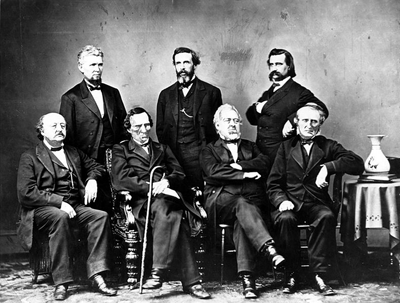
To focus on objectives is to keep foremost in mind what we're trying to achieve by solving the problem. To focus on obstacles is to look first at the difficulties we face when we try to implement candidate solutions.
When we approach problem solving, few of us are aware of whether we prefer to focus on objectives or obstacles. And few of us make conscious choices of focus during the solution process.
Because solving problems successfully requires balanced attention to both objectives and obstacles, choosing the right focus at the right stage of problem solving can dramatically enhance problem-solving effectiveness. Here are some observations that can help you make wise choices.
- Objective orientation
- A focus on objectives helps us find the way to the goal when we must make the detours needed to evade or eliminate obstacles. Keeping objectives in mind can be inspiring when attaining them seems out of reach, or when we encounter obstacles wherever we turn.
- The objective orientation has a dark side, too. It can lead to an obsession with ideas that seem promising, but which have little practical value. And it can lead us to reject out of hand any candidate solution that requires that we temporarily deviate from the direct path to our goal. Rigid adherence to the objective orientation can actually prevent us from finding ways around obstacles.
- Obstacle Orientation
- A focus on obstacles helps us find impediments Relying mostly on one approach —
either objectives or obstacles — to
the exclusion of the other is a
path to failureearly in the search for solutions. This enables wise allocation of resources, which helps us rank possible solutions according to likelihood of success. And when we notice a common theme among some of the obstacles we find early in the search, we can apply that insight to the task of generating more promising candidate solutions. - The obstacle orientation has a dark side, too. A focus on obstacles can be dispiriting, because we must search for reasons why candidate solutions don't work. Sometimes we must consider the question, "Can any solution at all ever work?" And sometimes we can become so lost in addressing obstacles that we lose sight of the objective.
Relying mostly on one approach to the exclusion of the other is a path to failure. Both orientations — objectives and obstacles — are needed at various times and in different situations. And often we can't tell which approach we need at any given moment. An appreciation for the advantages and risks associated with each perspective can lead to acceptance of the approaches and contributions of people whose preferences differ from our own.  Top
Top  Next Issue
Occasionally we have the experience of belonging to a great team. Thrilling as it is, the experience is rare. In part, it's rare because we usually strive only for adequacy, not for greatness. We do this because we don't fully appreciate the returns on greatness. Not only does it feel good to be part of great team — it pays off. Check out my Great Teams Workshop to lead your team onto the path toward greatness. More info
Your comments are welcome
Would you like to see your comments posted here? rbrendPtoGuFOkTSMQOzxner@ChacEgGqaylUnkmwIkkwoCanyon.comSend me your comments by email, or by Web form.About Point Lookout
 Thank you for reading this article. I hope you enjoyed it and
found it useful, and that you'll consider recommending it to a friend.
Thank you for reading this article. I hope you enjoyed it and
found it useful, and that you'll consider recommending it to a friend.
This article in its entirety was written by a human being. No machine intelligence was involved in any way.
Point Lookout is a free weekly email newsletter. Browse the archive of past issues. Subscribe for free.
Support Point Lookout by joining the Friends of Point Lookout, as an individual or as an organization.
Do you face a complex interpersonal situation? Send it in, anonymously if you like, and I'll give you my two cents.
Related articles
More articles on Problem Solving and Creativity:
 Abraham, Mark, and Henny
- Our plans, products, and processes are often awkward, bulky, and complex. They lack a certain spiritual
quality that some might call elegance. Yet we all recognize elegance when we see it. Why do we make
things so complicated?
 What Haven't I Told You?
- When a project team hits a speed bump, it often learns that it had all the information it needed to
avoid the problem, sometimes months in advance of uncovering it. Here's a technique for discovering
this kind of knowledge more systematically.
 Assumptions and the Johari Window: II
- The roots of both creative and destructive conflict can often be traced to the differing assumptions
of the parties to the conflict. Here's Part II of an essay on surfacing these differences using a tool
called the Johari window.
 New Ideas: Judging
- When groups work together to solve problems, they eventually evaluate the ideas they generate. They
sometimes reject perfectly good ideas, while accepting some really boneheaded ones. How can we judge
new ideas more effectively?
 The Goal Is Not the Path
- Sometimes, when reaching a goal is more difficult than we thought at first, instead of searching for
another way to get there, we adjust the goal. There are alternatives.
See also Problem Solving and Creativity and Personal, Team, and Organizational Effectiveness for more related articles.
Forthcoming issues of Point Lookout
 Coming May 1: Antipatterns for Time-Constrained Communication: 2
- Recognizing just a few patterns that can lead to miscommunication can reduce the incidence of miscommunications. Here's Part 2 of a collection of antipatterns that arise in communication under time pressure, emphasizing those that depend on content. Available here and by RSS on May 1.
- And on May 8: Antipatterns for Time-Constrained Communication: 3
- Recognizing just a few patterns that can lead to miscommunication can reduce the incidence of problems. Here is Part 3 of a collection of antipatterns that arise in technical communication under time pressure, emphasizing past experiences of participants. Available here and by RSS on May 8.
Coaching services
I offer email and telephone coaching at both corporate and individual rates. Contact Rick for details at rbrendPtoGuFOkTSMQOzxner@ChacEgGqaylUnkmwIkkwoCanyon.com or (650) 787-6475, or toll-free in the continental US at (866) 378-5470.
Get the ebook!
Past issues of Point Lookout are available in six ebooks:
- Get 2001-2 in Geese Don't Land on Twigs (PDF, )
- Get 2003-4 in Why Dogs Wag (PDF, )
- Get 2005-6 in Loopy Things We Do (PDF, )
- Get 2007-8 in Things We Believe That Maybe Aren't So True (PDF, )
- Get 2009-10 in The Questions Not Asked (PDF, )
- Get all of the first twelve years (2001-2012) in The Collected Issues of Point Lookout (PDF, )
Are you a writer, editor or publisher on deadline? Are you looking for an article that will get people talking and get compliments flying your way? You can have 500-1000 words in your inbox in one hour. License any article from this Web site. More info
Follow Rick


Recommend this issue to a friend
Send an email message to a friend
rbrendPtoGuFOkTSMQOzxner@ChacEgGqaylUnkmwIkkwoCanyon.comSend a message to Rick
A Tip A Day feed
Point Lookout weekly feed
 My blog, Technical Debt for Policymakers, offers
resources, insights, and conversations of interest to policymakers who are concerned with managing
technical debt within their organizations. Get the millstone of technical debt off the neck of your
organization!
My blog, Technical Debt for Policymakers, offers
resources, insights, and conversations of interest to policymakers who are concerned with managing
technical debt within their organizations. Get the millstone of technical debt off the neck of your
organization! Bad boss, long commute, troubling ethical questions, hateful colleague? Learn what we can do when we
love the work but not the job.Learn how to make your virtual global team sing.Are you managing a change effort that faces rampant cynicism, passive non-cooperation, or
maybe even outright revolt?Learn how to make meetings more productive — and more rare.
Bad boss, long commute, troubling ethical questions, hateful colleague? Learn what we can do when we
love the work but not the job.Learn how to make your virtual global team sing.Are you managing a change effort that faces rampant cynicism, passive non-cooperation, or
maybe even outright revolt?Learn how to make meetings more productive — and more rare.