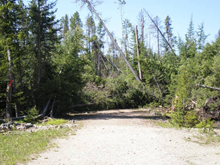
Timber blowdown in the Beaverhead-Deerlodge National Forest on July 13, 2009. Timber blowdown is a term that denotes wind damage in forests due to winds felling trees. Although any tree can be blown down by high winds, trees that are near the edges of stands are especially vulnerable. And among those most vulnerable are those near new edges — edges that postdate any severe windstorms and which result from road cuts, skid cuts, thinning, cutting, fire, or recent natural events such as disease, floods, landslides, avalanches, or other similar events. Trees near new edges are more vulnerable because their species might be inappropriate to edge life, or they might have directional wind firmness inappropriate to the new edge. In other words, the individual tree might be making an assumption about what it needs to thrive where it is, but the recent formation of an edge renders that assumption invalid.
Analogous issues can arise for us at work. We might make assumptions in the form of presuppositions of type 1 that are innocent enough, but changes in the organizational context can render those presuppositions inconsistent with career security. And uncovering those problematic presuppositions can be difficult indeed. This is one of the uncertainties of organizational life that makes many of us justifiably uncomfortable about organizational change. Photo courtesy U.S. Department of Agriculture.
Some people use presuppositions to coerce others into accepting responsibilities they don't want or can't fulfill. Here's an example: "Jesse, when can you have this done?" It sounds like an innocent question, and often, it is. But suppose Jesse hasn't yet committed to the task because he's overloaded, as he had politely explained yesterday. And suppose further that the question is asked in a meeting, with colleagues and perhaps Jesse's supervisor looking on (or listening in).
Jesse would be cornered. He would have to choose between acquiescence and contradicting the speaker, and thereby seeming uncooperative. Worse, if he contradicts the speaker, however politely, the speaker might respond with something like, "Whoa, pal, you already committed to doing this. Are you reneging now at this late date?" Some operators might do this even if Jesse had never said or done anything resembling accepting responsibility.
This tactic is difficult to deal with because it contains a presupposition. A swatch of speech or text contains a presupposition if it assumes something, usually implicitly. In the example above, the presupposition is that Jesse has agreed to do the work. (See "The Power of Presuppositions," Point Lookout for September 1, 2004, for more.)
Presuppositions aren't inherently evil. A presupposition can be appropriate when all parties to the exchange are aware of the assumption and agree to it. I call this a Type 1 Presupposition (PS1). But when the recipient of the message is unaware of the presupposition or doesn't agree with it, trouble like Jesse's begins. If the presupposition is inadvertent it's of Type 2 (PS2). If it's intentional, it's Type 3 (PS3).
Here's what you can do about Type 3 presuppositions.
- Educate everyone
- Ending the use of PS3s begins with learning what they are. Outside the context of any PS3 incident, explain PS3s to others. The word presupposition is familiar to some, but many don't really know what it means.
- Recognize PS3s as abuse
- PS1s are useful shorthand; PS2s are accidents; PS3s are a We must recognize as abusers any
managers who use presuppositions
to coerce subordinatesform of psychological abuse. We must recognize as abusers any managers who use presuppositions to coerce subordinates. - As a third party, point out presuppositions when they're used
- Targets of PS2s and PS3s are vulnerable. Responding safely is difficult. But third party bystanders can respond constructively and forcefully by simply identifying the presupposition. Example: "Wait a minute, I didn't realize Jesse had committed to this task. I'm concerned that he might become overloaded."
One step you can take right away: circulate this essay. If your organization harbors operators who use presuppositions as tools of coercion, you'll do a great deal of good by making people aware of the tactic in advance, even if you can't take overt action "in the moment." It's a small step towards eliminating this form of coercion, but it is a step.  Top
Top  Next Issue
Is every other day a tense, anxious, angry misery as you watch people around you, who couldn't even think their way through a game of Jacks, win at workplace politics and steal the credit and glory for just about everyone's best work including yours? Read 303 Secrets of Workplace Politics, filled with tips and techniques for succeeding in workplace politics. More info
Your comments are welcome
Would you like to see your comments posted here? rbrendPtoGuFOkTSMQOzxner@ChacEgGqaylUnkmwIkkwoCanyon.comSend me your comments by email, or by Web form.About Point Lookout
 Thank you for reading this article. I hope you enjoyed it and
found it useful, and that you'll consider recommending it to a friend.
Thank you for reading this article. I hope you enjoyed it and
found it useful, and that you'll consider recommending it to a friend.
This article in its entirety was written by a human being. No machine intelligence was involved in any way.
Point Lookout is a free weekly email newsletter. Browse the archive of past issues. Subscribe for free.
Support Point Lookout by joining the Friends of Point Lookout, as an individual or as an organization.
Do you face a complex interpersonal situation? Send it in, anonymously if you like, and I'll give you my two cents.
Related articles
More articles on Workplace Politics:
 Ten Tactics for Tough Times: I
- When you find yourself in a tough spot politically, what can you do? Most of us obsess about the situation
for a while, and then if we still have time to act, we do what seems best. Here's Part I of a set of
approaches that can organize your thinking and shorten the obsessing.
 Stonewalling: I
- Stonewalling is a tactic of obstruction used by those who wish to stall the forward progress of some
effort. Whether the effort is a rival project, an investigation, or just the work of a colleague, the
stonewaller hopes to gain advantage. What can you do about stonewalling?
 Some Hazards of Skip-Level Interviews: III
- Skip-level interviews — dialogs between a subordinate and the subordinate's supervisor's supervisor
— can be hazardous. Here's Part III of a little catalog of the hazards, emphasizing subordinate-initiated
skip-level interviews.
 Allocating Airtime: I
- The problem of people who dominate meetings is so serious that we've even devised processes intended
to more fairly allocate speaking time. What's happening here?
 Off-Putting and Conversational Narcissism at Work: I
- Having off-putting interactions is one of four themes of conversational narcissism. Here are six behavioral
patterns that relate to off-putting interactions and how abusers use them to control conversations.
See also Workplace Politics and Emotions at Work for more related articles.
Forthcoming issues of Point Lookout
 Coming May 1: Antipatterns for Time-Constrained Communication: 2
- Recognizing just a few patterns that can lead to miscommunication can reduce the incidence of miscommunications. Here's Part 2 of a collection of antipatterns that arise in communication under time pressure, emphasizing those that depend on content. Available here and by RSS on May 1.
- And on May 8: Antipatterns for Time-Constrained Communication: 3
- Recognizing just a few patterns that can lead to miscommunication can reduce the incidence of problems. Here is Part 3 of a collection of antipatterns that arise in technical communication under time pressure, emphasizing past experiences of participants. Available here and by RSS on May 8.
Coaching services
I offer email and telephone coaching at both corporate and individual rates. Contact Rick for details at rbrendPtoGuFOkTSMQOzxner@ChacEgGqaylUnkmwIkkwoCanyon.com or (650) 787-6475, or toll-free in the continental US at (866) 378-5470.
Get the ebook!
Past issues of Point Lookout are available in six ebooks:
- Get 2001-2 in Geese Don't Land on Twigs (PDF, )
- Get 2003-4 in Why Dogs Wag (PDF, )
- Get 2005-6 in Loopy Things We Do (PDF, )
- Get 2007-8 in Things We Believe That Maybe Aren't So True (PDF, )
- Get 2009-10 in The Questions Not Asked (PDF, )
- Get all of the first twelve years (2001-2012) in The Collected Issues of Point Lookout (PDF, )
Are you a writer, editor or publisher on deadline? Are you looking for an article that will get people talking and get compliments flying your way? You can have 500-1000 words in your inbox in one hour. License any article from this Web site. More info
Follow Rick


Recommend this issue to a friend
Send an email message to a friend
rbrendPtoGuFOkTSMQOzxner@ChacEgGqaylUnkmwIkkwoCanyon.comSend a message to Rick
A Tip A Day feed
Point Lookout weekly feed
 The message of Point Lookout is unique. Help get the message out. Please donate to help keep Point Lookout available for free to everyone.
 My blog, Technical Debt for Policymakers, offers
resources, insights, and conversations of interest to policymakers who are concerned with managing
technical debt within their organizations. Get the millstone of technical debt off the neck of your
organization!
My blog, Technical Debt for Policymakers, offers
resources, insights, and conversations of interest to policymakers who are concerned with managing
technical debt within their organizations. Get the millstone of technical debt off the neck of your
organization!Beware any resource that speaks of "winning" at workplace politics or "defeating" it. You can benefit or not, but there is no score-keeping, and it isn't a game.
- Wikipedia has a nice article with a list of additional resources
- Some public libraries offer collections. Here's an example from Saskatoon.
- Check my own links collection
- LinkedIn's Office Politics discussion group
 Is every other day a tense, anxious, angry misery as you watch people around you, who couldn't even
think their way through a game of Jacks, win at workplace politics and steal the credit and glory
for just about everyone's best work including yours? Read 303 Secrets of Workplace Politics!Learn how to make your virtual global team sing.A Tip a Day arrives by email, or by RSS Feed, each business day. It's 20 to 30 words at most, and gives
you a new perspective on the hassles and rewards of work life. Most tips also contain links to
related articles. Free!Learn how to make meetings more productive — and more rare.
Is every other day a tense, anxious, angry misery as you watch people around you, who couldn't even
think their way through a game of Jacks, win at workplace politics and steal the credit and glory
for just about everyone's best work including yours? Read 303 Secrets of Workplace Politics!Learn how to make your virtual global team sing.A Tip a Day arrives by email, or by RSS Feed, each business day. It's 20 to 30 words at most, and gives
you a new perspective on the hassles and rewards of work life. Most tips also contain links to
related articles. Free!Learn how to make meetings more productive — and more rare.