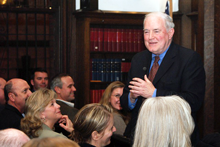
Professor Brian Kelley, retired CIA officer, speaking at The Institute of World Politics to students, faculty, and friends, on the "story behind the story" of the investigation of former FBI agent Robert Hanssen, who spied for the Soviet and Russian intelligence services from 1979 to 2001. For years, Prof. Kelley himself had been the prime suspect in a series of incidents that were actually the work of Hanssen's espionage. In November of 1998, investigators attempted to trap Kelley using a disinformation tactic. They had a man with a foreign accent come to Kelley's door and warn him that the FBI knew he was a spy. The man told him to go to a specific Metro station the next day to escape. The strategy was designed to prove Kelley's guilt by trapping him into trying to escape. Kelley instead reported the incident to the FBI, but that didn't ease the investigators' suspicions. Kelley and his family were interrogated and he was put on administrative leave for almost two years, ending only with Hanssen's arrest based on evidence obtained elsewhere. Photo courtesy The Institute of World Politics.
Shredding documents, destroying or recycling hard drives, and altering records are examples of destroying evidence of what the organization is concealing. Even when evidence destruction is the primary concealment strategy, it's effective only if all evidence is destroyed or rendered unobtainable.
The testimony of witnesses is one kind of evidence that cannot be destroyed as long as the witnesses are able to bear witness. Testimony can be prevented by intimidation, brutality, bribery, and other means, but if prevention fails, what then? From the concealer's perspective, two techniques can be effective even if the whistleblower blows the whistle.
- Indirect personal attacks
- Most whistleblowers anticipate direct personal attacks, but personal attacks can be directed at loved ones, too. Children, spouses, parents, siblings — all are potential targets. Spouses can be seduced. Legal, emotional, financial, marital, or other difficulties of close family members can be exposed and used to discredit or apply pressure to whistleblowers.
- If you already know of vulnerabilities of this kind, consider carefully how to protect yourself. Finding employment elsewhere is not protection from those who fear exposure. If the organization or its employees believe that you might someday become a problem, they might preemptively destroy your credibility in advance of any action you might take, no matter where you go for your next job or assignment. Effective protection usually involves convincing them of your ability to do more damage to them than they can do to you. That strategy often requires assembling evidence and seeking professional assistance.
- Direct disinformation
- Employees not directly implicated Finding employment elsewhere
is not protection from
those who fear exposurein the concealed activity (or inactivity) are potential candidate whistleblowers, because they often feel — justifiably or not — that they haven't themselves transgressed. From the perspective of those directly involved, even candidate whistleblowers constitute risk. To limit risk, false information of a seemingly incriminating nature is sometimes made available to them. Passing along this disinformation to investigators or media could then damage the whistleblower's credibility. - Don't assume that everything you think you know about the concealed activity is actually true. Be especially careful about material that came to you too easily, or uncorroborated, or which had a "stage-managed" feel. If you suspect that you've received disinformation, interpret it as an indicator that you're being targeted proactively as a potential whistleblower. That could mean that the organization, or individuals within it, have taken other actions as well, such as investigating you or your family members, or tampering with your work products or records. When you do pass along information to counsel, investigators, or media, be careful to indicate whether you suspect that any of it is disinformation intentionally passed along to you.
These tactics are rarely obvious. Intuition and good judgment are required. Trust the Force, Luke. First in this series  Top
Top  Next Issue
Is every other day a tense, anxious, angry misery as you watch people around you, who couldn't even think their way through a game of Jacks, win at workplace politics and steal the credit and glory for just about everyone's best work including yours? Read 303 Secrets of Workplace Politics, filled with tips and techniques for succeeding in workplace politics. More info
Your comments are welcome
Would you like to see your comments posted here? rbrendPtoGuFOkTSMQOzxner@ChacEgGqaylUnkmwIkkwoCanyon.comSend me your comments by email, or by Web form.About Point Lookout
 Thank you for reading this article. I hope you enjoyed it and
found it useful, and that you'll consider recommending it to a friend.
Thank you for reading this article. I hope you enjoyed it and
found it useful, and that you'll consider recommending it to a friend.
This article in its entirety was written by a human being. No machine intelligence was involved in any way.
Point Lookout is a free weekly email newsletter. Browse the archive of past issues. Subscribe for free.
Support Point Lookout by joining the Friends of Point Lookout, as an individual or as an organization.
Do you face a complex interpersonal situation? Send it in, anonymously if you like, and I'll give you my two cents.
Related articles
More articles on Workplace Politics:
 When Leaders Fight
- Organizations often pretend that feuds between leaders do not exist. But when the two most powerful
people in your organization go head-to-head, everyone in the organization suffers. How can you survive
a feud between people above you in the org chart?
 Obstacles to Finding the Reasons Why
- When we investigate what went wrong, we sometimes encounter obstacles. Interviewing witnesses and participants
doesn't always uncover the reasons why. What are these obstacles?
 Human Limitations and Meeting Agendas
- Recent research has discovered a class of human limitations that constrain our ability to exert self-control
and to make wise decisions. Accounting for these effects when we construct agendas can make meetings
more productive and save us from ourselves.
 Problem Displacement by Intention
- When solving problems creates new problems, or creates problems elsewhere, we say that problem displacement
has occurred. Sometimes it's intentional.
 Would Anyone Object?
- When groups consider whether to adopt proposals, some elect to poll everyone with a question of the
form, "Would anyone object if X?" It's a risky approach, because it can lead to damaging decisions
that open discussion in meetings can avoid.
See also Workplace Politics and Managing Your Boss for more related articles.
Forthcoming issues of Point Lookout
 Coming April 24: Antipatterns for Time-Constrained Communication: 1
- Knowing how to recognize just a few patterns that can lead to miscommunication can be helpful in reducing the incidence of problems. Here is Part 1 of a collection of communication antipatterns that arise in technical communication under time pressure. Available here and by RSS on April 24.
 And on May 1: Antipatterns for Time-Constrained Communication: 2
- Recognizing just a few patterns that can lead to miscommunication can reduce the incidence of problems. Here is Part 2 of a collection of antipatterns that arise in technical communication under time pressure, emphasizing those that depend on content. Available here and by RSS on May 1.
Coaching services
I offer email and telephone coaching at both corporate and individual rates. Contact Rick for details at rbrendPtoGuFOkTSMQOzxner@ChacEgGqaylUnkmwIkkwoCanyon.com or (650) 787-6475, or toll-free in the continental US at (866) 378-5470.
Get the ebook!
Past issues of Point Lookout are available in six ebooks:
- Get 2001-2 in Geese Don't Land on Twigs (PDF, )
- Get 2003-4 in Why Dogs Wag (PDF, )
- Get 2005-6 in Loopy Things We Do (PDF, )
- Get 2007-8 in Things We Believe That Maybe Aren't So True (PDF, )
- Get 2009-10 in The Questions Not Asked (PDF, )
- Get all of the first twelve years (2001-2012) in The Collected Issues of Point Lookout (PDF, )
Are you a writer, editor or publisher on deadline? Are you looking for an article that will get people talking and get compliments flying your way? You can have 500-1000 words in your inbox in one hour. License any article from this Web site. More info
Follow Rick


Recommend this issue to a friend
Send an email message to a friend
rbrendPtoGuFOkTSMQOzxner@ChacEgGqaylUnkmwIkkwoCanyon.comSend a message to Rick
A Tip A Day feed
Point Lookout weekly feed
 The message of Point Lookout is unique. Help get the message out. Please donate to help keep Point Lookout available for free to everyone.
 My blog, Technical Debt for Policymakers, offers
resources, insights, and conversations of interest to policymakers who are concerned with managing
technical debt within their organizations. Get the millstone of technical debt off the neck of your
organization!
My blog, Technical Debt for Policymakers, offers
resources, insights, and conversations of interest to policymakers who are concerned with managing
technical debt within their organizations. Get the millstone of technical debt off the neck of your
organization!Beware any resource that speaks of "winning" at workplace politics or "defeating" it. You can benefit or not, but there is no score-keeping, and it isn't a game.
- Wikipedia has a nice article with a list of additional resources
- Some public libraries offer collections. Here's an example from Saskatoon.
- Check my own links collection
- LinkedIn's Office Politics discussion group
 Is every other day a tense, anxious, angry misery as you watch people around you, who couldn't even
think their way through a game of Jacks, win at workplace politics and steal the credit and glory
for just about everyone's best work including yours? Read 303 Secrets of Workplace Politics!Learn how to make your virtual global team sing.A Tip a Day arrives by email, or by RSS Feed, each business day. It's 20 to 30 words at most, and gives
you a new perspective on the hassles and rewards of work life. Most tips also contain links to
related articles. Free!Learn how to make meetings more productive — and more rare.
Is every other day a tense, anxious, angry misery as you watch people around you, who couldn't even
think their way through a game of Jacks, win at workplace politics and steal the credit and glory
for just about everyone's best work including yours? Read 303 Secrets of Workplace Politics!Learn how to make your virtual global team sing.A Tip a Day arrives by email, or by RSS Feed, each business day. It's 20 to 30 words at most, and gives
you a new perspective on the hassles and rewards of work life. Most tips also contain links to
related articles. Free!Learn how to make meetings more productive — and more rare.