What's a global team? You'll find Skip to the Details:
How To Ordervarious definitions if you surf
around a bit, but the main features of a global team are what make them so difficult to manage
— the people are dispersed geographically, they meet infrequently or never, and they come from
different cultures.
The key to success for a global team is building
a sense of team despite the obstacles of separation
Is your organization a participant in one or more global teams? Are you the owner/sponsor of a global team? Are you managing a global team? Is everything going well, or at least as well as any project goes? Probably not. And the troubles people encounter are traceable to the obstacles global teams face when building working professional relationships from afar.
What you'll learn
 Read 303 Tips for Virtual and Global Teams to learn techniques for managing global teams — tips
and insights that could take you a lifetime to invent on your own. You'll learn:
Read 303 Tips for Virtual and Global Teams to learn techniques for managing global teams — tips
and insights that could take you a lifetime to invent on your own. You'll learn:
- How to build trust in a multicultural team where what defines "trustworthy" differs from person to person.
- How to run a telephone meeting effectively when a third of the attendees speak the language so poorly that it's difficult to understand what they mean, but since they all do it the same way, they understand each other perfectly.
- How to minimize errors when
critical documents are translated from one language to another by people who know how to translate, but who don't know even the basics of the subject matter. - How to divide the work so as to minimize turf battles and battles over budget.
- How to minimize resentments when only some members of the team are selected to attend the worldwide recognition banquet.
It's a massive collection — 49 pages (27,000 words) in all. That's about 2.2 times the size of Who Moved My Cheese?
Who can benefit
Check out my workshop on Managing Global and Distributed Teams. It's the most effective way I know to bring the skills of your organization to the level it needs.This tips book addresses a broad readership:
- Organizational leaders who want to guide sponsors and leaders of global teams within their organizations
- Sponsors of global teams who want better results faster
- Leaders of global teams and global project managers who want to adjust their approaches to the special requirements of a global or dispersed configuration
- Members of global teams who want to learn how to excel in the global team environment
What you do with it depends on your role in your organization. Here are just a few ideas:
- Organizational leaders
- Check out my Virtual Team Assessment Services. Find out how to make the people of your organization more effective managers and sponsors of distributed and global teams. MoreUse the tips book as part of a program for enhancing your organization's sophistication with global teams. Pick and choose ideas, add your own insights, and get the message out to the organization. Or have us customize the tips book to your organization to create training and reference materials for sponsors, project managers, team leads, and team members.
- Sponsors of global teams
- Downside surprises are anathema. To maximize your chances of getting what you want from the team, it helps to know what they need to get the job done. And what the team needs in the global dispersed configuration is different from what a less dispersed team needs. This tips book gives you insight into these needs — even about things the team itself doesn't recognize. Use these insights to manage risk, to project needed resources, to craft agreements among and between partner organizations, or to create your own tips book specifically for your team. Or let us work with you to customize these ideas to your particular project.
- Leaders of global teams and global project managers
- Looking for an economical training
alternative?
 Check out
Managing Global and Distributed Teams: Training Pack. A self-contained one-day training program,
including an 80-slide PowerPoint presentation, a 20,000 word script, and a copy of
303 Tips for Virtual and Global Teams. All for only !
MoreWhether managing a crisis or creating a risk management plan,
understanding the problems and pitfalls of the global dispersed organization helps you
deliver a successful project or operate with enhanced predictability.
Check out
Managing Global and Distributed Teams: Training Pack. A self-contained one-day training program,
including an 80-slide PowerPoint presentation, a 20,000 word script, and a copy of
303 Tips for Virtual and Global Teams. All for only !
MoreWhether managing a crisis or creating a risk management plan,
understanding the problems and pitfalls of the global dispersed organization helps you
deliver a successful project or operate with enhanced predictability. - Members of global teams
- Even experienced professionals can learn from this tips book how to excel in the global dispersed team configuration. You need new skills for communication, negotiation, and even for meeting people. This tips book suggests some of these skills, and it will get you thinking about many more.
What's in this tips book
This tips book includes a range of suggestions for helping people work better together in the global, dispersed team context. It's packed with tips and techniques for:
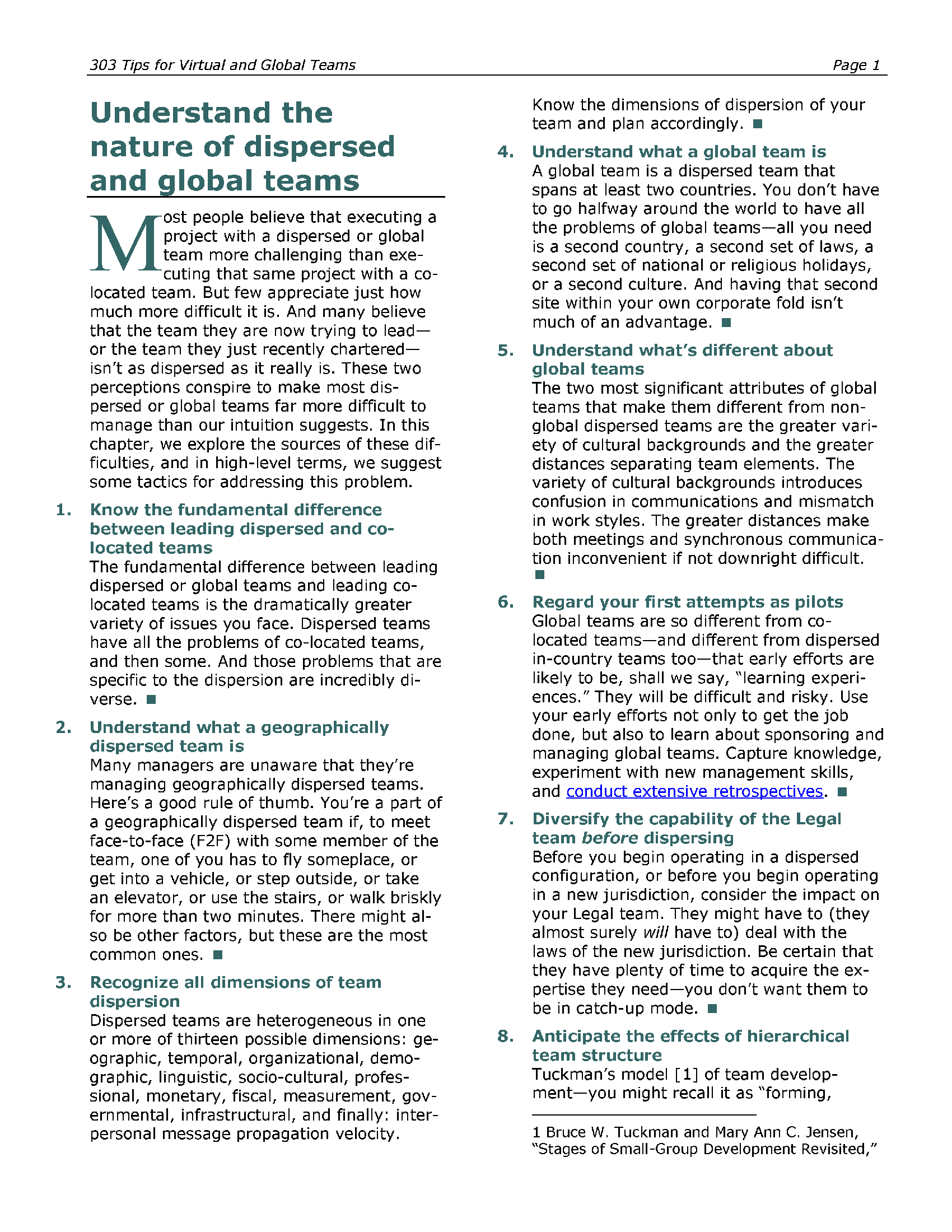
- Understanding the nature of global and dispersed teams
- Building and maintaining a high level of trust
- Planning your communications
- Dealing with dispersion
- Taking account of socio-cultural differences
- Taking account of language differences
- Allocating the work with dispersion in mind
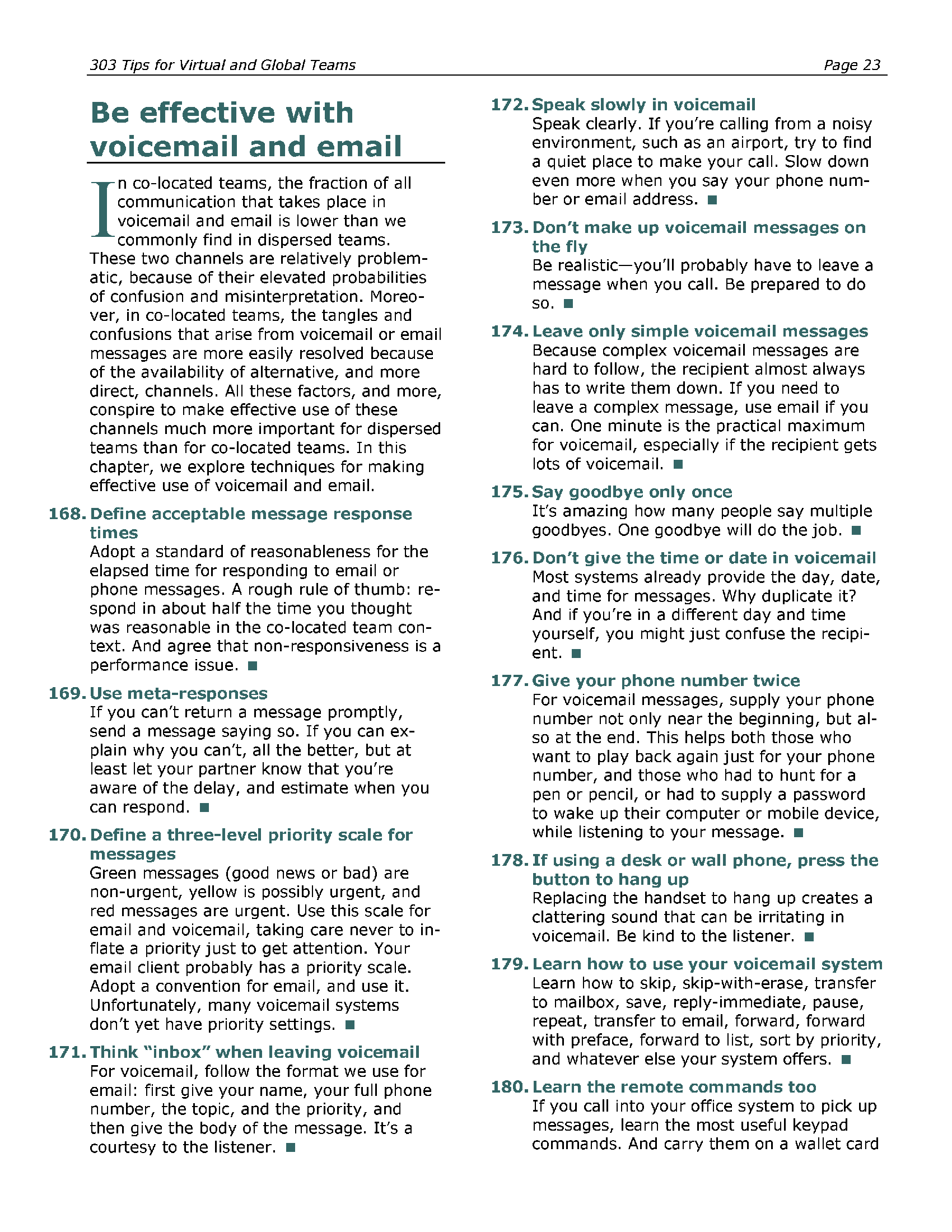
- Being smart about voicemail and email
- Be effective on the telephone
- Making your face-to-face meetings count
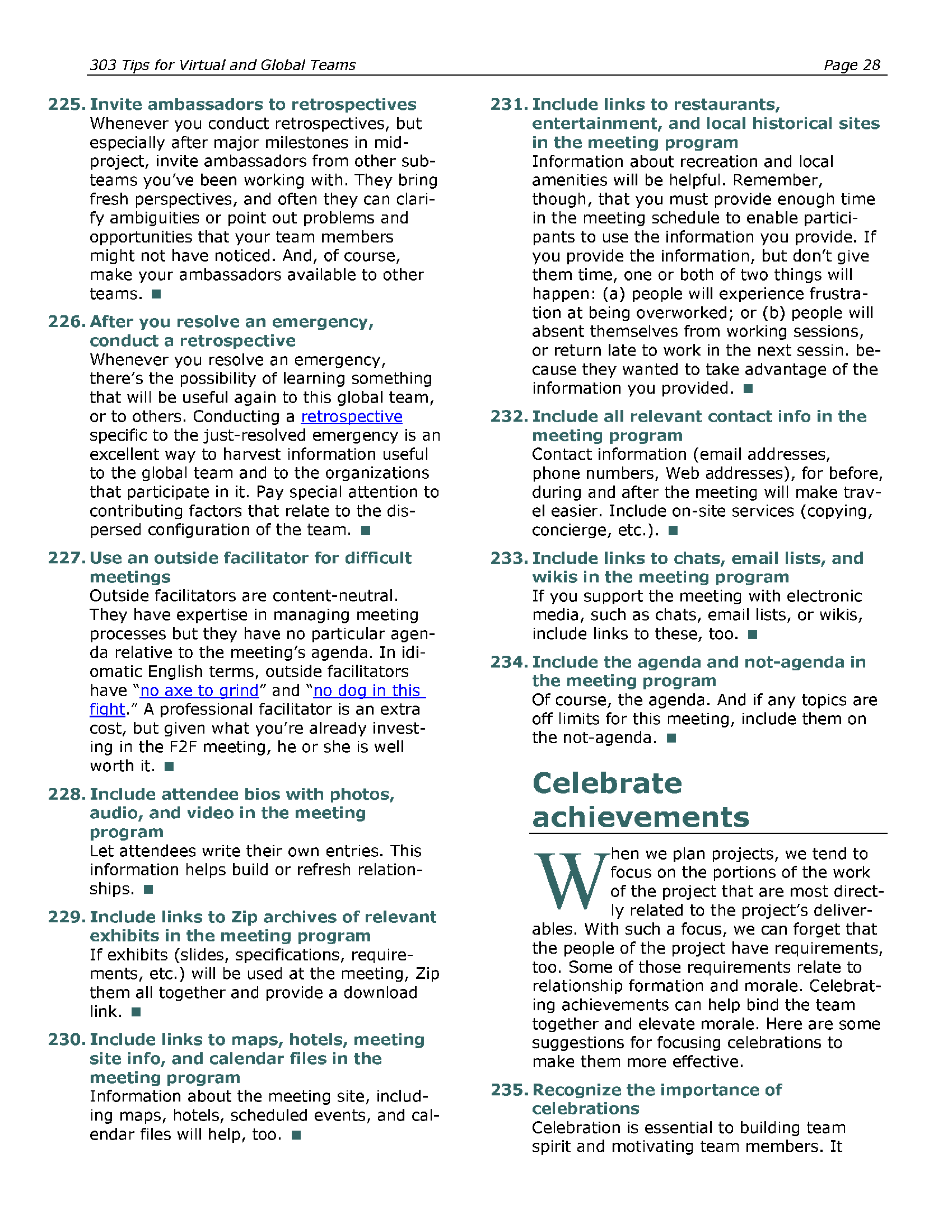
- Celebrating achievements
- Leading telemeetings proactively
- Participating fully in telemeetings
And it's all packaged in a single, compact ebook. Load it onto your Acrobat-enabled tablet, mobile devices, or laptop and carry it with you on your next trip.
Some sample tips
Here are some sample tips.
- For meetings, create a program, not just an agenda
- You'll probably circulate a pre-meeting information packet, and following the pattern of face-to-face teams, we tend to think of this as the meeting agenda. But for dispersed teams, it ought to be much more, because one of our goals is to foster relationships and trust. Think of it as a program. Model your program from the document you receive at the theatre, the ballet, or a sporting event. Include not only the agenda, but also roles and responsibilities, and short bios and photos. Include links to exhibits and to each person's personal home page, or relevant items in the Project Family Album. The program need not be an attached document; it can be links to pages at the project's Intranet site.
- Align budget authority with capability
- As you partition task responsibility among the different team components, take care to partition budget responsibility along parallel lines. When the two partitions are incongruent, tensions can develop as one budget control center attempts to export work (and therefore cost, schedule and risk) onto other budget control centers. By keeping the two partitions congruent, you limit these tensions and their associated politics.
- Appreciate the accounting system illusion
- Many organizations are seduced by the apparent economies of dispersed teams because the accounting system presents a false impression of where projects incur costs. Accounting systems lack line items for activities such as "building trust" or "informal water-cooler communication." Unfortunately, it is precisely this kind of item that sustains the most dramatic cost increases in the dispersed or global configuration relative to the face-to-face configuration. Take this illusion into account as you plan the dispersed project — you will have to find ways to sup-port these increased costs.
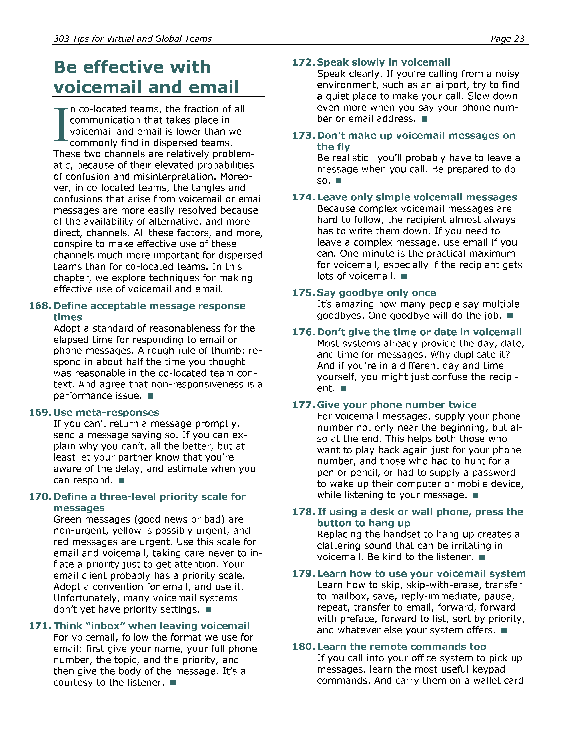
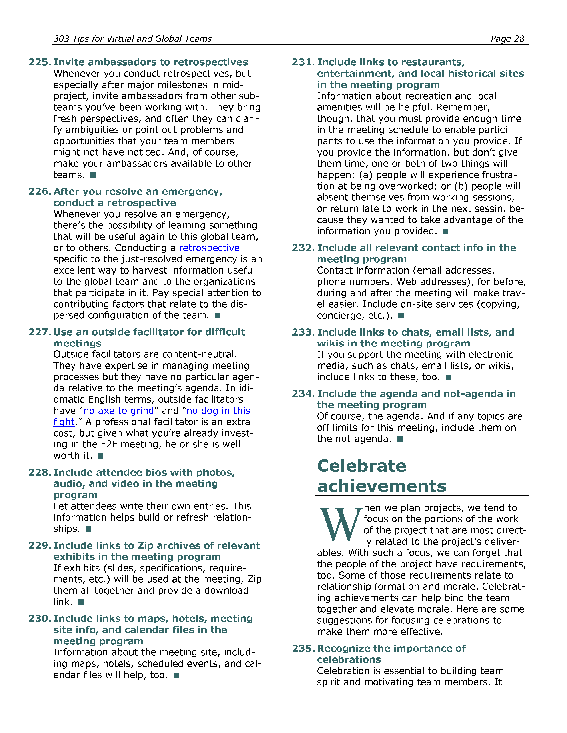
Screenshots
Click one of the miniature screenshot images below to expose a larger image; click that larger image to dismiss it.
How to order
This item is also available through ClickBank.com, the largest seller of downloadable products and software. If you prefer, you can .
This item is also available in a 10-pack (USD 166.95 per pack, or USD 16.70 per copy):
Or as a 50-pack (USD 665.00 per pack, or USD 13.30 per copy):
Or as a 100-pack (USD 1,129.00 per pack, or USD 11.29 per copy):
Or as a 500-pack (USD 4,659.00 per pack, or USD 9.32 per copy):
This book has an ISBN of 978-1-938932-12-0.
Table of contents
Click the folder icons to reveal (or hide) individual chapter content summaries, or:
- 1Know the fundamental difference between leading dispersed and co-located teams
- 2Understand what a geographically dispersed team is
- 3Recognize all dimensions of team dispersion
- 4Understand what a global team is
- 5Understand what's different about global teams
- 6Regard your first attempts as pilots
- 7Diversify the capability of the Legal team before dispersing
- 8Anticipate the effects of hierarchical team structure
- 9Recognize the Economic Paradox of dispersed teams
- 10Appreciate the accounting system illusion
- 11Understand the cost of dysfunction
- 12Develop dispersion-specific metrics
- 13Recognize the budgetary critical path
- 14Capture learning from foul-ups
- 15Expect a wider variety of hidden agendas
- 16Expect a wider variety of performance standards
- 17Expect increased likelihood and severity of communication problems
- 18Recognize the counter-synergy of cultural and geographic dispersion
- 19Expect more mismatch in work styles
- 20Understand Ashby's Law of Requisite Variety
- 21Harvest the experience of those who went before you
- 22Think of trust-building skills as organizational assets
- 23Consciously foster trust between team members
- 24Build trust hierarchically
- 25Conduct kickoff meetings face-to-face
- 26Beware the effects of split assignments on trust
- 27Conduct chartering sessions hierarchically
- 28Allocate time to resolving chartering ambiguities
- 29Eliminate coercive management
- 30Limit changes in team composition
- 31Deal with serious conflict face-to-face
- 32Don't let the accountants talk you out of travel
- 33Invest in relationship building
- 34Make a team family album
- 35Send birthday greetings
- 36Send holiday greetings when appropriate
- 37Clearly define roles and responsibilities
- 38Keep task groups small
- 39Make space for family involvement
- 40Encourage travelers to stay in the homes of team members
- 41Rotate meeting sites
- 42Rotate the travel burden for day-to-day work, too
- 43Choose site names carefully
- 44Rotate the site for the meeting leader or facilitator
- 45Rotate timing of teleconferences
- 46Monitor trust status
- 47Understand the issues for your team's communications
- 48View communications as a project in itself
- 49Develop a communications plan
- 50Appreciate communications risk
- 51Prepare for incompatible upgrades of substrate technologies
- 52Make an inventory of communications substrate technologies
- 53Prepare for upgrade synchronization skew within the embedding organizations
- 54Monitor IT upgrade plans at all sites
- 55Plan for addition or deletion of sites
- 56Investigate site addition and deletion processes, per site
- 57Make your communications system resistant to single-point communication failures
- 58Create organizational assets for single-point failure mitigation
- 59Understand how communications are affected by staff unavailability
- 60Understand how communications are affected by infrastructure changes
- 61Include IT in your team
- 62Understand the unique needs of long-lived teams
- 63Develop reusable communications plans
- 64Communicate as early as possible
- 65Have an inform-as-soon-as-you-know norm
- 66Understand the nature of non-verbal communication
- 67Train in non-verbal communication
- 68Take extra care when interpreting non-verbal communication
- 69Smoke out miscommunications proactively
- 70Define customs for email, text, wiki, and chat-based discussions
- 71Investigate records retention and destruction requirements for new channels
- 72Get training in audio, video, and email
- 73Vet your metaphors and allusions
- 74Review icon and logo designs
- 75Anticipate the effects of a reduction in informal communication
- 76Encourage people to "batch" less-than-urgent communications
- 77Consider dropping your landlines
- 78Create dedicated video wormholes in small meeting rooms
- 79Install video wormholes in the lunchroom
- 80Encourage OTWR threads in your email messaging system
- 81Prepare for personal tragedy
- 82Prepare for work-related tragedy
- 83Set Google Alerts for other sites
- 84Recognize the implications of the Economic Paradox
- 85Problem-solving skill is not enough
- 86Seek people who have a knack for finding a "third way"
- 87Seek problem-solving ambassadors
- 88Use compensation to collapse layers of subcontractors
- 89Eliminate pro forma project managers
- 90Allocate budget and schedule for dispersion taxes
- 91Anticipate organizational incompatibilities
- 92Investigate human resources policies
- 93Investigate recognition practices
- 94Understand fiscal mismatches
- 95Verify that software applications align
- 96Manage dispersion risk
- 97Send test shipments to uncover transnational shipping risks
- 98Manage turnover risk
- 99Manage contention risk
- 100Beware positive pressure gradients in split assignments
- 101Manage coherence risk
- 102Remember that malfeasance happens
- 103Manage malfeasance risk
- 104Recognize that malfeasance is culturally defined
- 105Make meetings as full-duplex as possible
- 106Delegate more deeply
- 107Track the incidence of I'll-have-to-get-back-to-you
- 108Define a team standard time
- 109Use Zulu time if you have multiple teams
- 110Know who's travel-capable at any given time
- 111Additional driver fees might apply
- 112Provide a travel concierge and staff
- 113Train your travelers in business travel
- 114Understand that the team culture is no longer your own culture
- 115Take care when referring to nations and nationalities
- 116Recognize that cultural diversity is an asset
- 117Recognize that cultural diversity is a potential risk
- 118Don't be fooled by your own effort data
- 119Expect expatriates to produce at levels consistent with their home cultures
- 120Pay attention to subcultures
- 121Vet your information sources
- 122Approach team trouble from a cultural perspective
- 123Deal with minor interpersonal problems immediately
- 124Beware the use of humor
- 125Consider training your team in cultural issues
- 126Foster cross-site relationships
- 127Manage your expectations about "buy-in"
- 128Define expectations about dates, times, and deadlines
- 129Define the consequences of missing dates
- 130Define the consequences of norm violation
- 131Research legal and religious holidays
- 132Know the dates of significant events
- 133Understand the cultural risks of videoconferences
- 134Beware numbers
- 135Be aware of rank
- 136Verify that your furniture, fonts, and supplies meet your needs
- 137Designate a team language
- 138Designate a meeting language
- 139Designate other languages and their scopes
- 140Have a translation/interpretation plan
- 141Take note of black market translations
- 142Use professional interpreters
- 143Use translators with domain expertise
- 144Avoid domain experts with translation expertise
- 145Understand how interpreters provide safety in tense situations
- 146Verify mission-critical translations
- 147Use sampling to verify less-than-critical translations
- 148Use code names instead of acronyms, abbreviations, and initialisms
- 149Explicitly decide on an alphabet and sort order
- 150Establish policy vis-à-vis localized software applications
- 151Choose filenames, directory names, email addresses, and domain names judiciously
- 152Avoid using organizational names for artifacts
- 153Understand the risks of fractal teams
- 154Pay special attention to modules that span sites
- 155Pay special attention to modules that span linguistic or cultural boundaries
- 156Pay special attention when a module spans a legacy or generational interface
- 157Avoid hockey-stick deliveries
- 158Use reconnaissance-in-force
- 159Use placeholders to uncover problems early
- 160Do "dry run" integrations periodically
- 161Get readings and guidance from Legal early and often
- 162Align module interfaces with site boundaries
- 163Align budget authority with capability
- 164Consider remodularizing according to geography
- 165Beware inappropriate partitioning
- 166Bring fluid modules closer together
- 167Segregate fluidity
- 168Define acceptable message response times
- 169Use meta-responses
- 170Define a three-level priority scale for messages
- 171Think "inbox" when leaving voicemail
- 172Speak slowly in voicemail
- 173Don't make up voicemail messages on the fly
- 174Leave only simple voicemail messages
- 175Say goodbye only once
- 176Don't give the time or date in voicemail
- 177Give your phone number twice
- 178If using a desk or wall phone, press the button to hang up
- 179Learn how to use your voicemail system
- 180Learn the remote commands too
- 181Customize your outgoing voicemail message
- 182Say your name and email address in your outgoing voicemail message
- 183Assume in your outgoing message that the caller knows how to leave voicemail
- 184Customize your outgoing message if you know you'll be away for an extended period
- 185Include outgoing message skip instructions
- 186Forward your line if you can take calls while away
- 187Consider calling their voicemail directly
- 188Always confirm — don't rely on silence
- 189Don't recycle irrelevant subject lines in email
- 190Use hierarchical subject lines
- 191Address email messages to group aliases instead of long lists of individuals
- 192Define acceptable topics for email
- 193Specify who can participate in email discussions
- 194Define criteria for switching from email to more direct channels
- 195Have a take-it-offline norm for email scuffles
- 196Ban Tweaking CCs
- 197Ban long, complex debates in email
- 198Ensure (in advance) safe passage through bulk mail filters
- 199Consider after-hours coverage
- 200Have regular check-ins for team members
- 201Have regular check-ins with your administrators
- 202Make appointments
- 203Keep your appointments
- 204Use Call Waiting only with Caller ID
- 205Eating, drinking, and chewing gum are no-nos on the phone
- 206Sit up straight or stand when you're on the phone
- 207Suspend interpretation of silences
- 208Slow down your "offense" response
- 209Express appreciations verbally, publicly, and often
- 210Get the very best mobile service you can find
- 211Use a headset at your desk and hands-free on your mobile
- 212Lock your mobile phone when you travel
- 213Don't skimp on the format of face-to-face meetings
- 214Having enough face-to-face meetings is cheaper than not having enough
- 215Give thought to the attendance list
- 216Create a program, not just an agenda
- 217Do something special to introduce people
- 218For long flights (more than 4-hour segments), fly business class
- 219Allow time and space for socializing
- 220Accommodate special dietary needs
- 221Preparation is important for everyone
- 222Ensure pre-meeting preparation
- 223Choose a venue that supports the work
- 224Conduct retrospectives while the project is still underway
- 225Invite ambassadors to retrospectives
- 226After you resolve an emergency, conduct a retrospective
- 227Use an outside facilitator for difficult meetings
- 228Include attendee bios with photos, audio, and video in the meeting program
- 229Include links to Zip archives of relevant exhibits in the meeting program
- 230Include links to maps, hotels, meeting site info, and calendar files in the meeting program
- 231Include links to restaurants, entertainment, and local historical sites in the meeting program
- 232Include all relevant contact info in the meeting program
- 233Include links to chats, email lists, and wikis in the meeting program
- 234Include the agenda and not-agenda in the meeting program
- 235Recognize the importance of celebrations
- 236Include a celebration in every face-to-face event
- 237Evaluate your celebration skills in co-located teams
- 238Allocate the organizational Morale Fund to individual teams
- 239Schedule celebrations near the middle of the stay
- 240Add recognition and honor to the mix
- 241Remember the people back home
- 242Consider dispersed banquets
- 243Restrict celebrations to team-relevant events
- 244Send invitations early
- 245Arrive early and welcome arriving attendees
- 246Choose passwords judiciously
- 247Favor symmetric meetings
- 248Avoid speakerphones
- 249Limit the attendance list
- 250Limit your objectives
- 251Limit the agenda
- 252Limit the number of speaking roles
- 253Hold some time in reserve
- 254Establish a timeline and enforce it ruthlessly
- 255Shift routine chores to pre-meeting activities
- 256Get training for meeting technologies in advance
- 257Manage technology risk
- 258Use trailing-edge technology when possible
- 259Set up a test meeting and leave it open for a day ahead of time
- 260Tailor exhibits to the needs of telemeetings
- 261Include on exhibits a URL for downloading
- 262Number the lines of complex documents
- 263Highlight key portions of exhibits
- 264Add a cover page (with large title) on exhibits
- 265Put version numbers on all exhibits
- 266Number the pages of all exhibits
- 267Include the document name on each page
- 268Create hyperlinks to other portions of the document
- 269Create and use bookmarks inside documents
- 270Distribute PDFs when possible
- 271Use bookmark panels in PDF and PowerPoint
- 272Keep the meeting short
- 273Schedule breaks and make them generous
- 274If you take a break, keep the connection alive
- 275Designate a scribe
- 276Use a parking lot
- 277Designate a parking lot attendant
- 278Get IM or texting addresses for all attendees who have speaking roles
- 279In asymmetric meetings, elicit contributions from tele-attendees
- 280Have a site chair at each site of an asymmetric telemeeting
- 281Skip the round-the-table introductions
- 282Establish an introduction norm for contributions
- 283Establish a handoff norm for contributions
- 284Establish a three-exchange limit for dialogs
- 285Be prepared for collapses of previously negotiated agreements
- 286Don't ever tighten knots
- 287Use podcasts
- 288Use a land line if you can
- 289Use a high-speed Internet connection
- 290Don't use the meeting to test tele-presentation software
- 291Listen by podcast if you don't have a speaking role
- 292Do your homework
- 293Close your door
- 294Mute your devices
- 295Mute other communication devices
- 296Take care of your biological needs
- 297Test the connection
- 298Monotask while on the phone
- 299In asymmetric telemeetings, wait to be recognized before speaking
- 300Do not eat while attending the meeting
- 301Mute yourself when you aren't speaking
- 302Practice muting/unmuting yourself before the call
- 303Identify yourself when you begin to speak
Follow Rick


Send an email message to a friend
rbrenIyeJIiAfnGdKlUXrner@ChacsxirZwZlENmHUNHioCanyon.comSend a message to Rick
A Tip A Day feed
Point Lookout weekly feed
 My blog, Technical Debt for Policymakers, offers
resources, insights, and conversations of interest to policymakers who are concerned with managing
technical debt within their organizations. Get the millstone of technical debt off the neck of your
organization!
My blog, Technical Debt for Policymakers, offers
resources, insights, and conversations of interest to policymakers who are concerned with managing
technical debt within their organizations. Get the millstone of technical debt off the neck of your
organization!Point Lookout by
starting your Amazon search here

 Save a bundle and even more important save time! Order the Combo Package and download all ebooks
and tips books at once.So buried in email that you don't even have time to delete your spam? Learn how to make
peace with your inbox.
Save a bundle and even more important save time! Order the Combo Package and download all ebooks
and tips books at once.So buried in email that you don't even have time to delete your spam? Learn how to make
peace with your inbox.