


Spreadsheet Models for Managers
Getting Access to Spreadsheet Models for Managers
If  you use Excel to model businesses, business processes, or
business transactions, this course will change your life. You’ll learn how to create tools for yourself that will amaze
even you. Unrestricted use of this material is available in two ways.
you use Excel to model businesses, business processes, or
business transactions, this course will change your life. You’ll learn how to create tools for yourself that will amaze
even you. Unrestricted use of this material is available in two ways.
- As a stand-alone Web site
- It resides on your computer, and you can use it anywhere. No need for Internet access.
- At this Web site
- If you have access to the Internet whenever you want to view this material, you can purchase on-line access. Unlimited usage. I’m constantly making improvements and you’ll get them as soon as they’re available.
To Order On Line
| Order "Spreadsheet Models for Managers, on-line edition, one month" by credit card, for USD 69.95 each, using our secure server, and receive download instructions by return email. |

| Order "Spreadsheet Models for Managers, on-line edition, three months" by credit card, for USD 199.00 each, using our secure server, and receive download instructions by return email. |
| Order "Spreadsheet Models for Managers, downloadable hyperbook edition" by credit card, for USD 199.00 each, using our secure server, and receive download instructions by return email. |
To Order by Mail
Make your check payable to Chaco Canyon Consulting, for the amount indicated:
|
And send it to: Chaco Canyon Consulting 700 Huron Avenue, Suite 19C Cambridge, MA 02138 |
To use the course software you’ll need some other applications, which you very probably already have. By placing your order, you’re confirming that you have the software you need, as described on this site.

Spreadsheet Models for Managers
| Constant demand | 11/10 Session Links |
- On annual basis:
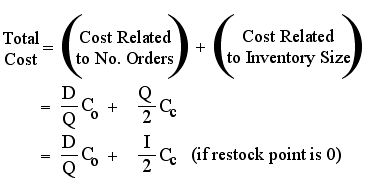
where
- D = Annual demand (units per year)
- Q = Quantity in one order (units)
- Co = Cost to place one order (dollars)
- Cc = Carrying cost of inventory (dollars per unit per year) (if restock point is 0)
For constant demand, use evenly spaced, equal sized orders
The total cost of acquiring and holding inventory has two contributions. Under conditions of constant demand, with equally spaced orders, the cost is as shown above in the second line. Since D/Q is the number of orders, multiplying by C0 gives the total cost of placing all the orders. And since the average inventory is Q/2, the cost of carrying the inventory is given by the second term. And since the average inventory is I/2 when the restock point is zero, we have the result as shown.

Last Modified: Wednesday, 27-Apr-2016 04:15:26 EDT
Although the assumption of constant demand is critical to justifying the derivation of the formula for Economic Order Quantity, most problems don’t satisfy that requirement in the strict sense. But EOQ is nevertheless a valuable concept in two kinds of circumstances. The first case is when the time scale of the inventory management decisions is much shorter than the time scale of the variations in demand. And the second is when the fluctuations in demand occur much more rapidly than the inventory management decisions.
These two approximations occur repeatedly in modeling problems. Watch for opportunities to apply them elsewhere.