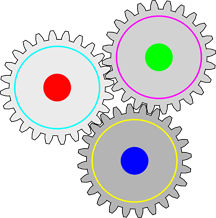
Three gears in a configuration that's inherently locked up. Any combination of an odd number of planar gears configured in a loop is inherently locked. When we communicate with each other under time pressure we're at risk of attempting to do the impossible without realizing it. We might inadvertently place too much emphasis on communication speed, and too little on communication quality. Image by J_Alves.
Communication can go wrong in so many ways and for so many different reasons that it's a wonder we can exchange any thoughts at all. But somehow, often, we can. And we can do even better if we learn to recognize communication patterns that lead to trouble even though they seem to be useful at first. Because these patterns lead to unwelcome outcomes, they're usually called antipatterns. [Koenig 1995]
This post and two more to come contain elements of one more tool you might add to your toolbox to help untangle miscommunications or — even better — to help prevent them. And to make this exploration manageable, I'll restrict it to time-constrained communication. The elements of this tool consist of a collection of antipatterns. Quoting Andrew Koenig, who coined the term in the context of software engineering, "An antipattern is just like a pattern, except that instead of a solution it gives something that looks superficially like a solution, but isn't one." We use many different patterns when we communicate. Among the simplest is what we say when we answer a phone: "Hello". Hello means, roughly, "I'm here and I'm listening; your turn." There are probably thousands of communication patterns. Some work, many don't. The ones that don't work are what we call antipatterns. This post has three examples. In what follows, I use the name Eugene (E for Expressing) when I'm referring to the person expressing an idea, asking a question, or in some other way contributing new material to an exchange. And I use the name Rachel (R for Receiving) when I'm referring to the person Receiving Eugene's communication. Finally, I assume that both Eugene and Rachel are under time pressure. With that prolog, here are three antipatterns that enhance the risk of miscommunication.- Too big and too complicated
- Eugene is busy and he knows that Rachel is too, so he tries to pack his message with his questions, insights, talking points, and all the background information he regards as relevant.
- As a Dealing with any subject with too
little time is unlikely to produce
the outcome we wantresult, what Eugene is trying to express is too complicated, too big, or requires too much time compared to the time available. If Rachel and Eugene push ahead anyway, confusion and miscommunication are the probable results. - Dealing with any subject with too little time is unlikely to produce the outcome they want. If Eugene's thoughts need more time, the two partners would do well to solve that problem first, and then address the subject of their conversation. If they can't expand the time available, exchanging messages in more compact packets is the best available alternative.
- Mismatched knowledge stacks
- A person's knowledge stack is the partially ordered collection of terms, experiences, and concepts that are needed to understand a message. For example, when someone asks for your email address, you retrieve it from your knowledge stack and relay it to the requestor. Or when you need to know the local time of day for someone you're planning to engage by phone, you reach into your knowledge stack for that answer or perhaps how to find that answer. Less trivial examples include the meanings of acronyms, or the current assessment of the capabilities of a market rival.
- When we fail to verify that participants in an exchange have compatible knowledge stacks, they might get deep into the exchange before they realize that they aren't using words or concepts in the same way. Then they have to retreat and reconstruct the conversation after they've verified that they're using terms compatibly. And they need to check that everyone's stack is free of gaps and omissions.
- One way to limit the occurrence of this antipattern is to publish and maintain a "terminology and concept glossary."
- Inappropriate focus: the McNamara Fallacy
- The McNamara Fallacy is the discredited idea that one can manage the missions of complex organizations by deriving guidance solely from numeric measurements of inputs and outputs. If these "metrics" are correctly chosen, so says the Fallacy, we can make good decisions based only on these metrics. [Baskin 2014] [Muller 2019] In this way, the Fallacy causes us to confuse Objectivity with Importance. More
- An antipattern in itself, the McNamara Fallacy appears in many contexts beyond communications. In the communications context, the McNamara Fallacy causes the exchange participants to focus attention on the values of one or a few metrics, instead of the process or entity that the metrics supposedly represent.
- For example, if a team is concerned that attendance at meetings is 85% instead of the goal value of 95%, the conversation might focus on percentage overall attendance instead of the fact that on average, all of the "right people" for any given meeting have been attending with regularity.
- By misleading the team with objective-sounding data, the Fallacy can cause a team to focus on related but inessential material instead of material that's central to the team's mission.
Last words
These three causes of miscommunication under time pressure are generic in the sense that they don't depend on message content. Next time I'll examine some patterns that lead to miscommunications in ways that do depend on message content. Next in this series Top
Top
Are you fed up with tense, explosive meetings? Are you or a colleague the target of a bully? Destructive conflict can ruin organizations. But if we believe that all conflict is destructive, and that we can somehow eliminate conflict, or that conflict is an enemy of productivity, then we're in conflict with Conflict itself. Read 101 Tips for Managing Conflict to learn how to make peace with conflict and make it an organizational asset. Order Now!
Footnotes
Your comments are welcome
Would you like to see your comments posted here? rbrendPtoGuFOkTSMQOzxner@ChacEgGqaylUnkmwIkkwoCanyon.comSend me your comments by email, or by Web form.About Point Lookout
 Thank you for reading this article. I hope you enjoyed it and
found it useful, and that you'll consider recommending it to a friend.
Thank you for reading this article. I hope you enjoyed it and
found it useful, and that you'll consider recommending it to a friend.
This article in its entirety was written by a human being. No machine intelligence was involved in any way.
Point Lookout is a free weekly email newsletter. Browse the archive of past issues. Subscribe for free.
Support Point Lookout by joining the Friends of Point Lookout, as an individual or as an organization.
Do you face a complex interpersonal situation? Send it in, anonymously if you like, and I'll give you my two cents.
Related articles
More articles on Effective Communication at Work:
 Let Me Finish, Please
- We use meetings to exchange information and to explore complex issues. In open discussion, we tend to
interrupt each other. Interruptions can be disruptive, distracting, funny, essential, and frustratingly
common. What can we do to limit interruptions without depriving ourselves of their benefits?
 Begging the Question
- Begging the question is a common, usually undetected, rhetorical fallacy. It leads to unsupported conclusions
and painful places we just can't live with. What can we do when it happens?
 The Fine Art of Quibbling
- We usually think of quibbling as an innocent swan dive into unnecessary detail, like calculating shares
of a lunch check to the nearest cent. In debate about substantive issues, a detour into quibbling can
be far more threatening — it can indicate much deeper problems.
 Dealing with Condescension
- Condescending remarks hurt. When we feel that pain, we often feel the urge to retaliate, even when retaliation
might not be appropriate. Our responses are more effective when we understand where condescending remarks
come from.
 The Passion-Professionalism Paradox
- Changing the direction of a group or a company requires passion and professionalism, two attributes
often in tension. Here's one possible way to resolve that tension.
See also Effective Communication at Work and Effective Meetings for more related articles.
Forthcoming issues of Point Lookout
 Coming May 1: Antipatterns for Time-Constrained Communication: 2
- Recognizing just a few patterns that can lead to miscommunication can reduce the incidence of miscommunications. Here's Part 2 of a collection of antipatterns that arise in communication under time pressure, emphasizing those that depend on content. Available here and by RSS on May 1.
- And on May 8: Antipatterns for Time-Constrained Communication: 3
- Recognizing just a few patterns that can lead to miscommunication can reduce the incidence of problems. Here is Part 3 of a collection of antipatterns that arise in technical communication under time pressure, emphasizing past experiences of participants. Available here and by RSS on May 8.
Coaching services
I offer email and telephone coaching at both corporate and individual rates. Contact Rick for details at rbrendPtoGuFOkTSMQOzxner@ChacEgGqaylUnkmwIkkwoCanyon.com or (650) 787-6475, or toll-free in the continental US at (866) 378-5470.
Get the ebook!
Past issues of Point Lookout are available in six ebooks:
- Get 2001-2 in Geese Don't Land on Twigs (PDF, )
- Get 2003-4 in Why Dogs Wag (PDF, )
- Get 2005-6 in Loopy Things We Do (PDF, )
- Get 2007-8 in Things We Believe That Maybe Aren't So True (PDF, )
- Get 2009-10 in The Questions Not Asked (PDF, )
- Get all of the first twelve years (2001-2012) in The Collected Issues of Point Lookout (PDF, )
Are you a writer, editor or publisher on deadline? Are you looking for an article that will get people talking and get compliments flying your way? You can have 500-1000 words in your inbox in one hour. License any article from this Web site. More info
Follow Rick


Recommend this issue to a friend
Send an email message to a friend
rbrendPtoGuFOkTSMQOzxner@ChacEgGqaylUnkmwIkkwoCanyon.comSend a message to Rick
A Tip A Day feed
Point Lookout weekly feed
 My blog, Technical Debt for Policymakers, offers
resources, insights, and conversations of interest to policymakers who are concerned with managing
technical debt within their organizations. Get the millstone of technical debt off the neck of your
organization!
My blog, Technical Debt for Policymakers, offers
resources, insights, and conversations of interest to policymakers who are concerned with managing
technical debt within their organizations. Get the millstone of technical debt off the neck of your
organization! Bad boss, long commute, troubling ethical questions, hateful colleague? Learn what we can do when we
love the work but not the job.Learn how to make your virtual global team sing.Are you managing a change effort that faces rampant cynicism, passive non-cooperation, or
maybe even outright revolt?Learn how to make meetings more productive — and more rare.
Bad boss, long commute, troubling ethical questions, hateful colleague? Learn what we can do when we
love the work but not the job.Learn how to make your virtual global team sing.Are you managing a change effort that faces rampant cynicism, passive non-cooperation, or
maybe even outright revolt?Learn how to make meetings more productive — and more rare.