When companies or projects get into trouble, we take corrective action, and usually we get things back into alignment. When we can't, and when new problems come up one after the other, we often describe our activities as "firefighting." We think of ourselves as moving from fire to fire, putting out the flames.
Firefighting is a metaphor that's more useful than it first appears. If we study the operations of the professional, especially wildland firefighters, we can learn some lessons that apply to managing projects or companies.
Safety first
Wildland firefighters know that they're doing dangerous work. They're trained in safety, and everyone understands that safety is the first priority. Just as wildland firefighting is dangerous, organizational firefighting is career-dangerous. Too often we put our own careers at risk, and expect others to willingly do so, too. They rarely do.
Asking people to take high-risk responsibilities without regard to their career health is unreasonable.
If we want people to step forward when they're needed, we must configure high-risk assignments to benefit the people who accept them.
Fire is natural
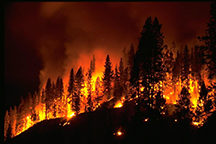 Wildland fire is a natural part of the ecosystem. Many plants and
animals depend on the effects of fire for their own health and for their very survival.
Wildland fire is a natural part of the ecosystem. Many plants and
animals depend on the effects of fire for their own health and for their very survival.
Sometimes we think of "organizational fires" as annoying and unexpected. We see them as signs of our failure to anticipate well enough, or as signs of poor team performance.
Organizational fires are natural for some kinds of work. They happen in almost all innovative organizations, because innovation is a high-risk activity. When you plan a project, include reserves to handle organizational fires. Expect the unexpected.
Fire spreads
Wildland firefighters don't try to extinguish major fires — they control them. They direct the fire into uninhabited areas, or into areas that will cause the fire to burn out.
When a project is in trouble, and we try to save it, we inevitably expend scarce resources and attention in what might be a futile effort. This puts other projects at risk, and can cause the organizational fire to spread.
When wisdom and experience suggest early cancellation or liquidation, consider these options seriously. By trying to "put out" the fire, we put the larger organization — or its remaining resources — at risk. Focus on protecting the parts of the organization that aren't yet on fire yet, rather than on rescuing doomed ventures.
Fight fire with hotshot teams
The US Forest Service uses a network of elite "Hotshot" teams to fight wildland fire. Local forest management staff may help out, but the hotshot teams are the primary firefighting resource. Team members are highly trained in wildland firefighting, they're in prime physical condition, and they're dedicated to their jobs.
For some reason, organizations typically rely on operational teams to extinguish their own fires. Except for a few consultants who do specialize in company or project turnarounds, we generally don't train or hire "organizational fire" specialists. Why not?
If your organization has many fires, consider designating and training an elite hotshot team of your own people. If you have a smaller organization, or if fires are rare, very high-risk or complex, use consulting specialists to fight organizational fires. Their experience is a valuable asset.
Understand and monitor the effects of weather
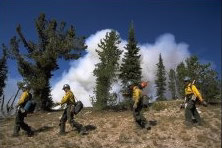 Fire danger is predictable. The Forest Service knows that
when the weather is hot and dry, and when fuel is abundant, forest fires are more likely. They
prepare accordingly.
Fire danger is predictable. The Forest Service knows that
when the weather is hot and dry, and when fuel is abundant, forest fires are more likely. They
prepare accordingly.
Organizational fires usually take us by surprise. We know how good (or bad) business is, and we track revenue trends pretty well, yet we often fail to use that information to adjust activities that are "fire-prone" - until they burst into flame.
Create a Fire Forecaster function, responsible for predicting the likelihood of organizational fire. Understand that when business is brisk, the organizational "forest" is building up fuel for fires. When business slackens, the Fire Forecasters will help plan anticipatory cutbacks to reduce the incidence of organizational fire.
Declare fire status
Wherever you go in US forests, you can see signs indicating the local fire status. Fire status determines the mode of operations for local forest management staff.
Although we're often in firefighting mode, we don't really know we are, and we don't know what it means, exactly. This ambiguity limits our ability to act in unison.
Most organizations think of firefighting mode as an informal concept, but you can make it formal. Defining a series of fire status levels for your organization removes ambiguity, and facilitates management actions in times of difficulty.
Track fire metrics
Historical data about fire conditions helps the forest service predict fire behavior. They use this information to allocate resources during fire season, and plan for the future.
Managers rarely know how much of the time the organization operates in "firefighting mode," or even what kinds of projects tend to be fire-prone. We fight organizational fires blindly, often caught by surprise when they occur.
By formally declaring fire status, and tracking these declarations, management could acquire a new set of data streams that could be helpful for predicting and managing organizational fires.
Effective organizational management requires acknowledging the reality and importance of
organization fire. To pretend that organizational fire doesn't exist, or that it can be
completely eliminated, is to provide fuel for the next fire.  Top
Top
References
For more info about wildland firefighting in the US, visit the US Public Broadcasting Web page about the Nova program "Fire Wars". Order from Amazon.com
Contact me
Does your organization spend too much time in firefighting mode? Contact me to discuss your specific situation, by email at rbrenjTnUayrCbSnnEcYfner@ChacdcYpBKAaMJgMalFXoCanyon.com or by telephone at (650) 787-6475, or toll-free at (866) 378-5470 in the continental US.
Are you a writer, editor or publisher on deadline? Are you looking for an article that will get people talking and get compliments flying your way? You can have 500-1000 words in your inbox in one hour. License any article from this Web site. More info
Follow Rick


Send an email message to a friend
rbrenjTnUayrCbSnnEcYfner@ChacdcYpBKAaMJgMalFXoCanyon.comSend a message to Rick
A Tip A Day feed
Point Lookout weekly feed
 My blog, Technical Debt for Policymakers, offers
resources, insights, and conversations of interest to policymakers who are concerned with managing
technical debt within their organizations. Get the millstone of technical debt off the neck of your
organization!
My blog, Technical Debt for Policymakers, offers
resources, insights, and conversations of interest to policymakers who are concerned with managing
technical debt within their organizations. Get the millstone of technical debt off the neck of your
organization!Point Lookout by
starting your Amazon search here

 Are your project teams plagued by turnover, burnout, and high defect rates? Turn your culture around.Save a bundle and even more important save time! Order the Combo Package and download all ebooks
and tips books at once.Bad boss, long commute, troubling ethical questions, hateful colleague? Learn what we can do when we
love the work but not the job.When you resume a paused project, are you frustrated by the politics? Learn techniques for leaders
of resuming projects.So buried in email that you don't even have time to delete your spam? Learn how to make
peace with your inbox.Learn how to make meetings more productive — and more rare.Fed up with tense, explosive meetings? Are you the target of a bully? Learn how to make peace with conflict.
Are your project teams plagued by turnover, burnout, and high defect rates? Turn your culture around.Save a bundle and even more important save time! Order the Combo Package and download all ebooks
and tips books at once.Bad boss, long commute, troubling ethical questions, hateful colleague? Learn what we can do when we
love the work but not the job.When you resume a paused project, are you frustrated by the politics? Learn techniques for leaders
of resuming projects.So buried in email that you don't even have time to delete your spam? Learn how to make
peace with your inbox.Learn how to make meetings more productive — and more rare.Fed up with tense, explosive meetings? Are you the target of a bully? Learn how to make peace with conflict.