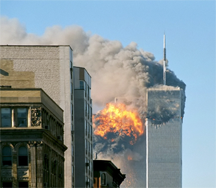
United Airlines Flight 175 crashes into the south tower of the World Trade Center complex in New York City during the September 11 attacks. Image (cc) Attribution-ShareAlike 2.0 Generic by Flickr user TheMachineStops (Robert J. Fisch) courtesy Wikipedia.

Everything changed on September Eleventh, and we're still learning the meaning of "everything." People working on projects, especially those that involve air travel, are now struggling with Change. Among models of Change, the Satir Change Model, developed by Virginia Satir, stands out for me as especially useful. It describes how we respond to change, using six elements:
- Old Status Quo
- The initial state of the system, before the change cycle begins. Example: September 10.
- Foreign Element
- The event, incident, or new information that disrupts the Old Status Quo. Example: the events of September 11.
- Chaos
- The state of confusion and disruption that persists following the recognition of the Foreign Element. Example: where we are now — we haven't yet adjusted to the new situation.
- Transforming Idea
- The realization or concept that takes us from Chaos toward a new way of operating. We probably don't yet have the Transforming Idea for the change cycle resulting from the events of September 11.
- Integration and Practice
- A period of assimilation of the Transforming Idea, when we practice ways of incorporating it into our operations.
- New Status Quo
- The Chaos of change
can create stress,
fatigue and
erratic performance - After we've integrated the Transforming Idea into our operations, a New Status Quo begins, in which we continue to enhance performance.
For many of us right now, after the Foreign Element that arrived on September 11, disruptions persist:
- Loss of key personnel, plant, equipment, and communications infrastructure
- Business disruption
- Unwillingness of staff to travel by air
- Restricted travel budgets
- Reductions in flight availability
- Increased inconvenience in traveling by air
These consequences become Foreign Elements themselves, with new change cycles of their own. The Satir Change Model provides a useful guide for dealing with them. I'll focus for now on Chaos, where most of us are right now.
- When in Chaos, acknowledge it
- Recognize that you're in Chaos, and that most people are under stress. Watch for signs of fatigue and erratic performance, and give people time to rest and to share their concerns. Use Temperature Readings to help people vent. See "Take Regular Temperature Readings," Point Lookout for August 29, 2001.
- Recognize the tug of Old Status Quo
- Chaos is uncomfortable. Many of us don't like it, and try to resurrect the Old Status Quo. Let go. Accept the change, and know that there's no going back. For example, if air travel now takes much longer, adjust project schedules — and employee compensation — accordingly.
- In Chaos, make no major decisions or commitments
- While we must make decisions, beware of making long-term decisions. When the Transforming Idea arrives, it will certainly provide better guidance than we now have. For example, avoid committing to a new project involving air travel.
- Watch for the Transforming Idea
- The Transforming Idea can come from anywhere — any level of your organization, even a competitor. Be open to ideas from all directions and all employees.
Chaos is not a bad thing. It just is. To manage through it, we must first accept it. Perhaps this is what Dorothy knew when, as she entered the Land of Oz for the first time, she said, "Toto, I have a feeling that we're not in Kansas anymore."  Top
Top  Next Issue
Is your organization embroiled in Change? Are you managing a change effort that faces rampant cynicism, passive non-cooperation, or maybe even outright revolt? Read 101 Tips for Managing Change to learn how to survive, how to plan and how to execute change efforts to inspire real, passionate support. Order Now!
For more on the Satir Change Model, see "Change How You Change," Point Lookout for March 20, 2002, and "Piling Change Upon Change: Management Credibility," Point Lookout for October 18, 2006. For other examples of the effects of change-driven Chaos, see "The True Costs of Cost-Cutting," Point Lookout for January 30, 2008.
Your comments are welcome
Would you like to see your comments posted here? rbrenaXXxGCwVgbgLZDuRner@ChacDjdMAATPdDNJnrSwoCanyon.comSend me your comments by email, or by Web form.About Point Lookout
 Thank you for reading this article. I hope you enjoyed it and
found it useful, and that you'll consider recommending it to a friend.
Thank you for reading this article. I hope you enjoyed it and
found it useful, and that you'll consider recommending it to a friend.
This article in its entirety was written by a human being. No machine intelligence was involved in any way.
Point Lookout is a free weekly email newsletter. Browse the archive of past issues. Subscribe for free.
Support Point Lookout by joining the Friends of Point Lookout, as an individual or as an organization.
Do you face a complex interpersonal situation? Send it in, anonymously if you like, and I'll give you my two cents.
Related articles
More articles on Organizational Change:
 Outsourcing Each Other's Kids
- Outsourcing is now so widespread that it has achieved status as a full-fledged management fad. But many
outsourcing decisions lack the justification that a full financial model provides. Here are some of
the factors that such a model should include.
 The Restructuring-Fear Cycle: II
- When enterprises restructure, reorganize, downsize, outsource, lay off, or make other organizational
adjustments, they usually focus on financial health. Here's Part II of an exploration of how the fear
induced by these changes can lead to the need for further restructuring.
 Motivation and the Reification Error
- We commit the reification error when we assume, incorrectly, that we can treat abstract constructs as
if they were real objects. It's a common error when we try to motivate people.
 Contrary Indicators of Psychological Safety: II
- When we begin using new tools or processes, we make mistakes. Practice is the cure, but practice can
be scary if the grace period for early mistakes is too short. For teams adopting new methods, psychological
safety is a fundamental component of success.
 Storming: Obstacle or Pathway?
- The Storming stage of Tuckman's model of small group development is widely misunderstood. Fighting the
storms, denying they exist, or bypassing them doesn't work. Letting them blow themselves out in a somewhat-controlled
manner is the path to Norming and Performing.
See also Organizational Change for more related articles.
Related programs
 Although the Satir Change Model model was
originally developed by Virginia Satir for managing change in individuals and family systems, it's
no less valuable for managing change in the workplace. My program, "Managing in Fluid Environments," explores how to apply this model in situations where changes
come along at such a rapid rate that the next change comes along before we reach the "New Status
Quo" of the changes we're already dealing with. More about this program.
Although the Satir Change Model model was
originally developed by Virginia Satir for managing change in individuals and family systems, it's
no less valuable for managing change in the workplace. My program, "Managing in Fluid Environments," explores how to apply this model in situations where changes
come along at such a rapid rate that the next change comes along before we reach the "New Status
Quo" of the changes we're already dealing with. More about this program.
 My program, "Changing How We Change: The Essence of Agility," focuses more intently on applications of the change model in a
wide variety of situations at work, from the perspective of organizational agility. This point of view
is especially valuable to people in organizations that use agile product development processes.
By applying the Satir Change Model, and more recent developments from group psychology, we can
substantially enhance an organization's ability to adapt to changing circumstances, and to transform itself
to more competitive stances. More about this program.
My program, "Changing How We Change: The Essence of Agility," focuses more intently on applications of the change model in a
wide variety of situations at work, from the perspective of organizational agility. This point of view
is especially valuable to people in organizations that use agile product development processes.
By applying the Satir Change Model, and more recent developments from group psychology, we can
substantially enhance an organization's ability to adapt to changing circumstances, and to transform itself
to more competitive stances. More about this program.
Are you planning an offsite or retreat for your organization? Or a conference for your professional society? My programs are fresh, original, and loaded with concrete tips that make an immediate difference. rbrenaXXxGCwVgbgLZDuRner@ChacDjdMAATPdDNJnrSwoCanyon.comContact me to discuss possibilities.
Forthcoming issues of Point Lookout
 Coming October 1: On the Risks of Obscuring Ignorance
- When people hide their ignorance of concepts fundamental to understanding the issues at hand, they expose their teams and organizations to a risk of making wrong decisions. The organizational costs of the consequences of those decisions can be unlimited. Available here and by RSS on October 1.
 And on October 8: Responding to Workplace Bullying
- Effective responses to bullying sometimes include "pushback tactics" that can deter perpetrators from further bullying. Because perpetrators use some of these same tactics, some people have difficulty employing them. But the need is real. Pushing back works. Available here and by RSS on October 8.
Coaching services
I offer email and telephone coaching at both corporate and individual rates. Contact Rick for details at rbrenaXXxGCwVgbgLZDuRner@ChacDjdMAATPdDNJnrSwoCanyon.com or (650) 787-6475, or toll-free in the continental US at (866) 378-5470.
Get the ebook!
Past issues of Point Lookout are available in six ebooks:
- Get 2001-2 in Geese Don't Land on Twigs (PDF, )
- Get 2003-4 in Why Dogs Wag (PDF, )
- Get 2005-6 in Loopy Things We Do (PDF, )
- Get 2007-8 in Things We Believe That Maybe Aren't So True (PDF, )
- Get 2009-10 in The Questions Not Asked (PDF, )
- Get all of the first twelve years (2001-2012) in The Collected Issues of Point Lookout (PDF, )
Are you a writer, editor or publisher on deadline? Are you looking for an article that will get people talking and get compliments flying your way? You can have 500-1000 words in your inbox in one hour. License any article from this Web site. More info
Follow Rick


Recommend this issue to a friend
Send an email message to a friend
rbrenaXXxGCwVgbgLZDuRner@ChacDjdMAATPdDNJnrSwoCanyon.comSend a message to Rick
A Tip A Day feed
Point Lookout weekly feed
 My blog, Technical Debt for Policymakers, offers
resources, insights, and conversations of interest to policymakers who are concerned with managing
technical debt within their organizations. Get the millstone of technical debt off the neck of your
organization!
My blog, Technical Debt for Policymakers, offers
resources, insights, and conversations of interest to policymakers who are concerned with managing
technical debt within their organizations. Get the millstone of technical debt off the neck of your
organization! Are your project teams plagued by turnover, burnout, and high defect rates? Turn your culture around.
- Your stuff is brilliant! Thank you!
- You and Scott Adams both secretly work here, right?
- I really enjoy my weekly newsletters. I appreciate the quick read.
- A sort of Dr. Phil for Management!
- …extremely accurate, inspiring and applicable to day-to-day … invaluable.
- More
Are you managing a change effort that faces rampant cynicism, passive non-cooperation, or
maybe even outright revolt?Fed up with tense, explosive meetings? Are you the target of a bully? Learn how to make peace with conflict.Save a bundle and even more important save time! Order the Combo Package and download all ebooks
and tips books at once.