Great teams don't just happen. The people who belong to them, and the organizations those teams belong to, make them great teams. It takes skill, the right resources, commitment, and — usually — the right guide. That's my role. I might be that guide for your team.
Great teams are rare, whether you call them "great teams" (my preference) or "high performance teams." To make your team a great team, the first step is to recognize how rare the desire for greatness truly is. Most teams are focused on putting out yesterday's brush fires. They have little energy left to think about making the team a great team. But you're one of the lucky few that think about greatness. And that puts you a long way down the path to achieving it.
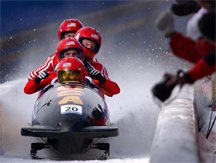
Bobsled racing is a team sport
There are three things to do to make any team a great team. Keep what's working, Change what isn't working so well, and Add some new things that might work better than what you're doing now. Keep, Change, and Add. Simple, but not so easy.
And there's something that makes this transformation a little tricky. As the team develops, we have to evolve what we Keep, what we Change and what we Add. Choosing wisely and choosing the timing wisely are delicate matters.
It takes commitment — months, rather than weeks — because changing a team requires changing the relationships between the people on the team, and changing the approaches of the team members themselves.
In the Great Teams Workshop, we take a look at your team — together. We learn its strengths and weaknesses. We explore its limitations. We uncover which limitations we can deal with right now, and which ones we have to accept for the time being. This examination can be difficult, because we have to see things as they really are. But we can do it if we follow a process of purposeful change:
- Becoming aware: We uncover the current state of things.
- Accepting: Through discussion and simulation we explore the premise that you can change only what you accept as real.
- Acknowledging: Whatever does change will change only as a result of actions that we ourselves take.
- Charting: The team devises a plan for making the changes.
- Executing: The changes begin. Based on results, we might revise the plan, or even discover new insights we had previously missed. We flex.
- Changing: With experience we learn about changing, and we change how we change.
This isn't a linear process. And the people of the team don't have to (and probably cannot) travel the steps of the path in the same ways or at the same time. But as they move along they gradually move closer together, and almost without understanding how it happened, suddenly we notice huge changes for the better.
This program is available as a workshop or clinic. For the shorter formats, coverage of the outline below is selective.
The returns on greatness
Too often, our goal in developing teams is only that they work well enough to get the job done. We sometimes spend some effort and cash on "team building," but even when we do that we're satisfied if the goal is achieved without too much strife, delay, and budget-busting. That's the main reason why — once the team-builders have left the building — we so often return to our old ways.
But greatness really pays. The primary mechanism that leads to the financial returns on greatness is based on loyalty and trust. Here are just three of the ways greatness pays.
- Reduced absenteeism and turnover
- One thing you hear very frequently in talking to wounded soldiers is their desire to get back to their units. You hear this even from the most gravely injured. They want to return to their units because they don't want to let their buddies down. This is a hallmark of a great team. In great teams, loyalty to one's teammates drives down absenteeism and turnover, two very important cost drivers of the modern organization.
- More predictable deliveries
- Loyalty also make deliveries more predictable. People don't want to let down their teammates, so they work harder to honor their commitments. And when they fear they might not be able to honor their commitments, they're more likely to let everyone know, to let the team make adjustments. And they're more likely to ask for help when they need it.
- Reduced focus on "my way" or "being right"
- Much of the debate that happens in not-so-great teams can be described as pecking order resolution activity. People endlessly debate points that are relatively unimportant to the task at hand, but could be very important in sorting out the dominance hierarchy. In great teams, people are more likely to recognize this behavior for what it is, and they use vehicles other than the team's mission to resolve status questions. This leads to faster deliveries, and to a more fluid and less hierarchical concept of status that's both more flexible and more congruent to the task at hand.
Program structure and content
We learn through exercises, simulations, and conversation. The order of what we actually do is driven almost completely by the team's needs, and the content itself is chosen from a library I've built up over the years. Some of it is common to many teams, and some will be devised on the fly for your unique situation.
For single-team programs, I'll usually visit once to meet everyone individually, once to conduct a one-day or two-day workshop, and once to follow up, depending on need. Between and after visits, I'm available as needed for email and telephone or video conferences.
Program outline
- Introduction
- What is a great team?
- Establishing the learning environment
- Defining the goal
- Change
- Models of change
- The Satir Change Model
- Applying the Satir Change Model
- Discovering what is
- Organizational mapping
- Team mapping
- Keep, Change, and Add
- Applications
- The use of simulations
- Developing targets to explore
- Running simulations
- Rediscovering what is
- Interactions
- Models of personal interactions
- Rules for interactions
- Avoiding gridlock
- Dealing with duels and feuds
- Interaction laboratory
- Summary and wrap-up
- What to do tomorrow
- Monitoring your own learning
- Resources for the future
Learning model
When we learn most new skills, we intend to apply them in situations with low emotional content. But skills for working together are most needed in highly charged situations. That's why we use a learning model that goes beyond presentation and discussion — it includes in the mix simulation, metaphorical problems, and group processing. In that way, we make available to participants the resources they need to make new, more constructive choices even in tense situations.
Target audience
Executives, leaders, managers, and project managers. We work either with individuals, with entire teams or with groups drawn from many teams.
Program duration
Available formats range from 50 minutes to one full day. The longer formats allow for more coverage or more material, more experiential content and deeper understanding of issues specific to audience experience.
Follow Rick


Send an email message to a friend
rbrenIyeJIiAfnGdKlUXrner@ChacsxirZwZlENmHUNHioCanyon.comSend a message to Rick
A Tip A Day feed
Point Lookout weekly feed
 My blog, Technical Debt for Policymakers, offers
resources, insights, and conversations of interest to policymakers who are concerned with managing
technical debt within their organizations. Get the millstone of technical debt off the neck of your
organization!
My blog, Technical Debt for Policymakers, offers
resources, insights, and conversations of interest to policymakers who are concerned with managing
technical debt within their organizations. Get the millstone of technical debt off the neck of your
organization!- "Rick is a dynamic presenter who thinks on his feet to keep the material relevant to the
group."
— Tina L. Lawson, Technical Project Manager, BankOne (now J.P. Morgan Chase) - "Rick truly has his finger on the pulse of teams and their communication."
— Mark Middleton, Team Lead, SERS
 Bad boss, long commute, troubling ethical questions, hateful colleague? Learn what we can do when we
love the work but not the job.Are your project teams plagued by turnover, burnout, and high defect rates? Turn your culture around.
Bad boss, long commute, troubling ethical questions, hateful colleague? Learn what we can do when we
love the work but not the job.Are your project teams plagued by turnover, burnout, and high defect rates? Turn your culture around.