The agile approach to product development can be regarded as a member of a class of methodologies that has probably been with us for a very, very long time — in all probability, millennia. Among contemporary processes, this class includes instances known as agile development, maneuver warfare, blitzkrieg, no-huddle offense, float-like-a-butterfly-sting-like-a-bee, lean manufacturing, and OODA. All of these process paradigms share a single central principle:
Success depends on being the most agile and efficient among the field of contenders.
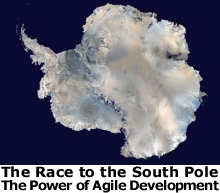
In this program, we explore one particular illustration of the power of the agile approach: the Race to the South Pole. Because agile methodology has implications for leadership, planning, scope management, risk management, improvisation, discipline, organizational politics, team dynamics, technology management and project complexity, the race between these two expeditions created sharp contrasts in each of these dimensions. By examining the contrast between these two expeditions, we reach a deeper understanding of what makes agile processes so powerful. And we do it in the interesting and novel context of the race to the South Pole.
Most of our learning about project management and product development comes from personal experience, from the experiences of others, from texts and professional materials and from presentations and training. The content of these sources is specifically about project management or product development. This is what I call direct learning.
But there are other ways to learn, ways I call indirect. One slightly surprising source of lessons about project management is film. Many films aren't directly about project management, and yet, indirectly, they have much to teach us. One of these is The Last Place on Earth. There are many more — for more examples, see "Films Not About Project Teams: I," Point Lookout for July 28, 2004.
I mention The Last Place on Earth because it's the story of the race to the South Pole, which occurred in the Antarctic summer of 1911-1912. The film is based on the book of the same title, by Roland Huntford. I recommend both.
In this program, we use the history of this event to explore important lessons about project management and product development. From this story we can learn lessons about leadership, planning, scope creep, risk management, improvisation, discipline, organizational politics, team dynamics, technology management, and the importance of simplicity.
Attendees will learn valuable lessons from history that they can apply immediately. The drama of the story of Amundsen and Scott makes these lessons more intriguing, easier to learn, and much, much more memorable.
This program is available as a keynote, workshop, seminar, breakout, or clinic. For the shorter formats, coverage of the outline below is selective.
Program structure and content
Each of the ten lessons we chose to examine is illustrated with background and stories from one or both of the two expeditions. The stories are memorable, and told with an emphasis on their value to project managers, sponsors, managers, and executives in project-oriented organizations.
Here is a concise summary of the topics we cover, based on the Agile Manifesto:
- Satisfy the customer early and often
Since the customer determines acceptability, frequently satisfying the customer prevents wandering away from the goal. - Welcome changing requirements
By accommodating changing requirements, we enable learning about the problem as we progress towards a solution. - Deliver frequently
Delivering frequently is the means by which we achieve frequent customer satisfaction. - Collaborate with the customer
Collaboration is essential. By inviting the customer to be a partner in the effort, we can be more certain of achieving customer goals. - Support, trust, and focus on highly motivated people
Highly motivated team members produce the best products. - Face-to-face is best
Although remote collaborations can be made to work, face-to-face truly is more effective than any other configuration. - Measure progress by what's working
The only real measure of progress is working deliverables. Everything else is less direct. - Work at a pace sustainable by all
Although we can work faster at times, the cost can be high. The cost of an unsustainable pace is rework, lower quality, burnout, and maybe even the team itself. - Value technical excellence and good design
Technical excellence makes all the rest possible. - Simplicity is essential
By keeping things as simple as possible — and no simpler — we make everything else easier. - Self-organizing teams produce the best results
Self-organizing teams can sustain a higher pace of development than more centralized structures can. - Regular reflection is the basis of behavioral advancement
Reflection and retrospection enable us to perfect our process — and the way we treat each other — as we go along.
This program is most suitable for keynote presentations and conference general sessions, or for large groups. Heavily illustrated with maps and original photographs, the stories bring the events of 1908 through 1912 — just over 100 years ago — to life. It is especially suitable for audiences that desire some relief from the sometimes-dry style of presentations that address similar subject matter. Audience interaction and table discussions about accompanying prepared discussion questions bring the lessons of the Race to the Pole into focus in contemporary experience.
Program outline
- Introduction
- Amundsen and Scott: Background
- Antarctica as it was known in 1910
- The two expeditions compared
- Assessing our decision-making process
- The dimensions from which we draw lessons
- Satisfy the customer early and often
- Welcome changing requirements
- Deliver frequently
- Collaborate with the customer
- Support, trust, and focus on highly motivated people
- Face-to-face is best
- Measure progress by what's working
- Work at a pace sustainable by all
- Value technical excellence and good design
- Simplicity is essential
- Self-organizing teams produce the best results
- Regular reflection is the basis of behavioral advancement
- Summary and wrap-up
- How we can apply these lessons in agile projects
- What to do tomorrow
- Monitoring your own learning
- Resources for the future
Learning model
We usually think of product development skills as rather technical — free of emotional content. We hold this belief even though we know that our most difficult situations can be highly charged. Despite our most sincere beliefs, taking a project organization to the next level of performance does require learning to apply knowledge management skills even in situations of high emotional content. That's why this program uses a learning model that differs from the one often used for technical content.
Our learning model is partly experiential, which makes the material accessible even during moments of stress. Using a mix of presentation, simulation, group discussion, and metaphorical team problems, we make available to participants the resources they need to make new, more constructive choices even in tense situations.
Target audience
Project managers, program managers, managers, executives, leaders, and project team members. Participants should have experienced at least six months working with or as a member of a project team.
Program duration
Available formats range from 50 minutes to one full day. The longer formats allow for more coverage or more material, more experiential content and deeper understanding of issues specific to audience experience.
Follow Rick


Send an email message to a friend
rbrenIyeJIiAfnGdKlUXrner@ChacsxirZwZlENmHUNHioCanyon.comSend a message to Rick
A Tip A Day feed
Point Lookout weekly feed
 My blog, Technical Debt for Policymakers, offers
resources, insights, and conversations of interest to policymakers who are concerned with managing
technical debt within their organizations. Get the millstone of technical debt off the neck of your
organization!
My blog, Technical Debt for Policymakers, offers
resources, insights, and conversations of interest to policymakers who are concerned with managing
technical debt within their organizations. Get the millstone of technical debt off the neck of your
organization!- "Rick is a dynamic presenter who thinks on his feet to keep the material relevant to the
group."
— Tina L. Lawson, Technical Project Manager, BankOne (now J.P. Morgan Chase) - "Rick truly has his finger on the pulse of teams and their communication."
— Mark Middleton, Team Lead, SERS
 Save a bundle and even more important save time! Order the Combo Package and download all ebooks
and tips books at once.
Save a bundle and even more important save time! Order the Combo Package and download all ebooks
and tips books at once.