Most of our learning about leadership and management comes from personal experience, from the experiences of others, from texts and professional materials and from presentations and training. The content of these sources is specifically about leadership and management. This is what I call direct learning.
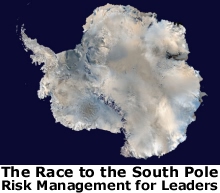
Here's a composite satellite view of Antarctica (false color).
But there are other ways to learn about leadership or management, ways I call indirect. One slightly surprising source is film. Many films aren't directly about leadership or management, and yet, indirectly, they have much to teach us. One of these is The Last Place on Earth. There are many more, of course.
I mention The Last Place on Earth because it's the story of the race to the South Pole, which occurred in the Antarctic summer of 1911-1912. The film is based on the book of the same title, by Roland Huntford. I recommend both.
In this program, we use the history of this event to explore important lessons about managing risk in organizational efforts of all kinds, including planned and unplanned change, complex projects, and mergers and acquisitions. We learn why leaders are uniquely positioned to manage whatever risks can be anticipated, and many risks we can't anticipate.
The leaders of these two expeditions took very different approaches to risk management. By comparing their approaches, we can come to understand the differences in the outcomes of the two expeditions. We explore a leadership-based approach to risk analysis and planning that considers the interplay between three categories of risk sources: the individual, the organizational, and the environmental. This framework is especially well suited to large, complex, high-risk organizational efforts.
Attendees learn valuable lessons from history that they can apply immediately to managing current organizational efforts and planning new ones. The drama of the story of Amundsen and Scott makes these lessons more intriguing, easier to learn, and much, much more memorable.
Program structure and content
Each of the lessons we examine is illustrated with background and stories from one or both of the two expeditions. The stories are memorable, and told with an emphasis on their value to leaders and managers of modern organizations.
Here is a description of the framework we use for analyzing the risks these expeditions faced:
- The individual
- These expeditions relied for success on covering all their needs for almost two years with the resources they had landed on the continent. The loss of any one person, or the failures, flaws, and shortcomings of any single person could have had — and did have — significant impact on expedition success. The two expeditions approach individual-centered risk management very differently, leading to very different outcomes.
- In modern organizations, we aren't as isolated as these expeditions were in Antarctica. But the consequences of turnover, or of individual failures, flaws, and shortcomings can be just as severe, because of the requirement that we work within tight constraints on resources and schedule. Replacing anyone is possible, but the impact on organizational efforts is often unacceptably severe.
- The organization
- Risk sources within the organization include the effects of management decisions, of course. But beyond that are the sometimes-unpredictable interactions between any or all of a long list of organizational components: people, groups, teams, technologies, processes, structures, politics, equipment of all kinds, information, beliefs, and procedures. The stories of the two expeditions provide many examples of how these interactions produce risks that affected expedition success.
- In modern organizations, when we are actually aware of organizational risk, we can sometimes manage it. Too often, though, we fail to perceive in our own organizations what is obvious to an outsider. Examining the management of organizational risk in these two historical examples helps leaders understand how difficult organizational risk management can be.
- The environment
- The environment external to the organization has a variety of risk effects. Certainly it's a source of risk, but it also supplies resources. Most important, it is dynamic. Its changes are perhaps its most troublesome attributes. Both expeditions dealt with weather, and both dealt with the constraints imposed by the environment, albeit in different ways. The two expeditions provide a marvelous comparison that illustrates the advantages of finding ways to exploit the environment to manage all three categories of risk sources.
- In modern organizations, we tend to overuse strategies that "fight" the external environment. Approaches that exploit the attributes of the environment to manage risk more cleverly are usually cheaper and much more effective.
This program is most suitable for keynote presentations and conference general sessions, or for large groups. Heavily illustrated with maps and original photographs, the stories bring the events of 1908 through 1912 — just over 100 years ago — to life. It's especially suitable for audiences that desire some relief from the sometimes-dry style of presentations that address similar subject matter. Audience interaction and table discussions about accompanying prepared discussion questions bring the lessons of the Race to the Pole into focus in contemporary experience.
Program outline
This program is available as a keynote, workshop, seminar, breakout, or clinic. For the shorter formats, coverage of the outline below is selective.
- Introduction
- Amundsen and Scott: Background
- Antarctica as it was known in 1910
- The two expeditions compared
- Three categories of risk sources, with examples
- Individual
- Organizational
- Environmental
- Risk management risk
- Definition
- Sources of risk management risk, with examples
- Comparing the two expeditions
- Mitigation strategies
- Summary and wrap-up
- How we can apply these lessons in modern projects
- What to do tomorrow
- Monitoring your own learning
- Resources for the future
Learning model
We usually think of project management skills as rather technical — free of emotional content. We hold this belief even though we know that our most difficult situations can be highly charged. Despite our most sincere beliefs, taking a project organization to the next level of performance does require learning to apply knowledge management skills even in situations of high emotional content. That's why this program uses a learning model that differs from the one often used for technical content.
Our learning model is partly experiential, which makes the material accessible even during moments of stress. Using a mix of presentation, simulation, group discussion, and metaphorical team problems, we make available to participants the resources they need to make new, more constructive choices even in tense situations.
Target audience
Project managers, program managers, managers, executives, and leaders at all levels. Participants should have experienced at least six months working with or as a member of a team.
Program duration
Available formats range from 50 minutes to one full day. The longer formats allow for more coverage or more material, more experiential content and deeper understanding of issues specific to audience experience.
Follow Rick


Send an email message to a friend
rbrenIyeJIiAfnGdKlUXrner@ChacsxirZwZlENmHUNHioCanyon.comSend a message to Rick
A Tip A Day feed
Point Lookout weekly feed
 My blog, Technical Debt for Policymakers, offers
resources, insights, and conversations of interest to policymakers who are concerned with managing
technical debt within their organizations. Get the millstone of technical debt off the neck of your
organization!
My blog, Technical Debt for Policymakers, offers
resources, insights, and conversations of interest to policymakers who are concerned with managing
technical debt within their organizations. Get the millstone of technical debt off the neck of your
organization!- "Rick is a dynamic presenter who thinks on his feet to keep the material relevant to the
group."
— Tina L. Lawson, Technical Project Manager, BankOne (now J.P. Morgan Chase) - "Rick truly has his finger on the pulse of teams and their communication."
— Mark Middleton, Team Lead, SERS
 Save a bundle and even more important save time! Order the Combo Package and download all ebooks
and tips books at once.
Save a bundle and even more important save time! Order the Combo Package and download all ebooks
and tips books at once.