In the Blaming pattern, the group seeks people or things to hold responsible for the problem. This is tricky, because even an organization that's coping congruently might do this kind of searching. In the Congruent stance, it can be helpful to know where mistakes arose, to make it possible to correct them for the future. But in Blaming, the learning motivation may be minimal or absent. In their search for a cause, people make an investment disproportionate to any organizational benefit they could derive from success. Think of the strawberry investigation in Herman Wouk's The Caine Mutiny [Wouk 1987]. The true purpose of the search for a cause is punishment, rather than learning. Even when training is offered, it often comes with stigma firmly attached.
One underlying theory of Blaming behavior is a deterrence model, which holds that once we identify and deal with the person or thing responsible, we deter others from making similar "mistakes." This assumes that the people supposedly deterred actually have choice, which can be a questionable assumption in project work. The deterrence model might work quite well for parking and jaywalking enforcement, but for project work it's particularly problematic because the work entails making judgments in the absence of full information, and relying on the best efforts of others. Things can go wrong that are just nobody's fault. Making examples of people by punishing infractions deters only one behavior — the taking of reasonable risks.
Blaming environments suffer generally from two results of the blaming atmosphere. The first is that good people — people with alternatives — leave. The second is that those who stay become risk-averse. These are serious handicaps for the Blaming organization, because successful project management depends on good people taking reasonable risks.
Blaming Vignette
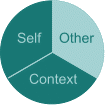
The Blaming Configuration
How would the emergency project situation unfold in a Blaming organization? We might hear questions and comments such as:
- Why can't we get Marketing to make up their minds about what this product should do and stick to it for more than two weeks in a row?
- I told them this would never work.
- As long as we have to use their software, we'll continue to have these schedule problems.
- We would have been on schedule if it weren't for that reorganization two months ago.
- This ain't rocket science…just tell them if they want this project done on time, we have to have the right equipment.
- Why can't we get Engineering to stop their endless byte-polishing and ship the darn thing?
- We would have had it ordered on time if Purchasing weren't such a bunch of nit-pickers.
From Blaming to Congruence
Notice that some of the comments in the Blaming vignette might well be heard in an organization that's dealing with the problem congruently. The comments themselves aren't necessarily Blaming, though some could be. Rather, blaming comes from the underlying meaning in the situation. It is true that people need adequate equipment to perform well. But it doesn't follow that inadequate equipment is the reason for poor performance. To evaluate the comments in the vignette, you need full information about Other and Context.
And that's the nature of the Blaming coping strategy. Fundamentally, it fails to give adequate value to the Other. Whether the Other is a person or an organization, in the Blaming pattern, we first create a caricature of it — one that allows us to attribute to it whatever failure or shortcomings might be necessary to transfer responsibility for the situation to the Other. When you notice this happening, be alert for the Blaming pattern.
Blaming works by dehumanizing the Other, whether that Other is a person or an organization. To make it more difficult for your organization to Blame another, recognize the human qualities of the Other. For example, if Marketing is being blamed, as in the first quote above, you might inquire "I wonder what forces are at work that cause them to change their minds so frequently. Are they being jerked around by somebody?" This opens the possibility that they're people too, even if there are no external forces at work. Once the discussion moves to this level, they're being seen as people. Only from this position can the organization consider working with Marketing in partnership to resolve the problem.
If you're familiar with the concrete facts of the situation, make an effort to keep the organization's awareness focused on the facts. For example, if you're hearing that another organization is being blamed for all schedule problems, and you know of — or suspect — problems elsewhere, raise questions among your colleagues about whether responsibility for the problem might be more widespread. When several "Others" exhibit similar behavior, it's more difficult for people to blame only one of them.
When you work to move a group from Blaming to a more Congruent position, it's possible the
Blaming will turn towards you. Be aware of this possibility. Deal with it congruently if it
should happen.  Top
Top
Back to "Organizational Coping Patterns"
References
 Wouk 1987
- Wouk, Herman. The Caine Mutiny: A Novel of World War II. Annapolis: Naval Institute Press, 1987. Order from Amazon.com
 Dmytryk 1954
- The Caine Mutiny (1954). Humphrey Bogart, José Ferrer. Dir. Edward Dmytryk. Columbia/Tristar. Order from Amazon.com
Are you a writer, editor or publisher on deadline? Are you looking for an article that will get people talking and get compliments flying your way? You can have 500-1000 words in your inbox in one hour. License any article from this Web site. More info
Follow Rick


Send an email message to a friend
rbrenjTnUayrCbSnnEcYfner@ChacdcYpBKAaMJgMalFXoCanyon.comSend a message to Rick
A Tip A Day feed
Point Lookout weekly feed
 My blog, Technical Debt for Policymakers, offers
resources, insights, and conversations of interest to policymakers who are concerned with managing
technical debt within their organizations. Get the millstone of technical debt off the neck of your
organization!
My blog, Technical Debt for Policymakers, offers
resources, insights, and conversations of interest to policymakers who are concerned with managing
technical debt within their organizations. Get the millstone of technical debt off the neck of your
organization!Point Lookout by
starting your Amazon search here

 Bad boss, long commute, troubling ethical questions, hateful colleague? Learn what we can do when we
love the work but not the job.Are your project teams plagued by turnover, burnout, and high defect rates? Turn your culture around.Fed up with tense, explosive meetings? Are you the target of a bully? Learn how to make peace with conflict.Learn how to make meetings more productive — and more rare.Save a bundle and even more important save time! Order the Combo Package and download all ebooks
and tips books at once.
Bad boss, long commute, troubling ethical questions, hateful colleague? Learn what we can do when we
love the work but not the job.Are your project teams plagued by turnover, burnout, and high defect rates? Turn your culture around.Fed up with tense, explosive meetings? Are you the target of a bully? Learn how to make peace with conflict.Learn how to make meetings more productive — and more rare.Save a bundle and even more important save time! Order the Combo Package and download all ebooks
and tips books at once.