Organizations deal with adversity by coping in characteristic ways. Although every organization is unique, you can understand its coping patterns in terms of three basic elements. The description that follows is based on a model of personal coping behavior first developed by Virginia Satir [Satir 1976, Satir 1988] and elaborated by others. I found Weinberg [Weinberg 1994] and McLendon and Weinberg [McLendon 1996] especially helpful.
The fundamental idea of Satir's model, as applied to organizations, is that organizational coping patterns take reality into account in different ways. We can represent reality as a combination of three elemental factors: the Self, the Other, and the Context. In organizational terms, the Self represents the internal world of the organization itself. The Other represents people or organizations external to the organization, but close to the organization. Finally, the Context represents the world beyond that — everything else.
Once you've identified a pattern that your organization uses repeatedly, you have all the tools you need to modify that pattern. If one or more elements of reality is under-represented or over-represented, you can work to bring things back into balance.
Here's an example. Let's suppose that we're trying to understand how a project team came to a certain state of stress, and we're looking at the flow of its communications with Marketing. Applying Satir's model, Self would be the Project Team, Other would be Marketing, and all other factors are part of Context. In this example, the CEO and the Finance organization, as well as the Federal Communications Commission and the Law of Gravity, are part of Context.
When we put appropriate weight on each of these three elements, we have the best chance of coping well with reality. When coping and communication are effective, the organization's internal representation of reality coincides with — is congruent to — reality itself. In the same way, the organization's representation of itself to the outside world coincides well with — is congruent to — the internal reality of the organization. An organization that's coping with reality from this position is said to be in a Congruent stance. When an organization's views disregard one or more of these three elements, unfavorable outcomes are more likely. This is called incongruent coping.
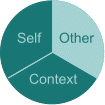
The Blaming Configuration
Satir represents these possibilities using a simple graphical notation. To the right is an example of her notation as applied to the incongruent coping stance called blaming. In blaming, Self and Context are taken into account, but the Other (the one blamed) isn't. In the graphic, I've chosen to represent with the dark color an element that's taken into account. Elements that are disregarded or not taken into account are represented with the light color.
Typically, when we blame, we disregard or deliberately hide the true worth of the person or thing blamed. For example, when we blame Congress for writing such complex laws, and when we really get worked up about it, we tend to ignore the good things Congress has done, and continues to do. It may well be true that Congress has written some bad laws — but it's just as certainly true that it has produced some good ones. It would be unwise to eliminate Congress just because it has made some mistakes.
Yet, in project work, when a colleague has made a drastic error that costs the project dearly, we sometimes blame the project's failure on that one person. And, sometimes, such people are terminated, demoted, or moved to other assignments, even when we need their unique capabilities. Although this is sometimes the right thing to do, it's also true that the blaming position can lead to the unnecessary loss of capability that the organization really needs. And it can bring unjustified harm to any person's career. An organization that's conversant with Satir's model of coping stances has the best chance to notice itself adopting a blaming pattern in a situation like this one. Once it has noticed the pattern, it can begin to formulate alternate choices, and perhaps find a way to deal with the problem while avoiding undue harm to the person who erred, and to itself.
An emergency project situation
In the rest of this essay, I'll list all eight patterns of organizational coping. To help convey the characteristic behavior of each pattern, each description contains a brief summary of how an organization that has adopted that pattern would respond in a typical emergency project situation:
The scene is a hastily-called meeting of executives, managers, and project managers. The agenda for this meeting is a review of the status of a key project, upon which the future of the organization depends. The meeting is being held because the project's manager, in response to new information about three problematic tasks, has re-estimated the delivery date, and now expects a significant slip, which would have serious negative consequences for the organization and its customers.
Each of the eight characteristic organizational patterns suggests a characteristic atmosphere for such a meeting. That's why this scenario is so useful for conveying the character of each pattern. And, of course, we've all attended such meetings, so we have our own experiences to compare to. Comparing the different responses within this one vignette helps clarify the distinctions among the eight patterns.
Each description concludes with a brief discussion of what might be needed to change that coping pattern to the Congruent pattern. You might be able to use these insights to help guide your organization to behave more congruently in similar situations.
The eight organizational coping patterns are:
- Congruent
- When an organization copes on the basis of understanding its own value, its own flaws, and its own limitations, it has the best chance of achieving its potential — and great things.
- Placating
- A Placating organization shows undue concern for possible negative consequences. The group can be so driven by avoidance of discomfort right now, that it's willing to exchange it for far greater — even inevitable — discomfort in the future. When the group placates, it collectively avoids confronting issues or people, preferring instead to take full responsibility itself for any disappointing outcomes.
- Blaming
- When an organization copes by Blaming, it seeks people or things to hold responsible for any problem, not to learn from its mistakes, or to prevent them in the future, but to preserve its view of its own infallibility — and the fallibility of others.
- Loving/Hating
- In coping by Loving/Hating, the organization is driven by its relationship with other organizations, people, or ideas. Whether finally to destroy that organization, person, or idea; or to attach itself thereto in permanent adoration and ethereal bliss, it ignores almost everything and everyone else external to the focal relationship.
- Narcissistic
- When an organization is coping in the Narcissistic pattern, it's driven by its love of itself and disregard for everything else. No other organization, no person, nothing external to itself is of any worth or value, except perhaps as support or utility to itself. The Narcissistic organization is prepared to use, abuse, or exploit anyone, any idea, or any other organization, including its organizational parent, to further its own ends.
- Infatuated
- The Infatuated organizational coping pattern displays complete devotion to a particular person, idea, or organization. It remains dedicated in the face of almost any contradictory data, which can lead it to decisions that expose itself to inordinate risk or even to organizational disaster.
- Irrelevant
- Irrelevant coping in an organization is coping by flight. In the face of adversity, the organization copes by avoiding not only the adversity, but any recognition of it.
- Super-reasonable
- Super-reasonable organizational coping emphasizes Context, usually through a devotion to "objectivity" and at the expense of human considerations or considerations of relationship. Super-reasonable coping can lead an organization to adopt self-destructive strategies because they make sense for the "bottom line," or because they emphasize some specific organizational priorities, even if they're self-destructive.
Variability of coping stances
When an organization copes with a situation, it assumes a coping stance, which might be any one of the eight possible stances, or it might be a combination of two or more. To perhaps a greater extent than personal coping, organizational coping can more easily involve combinations, because so many people are involved. For instance, some of the people in the organization might prefer Blaming, while others might prefer Placating. What emerges for the organization is the result of everyone's contributions.
The incongruent coping patterns of organizations are thus distinct from what might be perceived as organizational behavior disorders, in that they're transient. Coping styles can vary with time and certainly with situation. Like people, the coping behavior of an organization in any specific situation might not fit any neat categorization scheme. Nevertheless, patterns of coping can emerge. An organization might favor one or two incongruent coping stances, on the whole and most of the time, but it still has the potential for Congruence at any time. An organization that behaves congruently most of the time can still occasionally adopt a blaming or placating stance once in a while. Variation is the only constant.
Learning to use the model
Learning to use the model is difficult, especially when we try to apply it to an organization in which we play a key role, in part because of our own role in the incongruence. It might be easier to begin by studying incongruent coping of organizations in which you play a minor role, or no role at all. One very effective approach might be to study a historical situation from the perspective of this model. Historical examples are especially useful, because we often have access to detailed background information that's difficult to obtain in real-life personal experiences. For example, the Munich Pact of 1938, under which Germany acquired the Sudetenland from Czechoslovakia, could be an example of organizational placating by Great Britain. By exploring historical examples, you can become familiar with the model and its application to organizations.
Once you have this familiarity, try tracking specific situations within your own
organization. And when the time is right, try to move your organization towards congruence.
 Top
Top
References
- McLendon 1996
- McLendon, Jean, and Gerald M. Weinberg. "Beyond Blaming: Congruence in Large Systems Development Projects." IEEE Software 13, 33-42, 1996.
 Satir 1976
- Satir, Virginia. Making Contact. Berkeley, CA: Celestial Arts, 1976. Order from Amazon.com
 Satir 1988
- Satir, Virginia. The New Peoplemaking. Mountain View, CA: Science and Behavior Books, 1988. Order from Amazon.com
 Weinberg 1994
- Weinberg, Gerald M. Quality Software Management Volume 3: Congruent Action. New York: Dorset House, 1994. Order from Amazon.com
- WGBH 1987
- WGBH Educational Foundation. Why Planes Crash. Columbus, OH: Coronet Films & Videos, 1987.
Are you a writer, editor or publisher on deadline? Are you looking for an article that will get people talking and get compliments flying your way? You can have 500-1000 words in your inbox in one hour. License any article from this Web site. More info
Follow Rick


Send an email message to a friend
rbrenjTnUayrCbSnnEcYfner@ChacdcYpBKAaMJgMalFXoCanyon.comSend a message to Rick
A Tip A Day feed
Point Lookout weekly feed
 My blog, Technical Debt for Policymakers, offers
resources, insights, and conversations of interest to policymakers who are concerned with managing
technical debt within their organizations. Get the millstone of technical debt off the neck of your
organization!
My blog, Technical Debt for Policymakers, offers
resources, insights, and conversations of interest to policymakers who are concerned with managing
technical debt within their organizations. Get the millstone of technical debt off the neck of your
organization!Point Lookout by
starting your Amazon search here

 Bad boss, long commute, troubling ethical questions, hateful colleague? Learn what we can do when we
love the work but not the job.Are your project teams plagued by turnover, burnout, and high defect rates? Turn your culture around.So buried in email that you don't even have time to delete your spam? Learn how to make
peace with your inbox.Fed up with tense, explosive meetings? Are you the target of a bully? Learn how to make peace with conflict.Learn how to make meetings more productive — and more rare.Save a bundle and even more important save time! Order the Combo Package and download all ebooks
and tips books at once.Is every other day a tense, anxious, angry misery as you watch people around you, who couldn't even
think their way through a game of Jacks, win at workplace politics and steal the credit and glory
for just about everyone's best work including yours? Read 303 Secrets of Workplace Politics!When you resume a paused project, are you frustrated by the politics? Learn techniques for leaders
of resuming projects.
Bad boss, long commute, troubling ethical questions, hateful colleague? Learn what we can do when we
love the work but not the job.Are your project teams plagued by turnover, burnout, and high defect rates? Turn your culture around.So buried in email that you don't even have time to delete your spam? Learn how to make
peace with your inbox.Fed up with tense, explosive meetings? Are you the target of a bully? Learn how to make peace with conflict.Learn how to make meetings more productive — and more rare.Save a bundle and even more important save time! Order the Combo Package and download all ebooks
and tips books at once.Is every other day a tense, anxious, angry misery as you watch people around you, who couldn't even
think their way through a game of Jacks, win at workplace politics and steal the credit and glory
for just about everyone's best work including yours? Read 303 Secrets of Workplace Politics!When you resume a paused project, are you frustrated by the politics? Learn techniques for leaders
of resuming projects.