Two complementary perspectives are frequently associated with the Narcissistic organizational coping pattern — Love of itself, and a willingness to use anyone or anything to advance its own interests. To support its Love of Self, the organization refuses to acknowledge any failure of its own, or the possible superiority — in any respect — of any other organization. The hallmark of Narcissistic organizational coping is a risk-everything approach to avoidance of seeing any of its own imperfections. Symmetrically, it projects vulnerability, weakness, and limitation on any organization it sees as related to itself.
As it tries to make meaning of the world around it, and the organizations with which it interacts, it adopts any interpretation that permits it to continue to see itself as flawless, favoring those interpretations that degrade the worth of others, other organizations, or the world at large. In this it has much in common with the Blaming organizational coping pattern, except that Narcissistic coping is less focused — the denigration of the Other that we find in Narcissistic coping isn't restricted to a single Other. Moreover, since it has regard only for itself, consistency and logic are unimportant — it might explain two independent failures using mutually contradictory arguments.
In Narcissistic coping, the organization finds it difficult to execute any of the forms of reflective learning that have become so valuable to other organizations. Retrospectives, "lessons learned" exercises and the like, which involve acknowledgment of imperfection, are particularly challenging. If they're attempted, a sense of hollowness or unreality can accompany them, as the organization works out ways of identifying "opportunities for improvement" while at the same time refusing to acknowledge any serious error.
Narcissistic Vignette
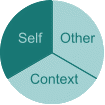
The Narcissistic Configuration
How would the emergency project situation unfold in a Narcissistic organization? We might hear questions and comments such as these.
- What's the big deal? So we miss this delivery date. Set a new one. Our product will be the best. People will wait for it because they know it will be the best.
- I think we can make the date if we downgrade these defects from "Fatal" to "Acceptable for Release." Sure some customers will be affected, but they'll be willing to live with it to get the rest of our enhancements six months earlier. They're that good.
- Engineer 1: "Suppose we get Firmware to stop working on Platinum and work 100% for us. Then we could fix these problems in firmware. Wouldn't we make the date then?" Engineer 2: "But then Platinum will be late, and they're already way late." Engineer 1: "And your point would be what, exactly?"
- I'm sorry, I just don't see this as a problem. Let's not announce a slip. We'll just finish when we finish. We let Marketing know when we get pretty close, and they deal with it.
From Narcissism to Congruence
To move from Narcissistic coping to Congruence, inquire about what's missing — make the missing elements visible to all. In Narcissistic coping, the organization sees only Self — ignoring both Context and Other. To move the coping stance towards Congruence, begin with Self, asking what-if questions that presume the Narcissistic view. In the first example above, the claim is made that "People will wait for [our product] because they know it will be the best." Check that out in more detail. You might ask:
- And if they do wait, and don't buy products from the competition, will they keep buying our old product? If not, can we survive the revenue loss?
- How do we know that people view our new product as best? Have we surveyed anybody? Have we run focus groups?
- We can't know for certain that they'll wait — there's some risk they won't. How do we plan to mitigate that risk?
In Narcissistic coping, it's rare that the organization would have done the financial
modeling, market research, or risk management studies to back up the proposed strategy,
because all of these activities involve acknowledgment of Other or Context. If you can bring
these activities about, the results could be the basis of a sound decision. If the
organization plows ahead without this backup, the foolishness of the decision to proceed will
be obvious to many people. That alone could bring about a change.  Top
Top
Back to "Organizational Coping Patterns"
Are you a writer, editor or publisher on deadline? Are you looking for an article that will get people talking and get compliments flying your way? You can have 500-1000 words in your inbox in one hour. License any article from this Web site. More info
Follow Rick


Send an email message to a friend
rbrenIyeJIiAfnGdKlUXrner@ChacsxirZwZlENmHUNHioCanyon.comSend a message to Rick
A Tip A Day feed
Point Lookout weekly feed
 My blog, Technical Debt for Policymakers, offers
resources, insights, and conversations of interest to policymakers who are concerned with managing
technical debt within their organizations. Get the millstone of technical debt off the neck of your
organization!
My blog, Technical Debt for Policymakers, offers
resources, insights, and conversations of interest to policymakers who are concerned with managing
technical debt within their organizations. Get the millstone of technical debt off the neck of your
organization!Point Lookout by
starting your Amazon search here

 Bad boss, long commute, troubling ethical questions, hateful colleague? Learn what we can do when we
love the work but not the job.Are your project teams plagued by turnover, burnout, and high defect rates? Turn your culture around.Fed up with tense, explosive meetings? Are you the target of a bully? Learn how to make peace with conflict.Learn how to make meetings more productive — and more rare.
Bad boss, long commute, troubling ethical questions, hateful colleague? Learn what we can do when we
love the work but not the job.Are your project teams plagued by turnover, burnout, and high defect rates? Turn your culture around.Fed up with tense, explosive meetings? Are you the target of a bully? Learn how to make peace with conflict.Learn how to make meetings more productive — and more rare.