In the Placating pattern, we give consideration to Other and Context, but not to Self. Sometimes we might even weigh Other and Context too heavily. One way this can express itself is for a group to show undue concern for possible negative consequences. The group can be so driven by avoidance of the possibility of some discomfort right now, that it's willing to exchange it for far greater — even inevitable — discomfort in the future. When the group placates, it collectively avoids confronting issues. For example, to avoid the difficulty of explaining the project schedule slip to customers, it might commission a subgroup to develop a "party line" that masks the reality of the problem to such an extent that many customers choose not to act at all, on the mistaken impression that nothing is wrong. When they ultimately do find out how to parse the party line correctly, they'll be angry — but that's in the future.
Cover-up is only one of the tactics of the placating organization. Any approach will do, provided that it delays or postpones final engagement with the difficulty. One ploy is to escalate the scale of the project by combining it, with all of its problems, into something larger, thus concealing the difficulty — until some future date, when the problem will be even bigger. Another is to retroactively redefine the initial goals of the effort to exclude those elements that are causing difficulty, and then to declare victory for what remains. The problematic parts are then rescheduled for Phase II (or maybe it's Phase V, if they've done the same thing three times already).
Even when Placating organizations do recognize a problem, their solutions tend to place undue burden on the organization itself. They "tough it out," "make it happen," "push on," and "keep a stiff upper lip." They have difficulty asking for additional time or resources, or may be simply unable to report that their assignment is impossible.
To end Placating, to move the organization towards Congruence, bring the organization to an appreciation of itself, and all its capabilities.
Placating Vignette
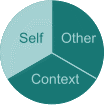
The Placating Configuration
How would the emergency project situation unfold in an organization that's placating? We might hear questions and comments such as:
- Maybe we can delay telling the customer about this until we're really sure we won't make the date.
- Let's look into this further. I think you're probably overestimating the size of the problem. Meeting adjourned until next week.
- Well, unless you want to be the one tell the CEO about this, we're just going to have to find a way to make the original date. So…make it happen.
- Why can't we ever get a project done on time?
- Can we find a way to announce this that leaves open the possibility that we still might deliver on time?
- If everyone works 70 hour weeks instead of 55 hour weeks, do you think we could make the date?
- Well, we can't ask for more money, and we can't ask for more time, so if we cut out some features can we possibly make the original date?
Notice here that the focus is on maintaining the original date at any cost. This organization is willing to sacrifice whatever it has to just to avoid announcing a schedule change. The Placating coping pattern drives an organization to sacrifice its Self to conform to the wishes of the Other or the constraints of the Context. It cannot imagine altering the Context or demanding that the Other negotiate its wishes.
From Placating to Congruence
In the Placating pattern, the organization considers the Other and Context, but not its Self. To move toward Congruence, the organization must consider its own needs as well. You can help to bring this about by asking what-if questions that presume the position the organization has adopted, but also get at self-interest issues.
In the first example above, someone has proposed delaying the announcement until we're "really sure." You might ask, "How will we know we're really sure?" Any debate about certainty criteria is healthy, of course, because the proposer of this idea probably wasn't really concerned about certainty — their goal was a delay. Focusing on the certainty issue could bring that to light, because there probably are no certainty criteria.
In the second example, there's an assertion that the project manager is overestimating the size of the problem. Applying the what-if pattern of investigation, we ask "What is the biggest the problem could be and still have no schedule impact?" Seeking refinement of the assertion keeps the discussion open, possibly making room for this inquiry: "How much extra delay does this delay generate?" This question begins to get at the interests of Self, because delaying the announcement, rather than relieving pressure, is actually raising the pressure on the project team — in the future.
What you can do depends on your own role and level of responsibility. If you're deep in the trenches, be prepared to take the extra burden that other organizations send towards yours (and which your management transmits to you). Remember that overtime is a choice — you can put in overtime, or you can decline. You can stay with the organization, and work longer hours, or you can move on, either internally or externally. If you agree to work longer hours, do it for the love of the work — it's unlikely that you'll be seen as a hero in the Placating organization. If your organization's leaders do try to change the organization's behavior, find a way to support and encourage them. Be alert for opportunities.
As a manager or leader, you have opportunities to help the organization to respond more
congruently. If asked to develop options for dealing with an emergency, you can omit options
that present additional burden to an overburdened team. If asked to support such plans, you can
oppose them. Instead, you can ask for resources and time. If you're asked to lead an effort
that's clearly doomed, you can say "I don't know how to do that," which would be true. Read my
essay on Saying No. Think about the needs of your organization, and
take opportunities to help others do the same.  Top
Top
Back to "Organizational Coping Patterns"
Are you a writer, editor or publisher on deadline? Are you looking for an article that will get people talking and get compliments flying your way? You can have 500-1000 words in your inbox in one hour. License any article from this Web site. More info
Follow Rick


Send an email message to a friend
rbrenjTnUayrCbSnnEcYfner@ChacdcYpBKAaMJgMalFXoCanyon.comSend a message to Rick
A Tip A Day feed
Point Lookout weekly feed
 My blog, Technical Debt for Policymakers, offers
resources, insights, and conversations of interest to policymakers who are concerned with managing
technical debt within their organizations. Get the millstone of technical debt off the neck of your
organization!
My blog, Technical Debt for Policymakers, offers
resources, insights, and conversations of interest to policymakers who are concerned with managing
technical debt within their organizations. Get the millstone of technical debt off the neck of your
organization!Point Lookout by
starting your Amazon search here

 Bad boss, long commute, troubling ethical questions, hateful colleague? Learn what we can do when we
love the work but not the job.Are your project teams plagued by turnover, burnout, and high defect rates? Turn your culture around.Fed up with tense, explosive meetings? Are you the target of a bully? Learn how to make peace with conflict.Learn how to make meetings more productive — and more rare.
Bad boss, long commute, troubling ethical questions, hateful colleague? Learn what we can do when we
love the work but not the job.Are your project teams plagued by turnover, burnout, and high defect rates? Turn your culture around.Fed up with tense, explosive meetings? Are you the target of a bully? Learn how to make peace with conflict.Learn how to make meetings more productive — and more rare.