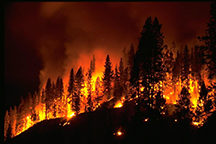
Wildfires in southeastern Australia in 2009. Photo credit: U.S. National Oceanic and Atmospheric Administration.
When companies or projects get into trouble, we take corrective action, and usually we get things back into alignment. When we can't, and when new problems come up one after the other, we often describe our activities as "firefighting." We think of ourselves as moving from fire to fire, putting out the flames.
Firefighting is a metaphor that's more useful than it first appears. If we study the operations of the professional firefighters, especially wildland firefighters, we can learn some lessons that apply to managing projects or companies.
- Safety first
- Wildland firefighters know that they're doing dangerous work. They're trained in safety, and everyone understands that safety is the first priority.
- Organizational firefighting is career-dangerous. Too often we put our own careers at risk, and expect others to do so, too.
- Asking people to take high-risk responsibilities without regard to their career health is unreasonable. If we want people to step forward when they're needed, and to be effective when they do, we must configure high-risk assignments to benefit the people who accept them. Put career-safety first.
- Fire is natural
- Wildland fire is a natural part of the forest ecosystem. Many plants and animals depend on the effects of fire for their own health and for their very survival.
- Sometimes we think of "organizational fires" as annoying and unexpected — as signs of our failure to anticipate well enough.
- Organizational Wildland firefighters
know that they're doing
dangerous workfires are natural for innovative activity, because innovation is inherently risky. When you plan a project, include reserves for handling organizational fires. Expect the unexpected. - Fire spreads
- Wildland firefighters don't try to extinguish major fires — they control them. They direct the fire into uninhabited areas, or into areas that will cause the fire to burn out.
- When we try to save a project that's in trouble, we expend scarce resources and attention in what might be a futile effort. This puts other projects at risk, and can cause the organizational fire to spread.
- When wisdom and experience suggest early cancellation or liquidation, consider these options seriously. Focus on protecting the parts of the organization that aren't yet on fire, rather than on rescuing doomed ventures.
- Fight fire with hotshot teams
- The US Forest Service uses a network of "Hotshot" teams to fight wildland fire. They're highly trained and dedicated to their jobs.
- Organizations typically rely on operational teams to extinguish their own fires. Except for a few "turnaround" consultants, we generally don't train or hire "organizational fire" specialists.
- If your organization has many fires, designate an elite hotshot team. If fires are rare, use consulting specialists to fight organizational fires. Their experience is a valuable asset.
Effective organizational management requires acknowledging the reality and importance of organization fire. To pretend that organizational fire doesn't exist, or that it can be completely eliminated, is to provide fuel for the next fire.  Top
Top  Next Issue
Are your projects always (or almost always) late and over budget? Are your project teams plagued by turnover, burnout, and high defect rates? Turn your culture around. Read 52 Tips for Leaders of Project-Oriented Organizations, filled with tips and techniques for organizational leaders. Order Now!
For more on organizational firefighting, see "Organizational Firefighting."
Or visit the US Public Broadcasting Web page about the Nova program Fire Wars, a documentary about a team of wildland firefighters called the Arrowhead Hotshots, filmed as they fought fires during the then-most-intense-to-date fire season of 2000. Order from Amazon.com.
Reader Comments
- Dwain Wilder
- Today's newsletter is inspired and inspiring! I wish I'd had that advice while I was on my last engagement in Software Configuration Management at Eastman Kodak.
- At one point my manager was complaining to me about being dinged by his manager so unfairly while his team (us) was doing the only productive work in fighting a fire. I told him, quite spontaneously, "This project is a place where firefighters are accused of arson because they're the closest to the fire." It really hit him, and he said he'd like to use that line on his boss! I think it's often true in projects in crisis.
Your comments are welcome
Would you like to see your comments posted here? rbrendPtoGuFOkTSMQOzxner@ChacEgGqaylUnkmwIkkwoCanyon.comSend me your comments by email, or by Web form.
About Point Lookout
 Thank you for reading this article. I hope you enjoyed it and
found it useful, and that you'll consider recommending it to a friend.
Thank you for reading this article. I hope you enjoyed it and
found it useful, and that you'll consider recommending it to a friend.
This article in its entirety was written by a human being. No machine intelligence was involved in any way.
Point Lookout is a free weekly email newsletter. Browse the archive of past issues. Subscribe for free.
Support Point Lookout by joining the Friends of Point Lookout, as an individual or as an organization.
Do you face a complex interpersonal situation? Send it in, anonymously if you like, and I'll give you my two cents.
Related articles
More articles on Personal, Team, and Organizational Effectiveness:
 A Message Is Only a Message
- When we receive messages of disapproval, we sometimes feel bad. And when we do, it can help to remember
that we have the freedom to decide whether or not to accept the messages we receive.
 Email Antics: I
- Nearly everyone I know complains that email is a time waster. Yet much of the problem results from our
own actions. If you're looking around for some New Year's resolutions to make, here are some ideas,
in this Part I of a little catalog of things we do that help waste our time.
 You Might Be Stressed If…
- A little stress once in a while keeps us sharp, but chronic intense stress shortens lives. Stress can
build gradually, out of our awareness. Here are some indicators of chronic intense stress.
 Wacky Words of Wisdom: V
- Adages, aphorisms, and "words of wisdom" are true often enough that we accept them as universal.
They aren't. Here's Part V of some widely held beliefs that mislead us at work.
 On Managing Life Event Risk
- Life events are those significant personal occurrences that lie outside the context of work. Some life
events cause enough stress and demand enough attention that they affect our performance at work. When
they do, they can affect our employers' plans.
See also Personal, Team, and Organizational Effectiveness for more related articles.
Forthcoming issues of Point Lookout
 Coming May 1: Antipatterns for Time-Constrained Communication: 2
- Recognizing just a few patterns that can lead to miscommunication can reduce the incidence of miscommunications. Here's Part 2 of a collection of antipatterns that arise in communication under time pressure, emphasizing those that depend on content. Available here and by RSS on May 1.
- And on May 8: Antipatterns for Time-Constrained Communication: 3
- Recognizing just a few patterns that can lead to miscommunication can reduce the incidence of problems. Here is Part 3 of a collection of antipatterns that arise in technical communication under time pressure, emphasizing past experiences of participants. Available here and by RSS on May 8.
Coaching services
I offer email and telephone coaching at both corporate and individual rates. Contact Rick for details at rbrendPtoGuFOkTSMQOzxner@ChacEgGqaylUnkmwIkkwoCanyon.com or (650) 787-6475, or toll-free in the continental US at (866) 378-5470.
Get the ebook!
Past issues of Point Lookout are available in six ebooks:
- Get 2001-2 in Geese Don't Land on Twigs (PDF, )
- Get 2003-4 in Why Dogs Wag (PDF, )
- Get 2005-6 in Loopy Things We Do (PDF, )
- Get 2007-8 in Things We Believe That Maybe Aren't So True (PDF, )
- Get 2009-10 in The Questions Not Asked (PDF, )
- Get all of the first twelve years (2001-2012) in The Collected Issues of Point Lookout (PDF, )
Are you a writer, editor or publisher on deadline? Are you looking for an article that will get people talking and get compliments flying your way? You can have 500-1000 words in your inbox in one hour. License any article from this Web site. More info
Follow Rick


Recommend this issue to a friend
Send an email message to a friend
rbrendPtoGuFOkTSMQOzxner@ChacEgGqaylUnkmwIkkwoCanyon.comSend a message to Rick
A Tip A Day feed
Point Lookout weekly feed
 My blog, Technical Debt for Policymakers, offers
resources, insights, and conversations of interest to policymakers who are concerned with managing
technical debt within their organizations. Get the millstone of technical debt off the neck of your
organization!
My blog, Technical Debt for Policymakers, offers
resources, insights, and conversations of interest to policymakers who are concerned with managing
technical debt within their organizations. Get the millstone of technical debt off the neck of your
organization! Are your project teams plagued by turnover, burnout, and high defect rates? Turn your culture around.
- Your stuff is brilliant! Thank you!
- You and Scott Adams both secretly work here, right?
- I really enjoy my weekly newsletters. I appreciate the quick read.
- A sort of Dr. Phil for Management!
- …extremely accurate, inspiring and applicable to day-to-day … invaluable.
- More
Fed up with tense, explosive meetings? Are you the target of a bully? Learn how to make peace with conflict.Is every other day a tense, anxious, angry misery as you watch people around you, who couldn't even
think their way through a game of Jacks, win at workplace politics and steal the credit and glory
for just about everyone's best work including yours? Read 303 Secrets of Workplace Politics!Save a bundle and even more important save time! Order the Combo Package and download all ebooks
and tips books at once.