Until very recently, ground war tactics emphasized control of the movement of forces and materiel. In this style of conflict, the flanking maneuver is a way of cutting off access of forces to resupply, and cutting off their ability to advance or retreat. In a typical flanking maneuver, force is applied to one side of the main opposing force, or perhaps to its rear, where the opponent's forces are less well protected. By contrast, a frontal assault applies force to the strongest face of the opposing configuration.
Project plans
generally consist
solely of plans
for "frontal assaults"In project management, we also perform flanking maneuvers, but we use other names for the tactics. Military flanking maneuvers, however, are often more sophisticated than those of project managers. We can learn much from studying even basic ground tactics.
When we encounter an obstacle in a project, we have three basic choices.
- We can quit
-
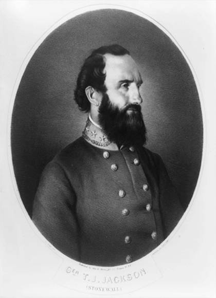
Gen. T.J. "Stonewall" Jackson executed a now-classic flanking maneuver at the Battle of Chancellorsville, during the U.S. Civil War. Photo by J.L. Giles, courtesy Prints and Photographs Division of the U.S. Library of Congress
- We can solve it
- In the military domain, we mount a frontal attack, possibly with enhanced forces. In project management, we add staff, budget or schedule.
- We can circumvent it
- In the military domain, we execute any of a variety of flanking maneuvers, or we bypass the position. In project management, we find a workaround, which might involve a redesign or using an alternative technology.
Project plans generally consist solely of plans for frontal assaults. We decide how we'll solve the problem, and we prepare a plan that implements that solution. We make few, if any, preparations for flanking maneuvers or alternatives of any kind that might be useful if we encounter obstacles. When we do, we call such plans "risk management," and too often, they're sketchy.
Military plans are usually more sophisticated. They include plans for acquiring intelligence, which is essential if adjustments are required. And they include possible adjustments too.
A more sophisticated project plan has resources allocated to three elements:
- Gathering and fusing intelligence
- Even though the plan focuses on a specific approach, we study alternative approaches right from the outset. If problems develop, we already know a fair amount about alternatives.
- Executing alternatives in parallel
- By executing at least one alternate approach in parallel, we facilitate collecting intelligence, and ensure a running start if the favored approach gets stuck. We might even provide insights that are useful in the favored approach.
- Looking far ahead
- A reconnaissance team working far ahead of the main body of the current effort searches for and provides early warning of hidden difficulty or unrecognized opportunity. If necessary, they use placeholders for yet-to-be-developed project elements.
The more expense-minded among us might resist allocating resources to these activities. Ask them this: What fraction of past projects was completed without flanking maneuvers?  Top
Top  Next Issue
Are your projects always (or almost always) late and over budget? Are your project teams plagued by turnover, burnout, and high defect rates? Turn your culture around. Read 52 Tips for Leaders of Project-Oriented Organizations, filled with tips and techniques for organizational leaders. Order Now!
For an overview of tactics, see "65 Operational Firepower: the Broader Stroke" by Colonel Lamar Tooke, US Army, Retired. Combined Arms Center: Military Review, July-August 2001.
Your comments are welcome
Would you like to see your comments posted here? rbrendPtoGuFOkTSMQOzxner@ChacEgGqaylUnkmwIkkwoCanyon.comSend me your comments by email, or by Web form.About Point Lookout
 Thank you for reading this article. I hope you enjoyed it and
found it useful, and that you'll consider recommending it to a friend.
Thank you for reading this article. I hope you enjoyed it and
found it useful, and that you'll consider recommending it to a friend.
This article in its entirety was written by a human being. No machine intelligence was involved in any way.
Point Lookout is a free weekly email newsletter. Browse the archive of past issues. Subscribe for free.
Support Point Lookout by joining the Friends of Point Lookout, as an individual or as an organization.
Do you face a complex interpersonal situation? Send it in, anonymously if you like, and I'll give you my two cents.
Related articles
More articles on Project Management:
 Deep Trouble and Getting Deeper
- Here's a catalog of actions people take when the projects they're leading are in deep trouble, and they're
pretty sure there's no way out.
 The Planning Fallacy and Self-Interest
- A well-known cognitive bias, the planning fallacy, accounts for many unrealistic estimates of project
cost and schedule. Overruns are common. But another cognitive bias, and organizational politics, combine
with the planning fallacy to make a bad situation even worse.
 Higher-Velocity Problem Definition
- Typical approaches to shortening time-to-market for new products often involve accelerating problem
solving. Accelerating problem definition can also help, but a curious paradox stands in the way.
 Seven Planning Pitfalls: III
- We usually attribute departures from plan to poor execution, or to "poor planning." But one
cause of plan ineffectiveness is the way we think when we set about devising plans. Three cognitive
biases that can play roles are the so-called Magical Number 7, the Ambiguity Effect, and the Planning Fallacy.
 Ten-Minute Training
- Despite decades of evolution of technology-assisted workplace learning, instructor-led classroom formats
remain the most popular and effective. Now perhaps videoconferencing can help to achieve that effectiveness
at lower cost.
See also Project Management for more related articles.
Forthcoming issues of Point Lookout
 Coming May 1: Antipatterns for Time-Constrained Communication: 2
- Recognizing just a few patterns that can lead to miscommunication can reduce the incidence of miscommunications. Here's Part 2 of a collection of antipatterns that arise in communication under time pressure, emphasizing those that depend on content. Available here and by RSS on May 1.
- And on May 8: Antipatterns for Time-Constrained Communication: 3
- Recognizing just a few patterns that can lead to miscommunication can reduce the incidence of problems. Here is Part 3 of a collection of antipatterns that arise in technical communication under time pressure, emphasizing past experiences of participants. Available here and by RSS on May 8.
Coaching services
I offer email and telephone coaching at both corporate and individual rates. Contact Rick for details at rbrendPtoGuFOkTSMQOzxner@ChacEgGqaylUnkmwIkkwoCanyon.com or (650) 787-6475, or toll-free in the continental US at (866) 378-5470.
Get the ebook!
Past issues of Point Lookout are available in six ebooks:
- Get 2001-2 in Geese Don't Land on Twigs (PDF, )
- Get 2003-4 in Why Dogs Wag (PDF, )
- Get 2005-6 in Loopy Things We Do (PDF, )
- Get 2007-8 in Things We Believe That Maybe Aren't So True (PDF, )
- Get 2009-10 in The Questions Not Asked (PDF, )
- Get all of the first twelve years (2001-2012) in The Collected Issues of Point Lookout (PDF, )
Are you a writer, editor or publisher on deadline? Are you looking for an article that will get people talking and get compliments flying your way? You can have 500-1000 words in your inbox in one hour. License any article from this Web site. More info
Follow Rick


Recommend this issue to a friend
Send an email message to a friend
rbrendPtoGuFOkTSMQOzxner@ChacEgGqaylUnkmwIkkwoCanyon.comSend a message to Rick
A Tip A Day feed
Point Lookout weekly feed
 My blog, Technical Debt for Policymakers, offers
resources, insights, and conversations of interest to policymakers who are concerned with managing
technical debt within their organizations. Get the millstone of technical debt off the neck of your
organization!
My blog, Technical Debt for Policymakers, offers
resources, insights, and conversations of interest to policymakers who are concerned with managing
technical debt within their organizations. Get the millstone of technical debt off the neck of your
organization! Bad boss, long commute, troubling ethical questions, hateful colleague? Learn what we can do when we
love the work but not the job.Are you managing a change effort that faces rampant cynicism, passive non-cooperation, or
maybe even outright revolt?Learn how to make meetings more productive — and more rare.Save a bundle and even more important save time! Order the Combo Package and download all ebooks
and tips books at once.
Bad boss, long commute, troubling ethical questions, hateful colleague? Learn what we can do when we
love the work but not the job.Are you managing a change effort that faces rampant cynicism, passive non-cooperation, or
maybe even outright revolt?Learn how to make meetings more productive — and more rare.Save a bundle and even more important save time! Order the Combo Package and download all ebooks
and tips books at once.