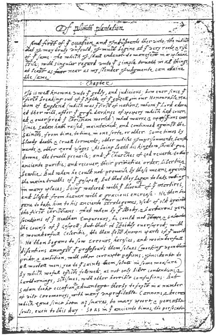
A page from the journal of William Bradford, Governor of Plymouth Colony in Massachusetts. It is from this journal that we know about the first Thanksgiving. Photo courtesy Massachusetts State House.
The Hawthorne Effect, the Heisenberg Uncertainty Principle, and the Pygmalion Effect are three examples of observer effects — phenomena that describe how observers interact with the systems or people they observe. We usually think of these effects as bad news, because they create outcomes different from what we were intending.
For instance, the Hawthorne Effect causes the system we're measuring to change its behavior, which can create paradoxical measurement results. See "Getting Around Hawthorne," Point Lookout for October 2, 2002, for more.
But observer effects can work to our advantage, too. In some ways, having a coach is like having an observer who watches your inner process. When you know you'll be talking to your coach next week, you just might be a little more careful about some of the choices you make this week.
Observing yourself is another way to exploit the observer effect. There's no easier way to do it than keeping a workplace journal, where you record anything you want about your experience of work. Here are some tips for successful workplace journaling.
- Choose your medium
- Some like to journal in a word processor; some prefer a blank book and a favorite pen or pencil. Choose deliberately. Do you like the feel of paper and ink? Or do you want to be able to search using the Find command?
- Let the writing slow you down
- If you're typing your journal, try typing slowly. If you're writing on paper, write carefully. Let the act of writing slow your thinking, to help you see things differently. Thinking slowly about the events of the day is like visiting a familiar place on foot, instead of by car — you see more.
- Write as if to your future self
- Thinking slowly about
the events of the day
is like visiting a familiar place
on foot, instead of by car - Like all good writing, both the writer and the reader benefit from a journal, but only if the writer keeps the reader in mind. For your journal, your reader is yourself, some months from now. Write to that person.
- Record why and why not
- Record why you made the choices you did, and why you didn't make the choices you didn't. This kind of information makes interesting reading six months from now.
- Read the old entries
- To get the full value of the observer effects, from time to time you have to read what you've written. Notice patterns. Think about (and write about) what you might change about yourself to displace patterns you don't like, or what to keep to re-enforce the patterns you do like.
If you don't already journal regularly, here's an idea for an entry: write about the thoughts that came to you as you were reading this little essay. What did you like about the idea of a working journal? If you were to start one, what would you like to have happen?  Top
Top  Next Issue
Love the work but not the job? Bad boss, long commute, troubling ethical questions, hateful colleague? This ebook looks at what we can do to get more out of life at work. It helps you get moving again! Read Go For It! Sometimes It's Easier If You Run, filled with tips and techniques for putting zing into your work life. Order Now!
One caution: If you decide to keep your journal at work, be certain that you comply with your employer's document retention and destruction policies. You might want to keep your journal at home.
For an example of something you might want to put in your working journal, suppose you were trying acquire skill in using indirectness. You might record in your journal any incidents you observed where someone used indirectness deftly and to good effect. Or you might record your own attempts or missed opportunities, along with short discussions of how you could improve.
Working journals are also useful if you're aiming for a promotion. See "How to Get Promoted in Place," Point Lookout for August 23, 2006, and "How to Get a Promotion in Line," Point Lookout for September 13, 2006, for more.
Your comments are welcome
Would you like to see your comments posted here? rbrenaXXxGCwVgbgLZDuRner@ChacDjdMAATPdDNJnrSwoCanyon.comSend me your comments by email, or by Web form.About Point Lookout
 Thank you for reading this article. I hope you enjoyed it and
found it useful, and that you'll consider recommending it to a friend.
Thank you for reading this article. I hope you enjoyed it and
found it useful, and that you'll consider recommending it to a friend.
This article in its entirety was written by a human being. No machine intelligence was involved in any way.
Point Lookout is a free weekly email newsletter. Browse the archive of past issues. Subscribe for free.
Support Point Lookout by joining the Friends of Point Lookout, as an individual or as an organization.
Do you face a complex interpersonal situation? Send it in, anonymously if you like, and I'll give you my two cents.
Related articles
More articles on Personal, Team, and Organizational Effectiveness:
 Games for Meetings: I
- We spend a lot of time and emotional energy in meetings, much of it engaged in any of dozens of ritualized
games. Here's Part I of a little catalog of some of our favorites, and what we can do about them.
 Social Distancing for Pandemic Flu
- It's time we all began to take seriously the warning about a possible influenza pandemic. Whether or
not your organization has a plan, you can do much to reduce your own chances of infection, and the chances
of mass infection, by adopting a set of practices known as social distancing.
 Twenty-Three Thoughts
- Sometimes we get so focused on the immediate problem that we lose sight of the larger questions. Here
are twenty-three thoughts to help you focus on what really counts.
 Holding Back: I
- When members of teams or groups hold back their efforts toward achieving group goals, schedule and budget
problems can arise, along with frustration and destructive intra-group conflict. What causes this behavior?
 Goodhart's Law and Gaming the Metrics
- Goodhart's Law is an observation about managing by metrics. When we make known the metrics' goals, we
risk collapse of the metrics, in part because people try to "game" the metrics by shading
or manufacturing the data to produce the goal result.
See also Personal, Team, and Organizational Effectiveness for more related articles.
Forthcoming issues of Point Lookout
 Coming October 1: On the Risks of Obscuring Ignorance
- When people hide their ignorance of concepts fundamental to understanding the issues at hand, they expose their teams and organizations to a risk of making wrong decisions. The organizational costs of the consequences of those decisions can be unlimited. Available here and by RSS on October 1.
 And on October 8: Responding to Workplace Bullying
- Effective responses to bullying sometimes include "pushback tactics" that can deter perpetrators from further bullying. Because perpetrators use some of these same tactics, some people have difficulty employing them. But the need is real. Pushing back works. Available here and by RSS on October 8.
Coaching services
I offer email and telephone coaching at both corporate and individual rates. Contact Rick for details at rbrenaXXxGCwVgbgLZDuRner@ChacDjdMAATPdDNJnrSwoCanyon.com or (650) 787-6475, or toll-free in the continental US at (866) 378-5470.
Get the ebook!
Past issues of Point Lookout are available in six ebooks:
- Get 2001-2 in Geese Don't Land on Twigs (PDF, )
- Get 2003-4 in Why Dogs Wag (PDF, )
- Get 2005-6 in Loopy Things We Do (PDF, )
- Get 2007-8 in Things We Believe That Maybe Aren't So True (PDF, )
- Get 2009-10 in The Questions Not Asked (PDF, )
- Get all of the first twelve years (2001-2012) in The Collected Issues of Point Lookout (PDF, )
Are you a writer, editor or publisher on deadline? Are you looking for an article that will get people talking and get compliments flying your way? You can have 500-1000 words in your inbox in one hour. License any article from this Web site. More info
Follow Rick


Recommend this issue to a friend
Send an email message to a friend
rbrenaXXxGCwVgbgLZDuRner@ChacDjdMAATPdDNJnrSwoCanyon.comSend a message to Rick
A Tip A Day feed
Point Lookout weekly feed
 My blog, Technical Debt for Policymakers, offers
resources, insights, and conversations of interest to policymakers who are concerned with managing
technical debt within their organizations. Get the millstone of technical debt off the neck of your
organization!
My blog, Technical Debt for Policymakers, offers
resources, insights, and conversations of interest to policymakers who are concerned with managing
technical debt within their organizations. Get the millstone of technical debt off the neck of your
organization! Bad boss, long commute, troubling ethical questions, hateful colleague? Learn what we can do when we
love the work but not the job.Learn how to make your virtual global team sing.Are you managing a change effort that faces rampant cynicism, passive non-cooperation, or
maybe even outright revolt?Learn how to make meetings more productive — and more rare.
Bad boss, long commute, troubling ethical questions, hateful colleague? Learn what we can do when we
love the work but not the job.Learn how to make your virtual global team sing.Are you managing a change effort that faces rampant cynicism, passive non-cooperation, or
maybe even outright revolt?Learn how to make meetings more productive — and more rare.