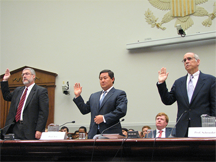
David Addington, John Yoo, and Chris Schroeder testify before the U.S. House Judiciary Committee's Subcommittee on the Constitution, Civil Rights and Civil Liberties on June 26, 2008. Mr. Addington was legal counsel (2001-2005) and chief of staff (2005-2009) to former Vice President Dick Cheney. Mr. Schroeder was in charge of the Bush Administration's Office of Legal Counsel (OLC) during the early years of the war on terror. Mr. Yoo worked in that office, authoring many internal memoranda about the use of torture. Generally, his position on torture was that the President could order torture, despite many laws prohibiting it, on the basis of his "constitutional authority to protect the nation from attack." The OLC is invested with legal and regulatory authority within the White House. It is this authority that was used to justify the use of torture. We may never know what happened or did not happen during those years, and we may never know definitively whether any crimes occurred. What does seem clear, however, is that the Presidency "captured" the OLC, in the sense that the OLC did not act as an independent legal authority. During those years, the Presidency was able to obtain whatever rulings it wanted to pursue the war on terror. Another example of capturing of legal authority within the U.S. administration is the string of events known colloquially as the "Saturday Night Massacre" — the firing of Archibald Cox in 1973 during the Watergate scandal.
The capturing of cognitive authorities, legal authorities, and administrative authorities does happen. When it does, the organization is at risk of undertaking self-destructive actions. Photo courtesy U.S. House of Representatives.
In the first installment of this series, we examined the interrelationships between power, authority, and influence, emphasizing the value that a systems view provides. Let's take a closer look now at the kinds of authority we find in organizations, beginning with kinds most often recognized as formal.
- Cognitive authority
- This term, coined by Patrick Wilson, denotes authority that influences thoughts that people consciously recognize as proper. It's specific to some particular field of knowledge. People usually confer it only upon someone whom they consider influential. In organizations, a common form of cognitive authority relates to the organization's mission and work. Since the organization's work usually factors into weakly interacting cells, its cognitive authority usually factors similarly.
- We're most comfortable citing cognitive authority. Even when we must yield to other kinds of authority, we sometimes seek cognitive authority to support our choices. We call this process "rationalization."
- Legal or regulatory authority
- Because laws and regulations can constrain everything we do, this form of cognitive authority deserves special attention. Since it is one of the few forms of cognitive authority that doesn't factor easily into cells, those who possess it usually work closely with those at the center of power.
- Ironically, legal authorities don't necessarily understand how to apply their authority in detail to the organization's work. Collaboration between legal experts and content experts is often necessary. The need for this collaboration is not always fully appreciated.
- Administrative authority
- Since this is the authority vested in an organizational position, it is sometimes (somewhat illegitimately) called "legitimate" authority. Administrative authority is thus founded on three relationships: that between the bearer of the authority and the organization; that between the organization and the conferrer; and that between the conferrer and the bearer.
- For some, being influenced by administrative authority is difficult, because it entails acknowledging one's own inferior station in the organization. On the other hand, to some, using administrative authority can also be difficult, because it can feel like saying, For some, being influenced by
administrative authority is
difficult, because it entails
acknowledging one's own
inferior station in
the organization"Because I said so." Thus, the exercise of administrative authority can be stressful to the relationship for both parties. This can lead both of them to seek the haven of cognitive authority, real or illusory. - Resource authority
- This authority derives from control of inanimate resources, such as facilities, equipment, or finance. Although it's usually a form of administrative authority, resource authority is unique in that it excludes administrative authority over the people. Exercising resource authority as a means of influence entails, for example, the using rewards, rationing, withholding, bribing, granting, secreting, scheduling, and so on.
- Using resource authority can be constructive or destructive for relationships. It can be facilitative or coercive. And there are gray areas: people can assert authority over resources that aren't formally theirs to control. Resource authority can thus be fertile territory for political wrangling.
Next time we'll investigate less formal kinds of authority. First in this series Next in this series  Top
Top  Next Issue
Is every other day a tense, anxious, angry misery as you watch people around you, who couldn't even think their way through a game of Jacks, win at workplace politics and steal the credit and glory for just about everyone's best work including yours? Read 303 Secrets of Workplace Politics, filled with tips and techniques for succeeding in workplace politics. More info
Your comments are welcome
Would you like to see your comments posted here? rbrendPtoGuFOkTSMQOzxner@ChacEgGqaylUnkmwIkkwoCanyon.comSend me your comments by email, or by Web form.About Point Lookout
 Thank you for reading this article. I hope you enjoyed it and
found it useful, and that you'll consider recommending it to a friend.
Thank you for reading this article. I hope you enjoyed it and
found it useful, and that you'll consider recommending it to a friend.
This article in its entirety was written by a human being. No machine intelligence was involved in any way.
Point Lookout is a free weekly email newsletter. Browse the archive of past issues. Subscribe for free.
Support Point Lookout by joining the Friends of Point Lookout, as an individual or as an organization.
Do you face a complex interpersonal situation? Send it in, anonymously if you like, and I'll give you my two cents.
Related articles
More articles on Organizational Change:
 Deciding to Change: Trusting
- When organizations change by choice, people who are included in the decision process understand the
issues. Whether they agree with the decision or not, they participate in the decision in some way. But
not everyone is included in the process. What about those who are excluded?
 Deciding to Change: Choosing
- When organizations decide to change what they do, the change sometimes requires that they change how
they make decisions, too. That part of the change is sometimes overlooked, in part, because it affects
most the people who make decisions. What can we do about this?
 Learning-Averse Organizations
- A learning-averse organization is one that seems constitutionally unwilling, if not unable, to learn
new and better ways of conducting its operations. Given the rapid pace of change in modern markets,
one wonders how they survive. Here's how.
 Organizational Roots of Toxic Conflict
- When toxic conflict erupts in a team, cooperation ends and person-to-person attacks begin. Usually we
hold responsible the people involved. But in some cases, the organization is the root cause, and then
replacing or disciplining the people might not help.
 Contrary Indicators of Psychological Safety: II
- When we begin using new tools or processes, we make mistakes. Practice is the cure, but practice can
be scary if the grace period for early mistakes is too short. For teams adopting new methods, psychological
safety is a fundamental component of success.
See also Organizational Change and Workplace Politics for more related articles.
Forthcoming issues of Point Lookout
 Coming May 15: Should I Write or Should I Call?
- After we recognize the need to contact a colleague or colleagues to work out a way to move forward, we next must decide how to make contact. Phone? Videoconference? Text message? There are some simple criteria that can help with such decisions. Available here and by RSS on May 15.
 And on May 22: Rescheduling Collaborative Work
- Rescheduling is what we do when the schedule we have now is so desperately unachievable that we must let go of it because when we look at it we can no longer decide whether to laugh or cry. The fear is that the new schedule might come to the same end. Available here and by RSS on May 22.
Coaching services
I offer email and telephone coaching at both corporate and individual rates. Contact Rick for details at rbrendPtoGuFOkTSMQOzxner@ChacEgGqaylUnkmwIkkwoCanyon.com or (650) 787-6475, or toll-free in the continental US at (866) 378-5470.
Get the ebook!
Past issues of Point Lookout are available in six ebooks:
- Get 2001-2 in Geese Don't Land on Twigs (PDF, )
- Get 2003-4 in Why Dogs Wag (PDF, )
- Get 2005-6 in Loopy Things We Do (PDF, )
- Get 2007-8 in Things We Believe That Maybe Aren't So True (PDF, )
- Get 2009-10 in The Questions Not Asked (PDF, )
- Get all of the first twelve years (2001-2012) in The Collected Issues of Point Lookout (PDF, )
Are you a writer, editor or publisher on deadline? Are you looking for an article that will get people talking and get compliments flying your way? You can have 500-1000 words in your inbox in one hour. License any article from this Web site. More info
Follow Rick


Recommend this issue to a friend
Send an email message to a friend
rbrendPtoGuFOkTSMQOzxner@ChacEgGqaylUnkmwIkkwoCanyon.comSend a message to Rick
A Tip A Day feed
Point Lookout weekly feed
 My blog, Technical Debt for Policymakers, offers
resources, insights, and conversations of interest to policymakers who are concerned with managing
technical debt within their organizations. Get the millstone of technical debt off the neck of your
organization!
My blog, Technical Debt for Policymakers, offers
resources, insights, and conversations of interest to policymakers who are concerned with managing
technical debt within their organizations. Get the millstone of technical debt off the neck of your
organization! Bad boss, long commute, troubling ethical questions, hateful colleague? Learn what we can do when we
love the work but not the job.Learn how to make your virtual global team sing.Are you managing a change effort that faces rampant cynicism, passive non-cooperation, or
maybe even outright revolt?Learn how to make meetings more productive — and more rare.
Bad boss, long commute, troubling ethical questions, hateful colleague? Learn what we can do when we
love the work but not the job.Learn how to make your virtual global team sing.Are you managing a change effort that faces rampant cynicism, passive non-cooperation, or
maybe even outright revolt?Learn how to make meetings more productive — and more rare.