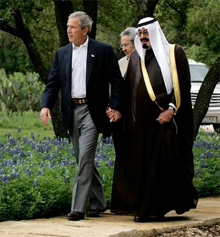
President George W. Bush of the United States and Crown Prince Abdullah of Saudi Arabia meeting at Bush's ranch in Crawford, Texas, April 25, 2005. This incident caused quite a stir in the United States, where it is unusual for men to hold hands. In Saudi Arabia, on the other hand, men hold hands as a sign of respect and affection. The stir in the U.S. can be viewed as an example of insisting on "doing it my way." See "Why Arab men hold hands," by Hassan M. Fattah, in The New York Times, May 1, 2005. White House photo by David Bohrer, courtesy Wikipedia.

Daily, we engage in dozens or hundreds of social transactions. We greet others; we say farewell; we yield (or not) in hallways, on the street, or entering elevators; we shake hands, wave, or hug; we hold doors open for others; we let doors close; we place lunch or latte orders; we leave voicemail; we send email thanks; and on and on.
We can choose from dozens of different approaches to these engagements. There are degrees of intensity, cheerfulness, and enthusiasm. Usually we make these choices without thinking much about them.
Some social transactions are reciprocal: one party initiates, and the other responds. Each chooses a style, more or less voluntarily. Waving hello from afar is an example of a reciprocal transaction. Other social transactions are mutual: the two parties usually engage in the transaction in similar styles, because of the nature of the transaction. Shaking hands and hugging are examples of mutual social transactions.
In mutual social transactions disagreements as to style are awkward at best. They can even result in insult. One stance that leads to disagreement is insisting on doing it one's own way, despite the preferences of the partner. Another stance, perhaps even more problematic, is being completely unaware that one's own way is just one way, and that it might differ from the partner's. The former entails at least an acknowledgment that others have a point of view, while the latter might be considered a form of cultural ignorance.
Here's an example of a disagreement. Interviewers of candidates for employment report that occasionally, at the end of an interview, when the interviewer extends a hand for a parting handshake, the candidate will approach for a hug, effectively brushing aside the extended hand, saying, "I'm a hugger." In effect, the candidate says, "We're doing it my way."
Sometimes, a power differential between the parties settles the question. The less powerful yield to the more powerful, because resistance can be socially — or financially — In mutual social transactions
disagreements as to style
are awkward at best. They
can even result in insult.expensive. Whether we have the greater power or not, we tend to accept this resolution, but when viewed from outside the power system, it's clear that using power to settle differences in approaches to social transactions is no more fair or right than is using any other form of coercion.
Our personal preferences probably arise from the cultures and microcultures of our early years. Yet, as adults, we mix with others from many different cultures, and then we must make choices about how we engage in mutual social transactions. We can demand that our own preferences prevail, we can yield to others, or we can seek a mutually acceptable arrangement. Reflect on how you've dealt with this issue so far today or so far this week. How do you feel about that? What can you change?  Top
Top  Next Issue
Is every other day a tense, anxious, angry misery as you watch people around you, who couldn't even think their way through a game of Jacks, win at workplace politics and steal the credit and glory for just about everyone's best work including yours? Read 303 Secrets of Workplace Politics, filled with tips and techniques for succeeding in workplace politics. More info
Your comments are welcome
Would you like to see your comments posted here? rbrendPtoGuFOkTSMQOzxner@ChacEgGqaylUnkmwIkkwoCanyon.comSend me your comments by email, or by Web form.About Point Lookout
 Thank you for reading this article. I hope you enjoyed it and
found it useful, and that you'll consider recommending it to a friend.
Thank you for reading this article. I hope you enjoyed it and
found it useful, and that you'll consider recommending it to a friend.
This article in its entirety was written by a human being. No machine intelligence was involved in any way.
Point Lookout is a free weekly email newsletter. Browse the archive of past issues. Subscribe for free.
Support Point Lookout by joining the Friends of Point Lookout, as an individual or as an organization.
Do you face a complex interpersonal situation? Send it in, anonymously if you like, and I'll give you my two cents.
Related articles
More articles on Workplace Politics:
 Empire Building
- Empire builders create bases of power within the larger organization. Typically, they use these domains
to advance personal or provincial agendas. What are the characteristics of empires? How can we navigate
through or around them?
 My Boss Gabs Too Much
- Your boss has popped into your office for another morning gab session. Normally, it's irritating, but
today you have a tight deadline, so you're royally ticked. What can you do?
 Projects as Proxy Targets: II
- Most projects have both supporters and detractors. When a project has been approved and execution begins,
some detractors don't give up. Here's Part II of a catalog of tactics detractors use to sow chaos.
 Some Hazards of Skip-Level Interviews: III
- Skip-level interviews — dialogs between a subordinate and the subordinate's supervisor's supervisor
— can be hazardous. Here's Part III of a little catalog of the hazards, emphasizing subordinate-initiated
skip-level interviews.
 Suppressing Dissent: I
- In some groups, disagreeing with the majority, or disagreeing with the Leader, can be a personally expensive
act. Here is Part I of a set of tactics used by Leaders who choose not to tolerate dissent.
See also Workplace Politics and Effective Communication at Work for more related articles.
Forthcoming issues of Point Lookout
 Coming May 1: Antipatterns for Time-Constrained Communication: 2
- Recognizing just a few patterns that can lead to miscommunication can reduce the incidence of miscommunications. Here's Part 2 of a collection of antipatterns that arise in communication under time pressure, emphasizing those that depend on content. Available here and by RSS on May 1.
- And on May 8: Antipatterns for Time-Constrained Communication: 3
- Recognizing just a few patterns that can lead to miscommunication can reduce the incidence of problems. Here is Part 3 of a collection of antipatterns that arise in technical communication under time pressure, emphasizing past experiences of participants. Available here and by RSS on May 8.
Coaching services
I offer email and telephone coaching at both corporate and individual rates. Contact Rick for details at rbrendPtoGuFOkTSMQOzxner@ChacEgGqaylUnkmwIkkwoCanyon.com or (650) 787-6475, or toll-free in the continental US at (866) 378-5470.
Get the ebook!
Past issues of Point Lookout are available in six ebooks:
- Get 2001-2 in Geese Don't Land on Twigs (PDF, )
- Get 2003-4 in Why Dogs Wag (PDF, )
- Get 2005-6 in Loopy Things We Do (PDF, )
- Get 2007-8 in Things We Believe That Maybe Aren't So True (PDF, )
- Get 2009-10 in The Questions Not Asked (PDF, )
- Get all of the first twelve years (2001-2012) in The Collected Issues of Point Lookout (PDF, )
Are you a writer, editor or publisher on deadline? Are you looking for an article that will get people talking and get compliments flying your way? You can have 500-1000 words in your inbox in one hour. License any article from this Web site. More info
Follow Rick


Recommend this issue to a friend
Send an email message to a friend
rbrendPtoGuFOkTSMQOzxner@ChacEgGqaylUnkmwIkkwoCanyon.comSend a message to Rick
A Tip A Day feed
Point Lookout weekly feed
 The message of Point Lookout is unique. Help get the message out. Please donate to help keep Point Lookout available for free to everyone.
 My blog, Technical Debt for Policymakers, offers
resources, insights, and conversations of interest to policymakers who are concerned with managing
technical debt within their organizations. Get the millstone of technical debt off the neck of your
organization!
My blog, Technical Debt for Policymakers, offers
resources, insights, and conversations of interest to policymakers who are concerned with managing
technical debt within their organizations. Get the millstone of technical debt off the neck of your
organization!Beware any resource that speaks of "winning" at workplace politics or "defeating" it. You can benefit or not, but there is no score-keeping, and it isn't a game.
- Wikipedia has a nice article with a list of additional resources
- Some public libraries offer collections. Here's an example from Saskatoon.
- Check my own links collection
- LinkedIn's Office Politics discussion group
 Is every other day a tense, anxious, angry misery as you watch people around you, who couldn't even
think their way through a game of Jacks, win at workplace politics and steal the credit and glory
for just about everyone's best work including yours? Read 303 Secrets of Workplace Politics!Learn how to make your virtual global team sing.A Tip a Day arrives by email, or by RSS Feed, each business day. It's 20 to 30 words at most, and gives
you a new perspective on the hassles and rewards of work life. Most tips also contain links to
related articles. Free!Learn how to make meetings more productive — and more rare.
Is every other day a tense, anxious, angry misery as you watch people around you, who couldn't even
think their way through a game of Jacks, win at workplace politics and steal the credit and glory
for just about everyone's best work including yours? Read 303 Secrets of Workplace Politics!Learn how to make your virtual global team sing.A Tip a Day arrives by email, or by RSS Feed, each business day. It's 20 to 30 words at most, and gives
you a new perspective on the hassles and rewards of work life. Most tips also contain links to
related articles. Free!Learn how to make meetings more productive — and more rare.