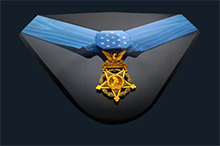
US Medal of Honor. The President, in the name of Congress, has awarded more than 3,400 Medals of Honor, the highest U.S. citation for bravery.
Don showed up at 11:40, on the dot. No surprise there. "Ready?" he asked. Staring intently at her screen, Pat replied, "Yeah, just have to save this, one sec." She did, and then threw on her jacket and off they went to lunch. Lunch seemed so inadequate, she thought, after Don had basically saved the company from a horrible end. She'd been over this in her mind for weeks, finally hitting on lunch. What else could she do? Give him one of those $50 Amazon gift certificates that the guidelines allowed? That would have been demoralizing for them both.
Perhaps you've been there. Some people in your organization have done really outstanding work. You want to recognize that work, but the budget is so small or the guidelines so miserly that anything you could do would be insulting. What can you do when people do really outstanding work? Express your genuine appreciation and trust — person-to-person, heart-to-heart. Remarking on outstanding performance is the basis of other public recognitions, such as the Oscars or military medals.
Paradoxically, a big budget for rewards is a liability — it tempts you to reward with money or resources, which can depress performance. This happens, in part, because rewards of evident value carry with them two messages that you cannot control.
Rewards of evident valueinvite comparisons
of their values.
We can't help but
make a meaning of
the size of the reward.
- Personal barriers
- The expression "please accept this token of our esteem" is so worn that we barely grasp its literal meaning. Instead of your esteem, you're offering a token — a placeholder, a barrier between yourself and the recipient.
- The value of the reward is significant
- Rewards of evident value invite comparisons of their values. We can't help but make a meaning of the size of the reward, usually related to the depth of the appreciation. Unless each reward is greater than the last, you risk being seen as less appreciative than you really are.
As an alternative, consider honoring the outstanding performance by expressing your appreciation and offering your trust. Express your appreciation and gratitude publicly at a ceremony with everyone in attendance.
Offer your trust by offering more responsibility and greater challenges. For example, Pat can say, "Don, I really appreciate what you did on the Metronome project — the whole company does. You did such great work, I wonder if you would want to consider taking on Daffodil."
By giving the outstanding performer an opportunity — a choice — to demonstrate further outstanding performance, you give both the performer and the organization opportunities to achieve together.
By expressing publicly your appreciation and gratitude, you give a reward that no one else can give. And you give yourself a gift too — the knowledge that the success of your organization is due not only to your own abilities, but to the achievements of everyone in it.  Top
Top  Next Issue
The article you've been reading is an archived issue of Point Lookout, my weekly newsletter. I've been publishing it since January, 2001, free to all subscribers, over the Web, and via RSS. You can help keep it free by donating either as an individual or as an organization. You'll receive in return my sincere thanks — and the comfort of knowing that you've helped to propagate insights and perspectives that can help make our workplaces a little more human-friendly. More
For an extensive study of the depressive effects of rewards, see Alfie Kohn, Punished by Rewards: The Trouble with Gold Stars, Incentive Plans, A's, Praise, and Other Bribes. Boston: Houghton Mifflin, 1993. Order from Amazon.com.
For more about Trust, see "Creating Trust," Point Lookout for January 21, 2009, "TINOs: Teams in Name Only," Point Lookout for March 19, 2008 and "The High Cost of Low Trust: I," Point Lookout for April 19, 2006.
Your comments are welcome
Would you like to see your comments posted here? rbrendPtoGuFOkTSMQOzxner@ChacEgGqaylUnkmwIkkwoCanyon.comSend me your comments by email, or by Web form.About Point Lookout
 Thank you for reading this article. I hope you enjoyed it and
found it useful, and that you'll consider recommending it to a friend.
Thank you for reading this article. I hope you enjoyed it and
found it useful, and that you'll consider recommending it to a friend.
This article in its entirety was written by a human being. No machine intelligence was involved in any way.
Point Lookout is a free weekly email newsletter. Browse the archive of past issues. Subscribe for free.
Support Point Lookout by joining the Friends of Point Lookout, as an individual or as an organization.
Do you face a complex interpersonal situation? Send it in, anonymously if you like, and I'll give you my two cents.
Related articles
More articles on Personal, Team, and Organizational Effectiveness:
 Decisions, Decisions: II
- Most of us have participated in group decision making. The process can be frustrating and painful, but
it can also be thrilling. What processes do groups use to make decisions?
 Working Journals
- Keeping a journal about your work can change how you work. You can record why you did what you did,
and why you didn't do what you didn't. You can record what you saw and what you only thought you saw.
And when you read the older entries, you can see patterns you might never have noticed any other way.
 What Measurements Work Well?
- To manage well, we need to know where we are, where we would like to be, and what we need to do to get
there. Measurement can help us achieve our goals, by telling us where we are and how much progress we're
making. But some things aren't measurable, and some measurement methods yield misleading results. How
can we use measurement effectively?
 Why Don't They Believe Me?
- When we want people to believe us, and they don't, it just might be a result of our own actions or demeanor.
How does this happen?
 Virtual Interviews: II
- The pandemic has made face-to-face job interviews less important. And so we must now also master virtual
interviews, and that requires understanding the effects of the attendance list, video presence, and
the technologies of staging, lighting, and makeup.
See also Personal, Team, and Organizational Effectiveness for more related articles.
Forthcoming issues of Point Lookout
 Coming May 1: Antipatterns for Time-Constrained Communication: 2
- Recognizing just a few patterns that can lead to miscommunication can reduce the incidence of miscommunications. Here's Part 2 of a collection of antipatterns that arise in communication under time pressure, emphasizing those that depend on content. Available here and by RSS on May 1.
- And on May 8: Antipatterns for Time-Constrained Communication: 3
- Recognizing just a few patterns that can lead to miscommunication can reduce the incidence of problems. Here is Part 3 of a collection of antipatterns that arise in technical communication under time pressure, emphasizing past experiences of participants. Available here and by RSS on May 8.
Coaching services
I offer email and telephone coaching at both corporate and individual rates. Contact Rick for details at rbrendPtoGuFOkTSMQOzxner@ChacEgGqaylUnkmwIkkwoCanyon.com or (650) 787-6475, or toll-free in the continental US at (866) 378-5470.
Get the ebook!
Past issues of Point Lookout are available in six ebooks:
- Get 2001-2 in Geese Don't Land on Twigs (PDF, )
- Get 2003-4 in Why Dogs Wag (PDF, )
- Get 2005-6 in Loopy Things We Do (PDF, )
- Get 2007-8 in Things We Believe That Maybe Aren't So True (PDF, )
- Get 2009-10 in The Questions Not Asked (PDF, )
- Get all of the first twelve years (2001-2012) in The Collected Issues of Point Lookout (PDF, )
Are you a writer, editor or publisher on deadline? Are you looking for an article that will get people talking and get compliments flying your way? You can have 500-1000 words in your inbox in one hour. License any article from this Web site. More info
Follow Rick


Recommend this issue to a friend
Send an email message to a friend
rbrendPtoGuFOkTSMQOzxner@ChacEgGqaylUnkmwIkkwoCanyon.comSend a message to Rick
A Tip A Day feed
Point Lookout weekly feed
 My blog, Technical Debt for Policymakers, offers
resources, insights, and conversations of interest to policymakers who are concerned with managing
technical debt within their organizations. Get the millstone of technical debt off the neck of your
organization!
My blog, Technical Debt for Policymakers, offers
resources, insights, and conversations of interest to policymakers who are concerned with managing
technical debt within their organizations. Get the millstone of technical debt off the neck of your
organization! Are your project teams plagued by turnover, burnout, and high defect rates? Turn your culture around.
- Your stuff is brilliant! Thank you!
- You and Scott Adams both secretly work here, right?
- I really enjoy my weekly newsletters. I appreciate the quick read.
- A sort of Dr. Phil for Management!
- …extremely accurate, inspiring and applicable to day-to-day … invaluable.
- More
Fed up with tense, explosive meetings? Are you the target of a bully? Learn how to make peace with conflict.Save a bundle and even more important save time! Order the Combo Package and download all ebooks
and tips books at once.