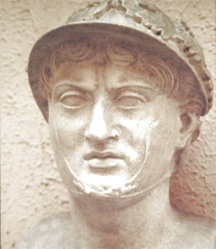
King Pyrrhus of Epiro, a region of northern ancient Greece. In 280 BCE, he led an invasion of southern Italy, in what would become the first engagement for the Romans with a then-modern Hellenistic armed force. In that year and the next, he won two major battles, but the cost in arms, men and elephants was so high that he is said to have remarked, "One more victory over the Romans and we are completely done for." At least he maintained his sense of irony, if not humor. These victories were the first to be called "Pyrrhic," though certainly Pyrrhic victories occurred earlier, and they would continue to accumulate throughout the history of warfare. Pyrrhic victories also occur on a daily basis in most organizations where people resolve conflicts of a somewhat less bloody kind. Photo of a piece held at Museo della Civiltà Romana (the Museum of Roman Civilization) in Rome.
Groups facing divisive issues risk making serious mistakes unknowingly. In group cultures accustomed to voting, formally or informally, people tend to measure the strength of alignments in terms of headcount. This perception obscures the passion people feel about the issues at hand, and it can lead us to make avoidable errors. Here are some insights about divisive issues.
- Headcount doesn't measure passion
- Whatever the actual numbers on any side of a question, they don't measure the intensity of feeling of group members. That intensity can determine how well the group works together after the decision.
- Consider how you would feel if you were one of those whose strong feelings the majority discounted. Work hard to devise a solution that excites no strong feelings of rejection on the part of any group member.
- Consider both content and consequences
- Making choices about divisive issues creates consequences for group cohesion. Focusing only on the content — the issue itself — and failing to consider the feelings of those who disagree is a risky approach.
- As a group member, include both content-related matters and the consequences for the group as you consider your choices. A legacy of bitterness and alienation can undermine the outcome you desire.
- Differing passions evolve differently
- After the decision, the passion people felt changes in different ways, depending upon whether the passion favored or opposed the decision. The passion of those who favored it is more likely to abate; the passion of those who opposed it is more likely to intensify.
- If the chosen solution excited strong contrary passions, beware their ongoing intensification. Prepare by finding ways to defuse the tension, possibly with other decisions in related areas.
- Refrain from imposing unsought advice
- Advice to As a group member, include
both content-related matters
and the consequences for the
group as you consider
your choicesthose about to prevail to "consider the consequences of narrow victory," can sound like threats or blackmail from disgruntled losers. Advice to those who opposed the decision to "put your feelings aside and move on," can feel like a fresh insult. - The urge on the part of one party to advise the other to surrender or relent is actually an index of the poverty of wisdom in the decision itself.
Victors in divisive debates, whether decided by vote or fiat, sometimes argue, "We cannot be held hostage to threats or bitterness. We had to do what's best for the group." This argument is seductively simplistic — it addresses a nasty problem by creating an even nastier problem. The real problem — the difference in perceptions about the issue at hand — must be resolved. It cannot be resolved by alienating those who stand on the other side of the issue. That tactic weakens the group, perhaps fatally.  Top
Top  Next Issue
Are you fed up with tense, explosive meetings? Are you or a colleague the target of a bully? Destructive conflict can ruin organizations. But if we believe that all conflict is destructive, and that we can somehow eliminate conflict, or that conflict is an enemy of productivity, then we're in conflict with Conflict itself. Read 101 Tips for Managing Conflict to learn how to make peace with conflict and make it an organizational asset. Order Now!
For more about the Pyrrhic War and other events of the early development of Rome, see The Beginnings of Rome: Italy From the Bronze Age to the Punic Wars (Circa 1,000 to 264 B.C.), by Tim Cornell. Order from Amazon.com
Your comments are welcome
Would you like to see your comments posted here? rbrendPtoGuFOkTSMQOzxner@ChacEgGqaylUnkmwIkkwoCanyon.comSend me your comments by email, or by Web form.About Point Lookout
 Thank you for reading this article. I hope you enjoyed it and
found it useful, and that you'll consider recommending it to a friend.
Thank you for reading this article. I hope you enjoyed it and
found it useful, and that you'll consider recommending it to a friend.
This article in its entirety was written by a human being. No machine intelligence was involved in any way.
Point Lookout is a free weekly email newsletter. Browse the archive of past issues. Subscribe for free.
Support Point Lookout by joining the Friends of Point Lookout, as an individual or as an organization.
Do you face a complex interpersonal situation? Send it in, anonymously if you like, and I'll give you my two cents.
Related articles
More articles on Conflict Management:
 Hurtful Clichés: II
- Much of our day-to-day conversation consists of harmless clichés: "How goes it?" or
"Nice to meet you." Some other clichés aren't harmless, but they're so common that
we use them without thinking. Here's Part II of a series exploring some of these clichés.
 Obstructionist Tactics: II
- Teams and groups depend for their success on highly effective cooperation between their members. If
even one person is unable or unwilling to cooperate, the team's performance is limited. Here's Part
II of a little catalog of tactics.
 Discussion Distractions: I
- Meetings could be far more productive, if only we could learn to recognize and prevent the distractions
that lead us off topic and into the woods. Here is Part I of a small catalog of distractions frequently
seen in meetings.
 Impasses in Group Decision Making: III
- In group decision making, impasses can develop. Some are related to the substance of the issue at hand.
With some effort, we can usually resolve substantive impasses. But treating nonsubstantive impasses
in the same way doesn't work. Here's why.
 Shame and Bullying
- Targets of bullies sometimes experience intense feelings of shame. Here are some insights that might
restore the ability to think, and maybe end the bullying.
See also Conflict Management and Effective Meetings for more related articles.
Forthcoming issues of Point Lookout
 Coming May 1: Antipatterns for Time-Constrained Communication: 2
- Recognizing just a few patterns that can lead to miscommunication can reduce the incidence of miscommunications. Here's Part 2 of a collection of antipatterns that arise in communication under time pressure, emphasizing those that depend on content. Available here and by RSS on May 1.
- And on May 8: Antipatterns for Time-Constrained Communication: 3
- Recognizing just a few patterns that can lead to miscommunication can reduce the incidence of problems. Here is Part 3 of a collection of antipatterns that arise in technical communication under time pressure, emphasizing past experiences of participants. Available here and by RSS on May 8.
Coaching services
I offer email and telephone coaching at both corporate and individual rates. Contact Rick for details at rbrendPtoGuFOkTSMQOzxner@ChacEgGqaylUnkmwIkkwoCanyon.com or (650) 787-6475, or toll-free in the continental US at (866) 378-5470.
Get the ebook!
Past issues of Point Lookout are available in six ebooks:
- Get 2001-2 in Geese Don't Land on Twigs (PDF, )
- Get 2003-4 in Why Dogs Wag (PDF, )
- Get 2005-6 in Loopy Things We Do (PDF, )
- Get 2007-8 in Things We Believe That Maybe Aren't So True (PDF, )
- Get 2009-10 in The Questions Not Asked (PDF, )
- Get all of the first twelve years (2001-2012) in The Collected Issues of Point Lookout (PDF, )
Are you a writer, editor or publisher on deadline? Are you looking for an article that will get people talking and get compliments flying your way? You can have 500-1000 words in your inbox in one hour. License any article from this Web site. More info
Follow Rick


Recommend this issue to a friend
Send an email message to a friend
rbrendPtoGuFOkTSMQOzxner@ChacEgGqaylUnkmwIkkwoCanyon.comSend a message to Rick
A Tip A Day feed
Point Lookout weekly feed
 My blog, Technical Debt for Policymakers, offers
resources, insights, and conversations of interest to policymakers who are concerned with managing
technical debt within their organizations. Get the millstone of technical debt off the neck of your
organization!
My blog, Technical Debt for Policymakers, offers
resources, insights, and conversations of interest to policymakers who are concerned with managing
technical debt within their organizations. Get the millstone of technical debt off the neck of your
organization! Bad boss, long commute, troubling ethical questions, hateful colleague? Learn what we can do when we
love the work but not the job.Learn how to make your virtual global team sing.Are you managing a change effort that faces rampant cynicism, passive non-cooperation, or
maybe even outright revolt?Learn how to make meetings more productive — and more rare.
Bad boss, long commute, troubling ethical questions, hateful colleague? Learn what we can do when we
love the work but not the job.Learn how to make your virtual global team sing.Are you managing a change effort that faces rampant cynicism, passive non-cooperation, or
maybe even outright revolt?Learn how to make meetings more productive — and more rare.