In this culture, and others, we value confidence in leaders, mechanics, doctors, generals, and even strangers we've asked for directions. But in all these cases, and more, we're actually seeking expertise, knowledge, and capability — in short, competence.
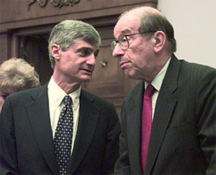
U.S. Secretary of the Treasury Robert Rubin (left) with Federal Reserve Board Chairman Alan Greenspan in discussion before meeting with the House Banking Committee on 20 May 1999, just six months before the work of Kruger and Dunning appeared. They were then both at the height of their power, which both used liberally to resist calls for regulation of new and growing sectors of the financial markets — the very sectors that contributed so much to the financial crisis at the end of 2008. Both men were studies in confidence, and that confidence played a role in persuading officials and the population at large that the U.S. economy was healthy and on course. Yet, on 23 October 2008, under questioning by Rep. Henry Waxman, chair of the Committee on Oversight and Government Reform of the U.S. House of Representatives, former Chairman Greenspan testified, with regard to his "conceptual framework with the way people deal with reality," that, "…I found a flaw, I don't know how significant or permanent it is, but I have been very distressed by that fact." He went on, "I found a flaw in the model that I perceived is the critical functioning structure that defines how the world works…I was shocked." One model of what might have happened to him is that he had discovered the limits of his competence. The fourth factor observed by Dunning and Kruger states that, "Incompetent individuals can gain insight about their shortcomings, but this comes (paradoxically) by gaining competence." If this model applies, one might conclude that by October, 2008, Mr. Greenspan was somewhat more competent than he had been in 1999. Read Mr. Greenspan's complete testimony and view other documents related to the hearing. Photo courtesy U.S. Department of the Treasury.
We usually assume that confidence comes from competence. We apply this assumption personally when we seek health care, investment advice, or other services. But we also apply it at work — when we make hiring decisions, when we evaluate the assertions of superiors and subordinates, and when we get advice from consultants.
Trouble is, the assumption is wrong.
We know this because of the pioneering work of Justin Kruger and David Dunning, who, working at Cornell in 1999, discovered a phenomenon now called the Dunning-Kruger effect. [Kruger & Dunning 1999] They performed experiments that yielded results consistent with these four principles (paraphrasing):
- Incompetent individuals, compared with their more competent peers, dramatically overestimate their ability and performance.
- Incompetent individuals are less able than their more competent peers to recognize competence when they see it.
- Incompetent individuals are less able than their more competent peers to gain insight into their true level of performance.
- Incompetent individuals can gain insight about their shortcomings, but this comes (paradoxically) by gaining competence.
Taken together, these four factors contribute to an inverse correlation between confidence and competence — exactly the opposite of what most of us assume.
If we can't rely on confidence as an indicator of competence, on what can we rely? In assessing competence, when we do consider factors beyond confidence, we tend to focus on domain-specific content. That helps, but it's not enough. Here are four generic indicators of competence for application in the workplace.
- Awareness of limitations
- The truly competent understand that their competence is limited — that there are things they can't do or don't know. This knowledge drives a continued desire to learn.
- Desire to learn
- Curiosity, practice, questioning, and continued study are signs of a drive to enhance competence. It is this drive that established the existing level of competence. Where this drive is weak, competence is questionable.
- Constructive response to failure
- Responding to Incompetent individuals, compared
with their more competent peers,
dramatically overestimate their
ability and performancefailure in constructive ways is another important way to build competence. This ability is probably essential to building competence. - Ability to assess risk realistically
- Realistic risk assessment requires a reservoir of experience — competence — in the relevant domains. Incompetence leads to mis-assessment of risk. The fearful and incompetent tend to overestimate risks; the brash and incompetent tend to underestimate them. Competence tempers both.
I'm not 100% sure that these indicators are necessary and sufficient — probably not. But they've come to me through a lifetime of experience. If you have others you rely on, send them to me and I'll consider adding them to my list.  Top
Top  Next Issue
Are your projects always (or almost always) late and over budget? Are your project teams plagued by turnover, burnout, and high defect rates? Turn your culture around. Read 52 Tips for Leaders of Project-Oriented Organizations, filled with tips and techniques for organizational leaders. Order Now!
More about the Dunning-Kruger Effect
 How to Reject Expert Opinion: II [January 4, 2012]
- When groups of decision makers confront complex problems, and they receive opinions from recognized experts, those opinions sometimes conflict with the group's own preferences. What tactics do groups use to reject the opinions of people with relevant expertise?
 Devious Political Tactics: More from the Field Manual [August 29, 2012]
- Careful observation of workplace politics reveals an assortment of devious tactics that the ruthless use to gain advantage. Here are some of their techniques, with suggestions for effective responses.
 Overconfidence at Work [April 15, 2015]
- Confidence in our judgments and ourselves is essential to success. Confidence misplaced — overconfidence — leads to trouble and failure. Understanding the causes and consequences of overconfidence can be most useful.
 Wishful Thinking and Perception: II [November 4, 2015]
- Continuing our exploration of causes of wishful thinking and what we can do about it, here's Part II of a little catalog of ways our preferences and wishes affect our perceptions.
 Wishful Significance: II [December 23, 2015]
- When we're beset by seemingly unresolvable problems, we sometimes conclude that "wishful thinking" was the cause. Wishful thinking can result from errors in assessing the significance of our observations. Here's a second group of causes of erroneous assessment of significance.
 Cognitive Biases and Influence: I [July 6, 2016]
- The techniques of influence include inadvertent — and not-so-inadvertent — uses of cognitive biases. They are one way we lead each other to accept or decide things that rationality cannot support.
 The Paradox of Carefully Chosen Words [November 16, 2016]
- When we take special care in choosing our words, so as to avoid creating misimpressions, something strange often happens: we create a misimpression of ignorance or deceitfulness. Why does this happen?
 Risk Acceptance: One Path [March 3, 2021]
- When a project team decides to accept a risk, and when their project eventually experiences that risk, a natural question arises: What were they thinking? Cognitive biases, other psychological phenomena, and organizational dysfunction all can play roles.
 Cassandra at Work [April 13, 2022]
- When a team makes a wrong choice, and only a tiny minority advocated for what turned out to have been the right choice, trouble can arise when the error at last becomes evident. Maintaining team cohesion can be a difficult challenge for team leaders.
 Embedded Technology Groups and the Dunning-Kruger Effect [March 12, 2025]
- Groups of technical specialists in fields that differ markedly from the main business of the enterprise that hosts them must sometimes deal with wrong-headed decisions made by people who think they know more about the technology than they actually do.
Footnotes
Your comments are welcome
Would you like to see your comments posted here? rbrenaXXxGCwVgbgLZDuRner@ChacDjdMAATPdDNJnrSwoCanyon.comSend me your comments by email, or by Web form.About Point Lookout
 Thank you for reading this article. I hope you enjoyed it and
found it useful, and that you'll consider recommending it to a friend.
Thank you for reading this article. I hope you enjoyed it and
found it useful, and that you'll consider recommending it to a friend.
This article in its entirety was written by a human being. No machine intelligence was involved in any way.
Point Lookout is a free weekly email newsletter. Browse the archive of past issues. Subscribe for free.
Support Point Lookout by joining the Friends of Point Lookout, as an individual or as an organization.
Do you face a complex interpersonal situation? Send it in, anonymously if you like, and I'll give you my two cents.
Related articles
More articles on Personal, Team, and Organizational Effectiveness:
 Food for Thought
- Most companies have employee cafeterias, with the usual not-much-better-than-high-school food service.
By upgrading — and subsidizing — food service, these companies can reduce turnover and improve
productivity dramatically.
 When You Think They've Made Up Their Minds
- In tough negotiations, when attempts to resolve differences have failed, we sometimes conclude that
"they've made up their minds," but other explanations abound. Keeping an open mind about why
other people seem to have closed theirs can help us find a resolution.
 Inner Babble
- It goes by various names — self-talk, inner dialog, or internal conversation. Because it is so
often disorganized and illogical, I like to call it inner babble. But whatever you call it,
it's often misleading, distracting, and unhelpful. How can you recognize inner babble?
 Office Automation
- Desktop computers, laptop computers, and tablets have automation capabilities that can transform our
lives, but few of us use them. Why not? What can we do about that?
 On Schedule Conflicts
- Schedule conflicts happen from time to time, even when the organization is healthy and all is well.
But when schedule conflicts are common, they might indicate that the organization is trying to do too
much with too few people.
See also Personal, Team, and Organizational Effectiveness for more related articles.
Forthcoming issues of Point Lookout
 Coming October 1: On the Risks of Obscuring Ignorance
- When people hide their ignorance of concepts fundamental to understanding the issues at hand, they expose their teams and organizations to a risk of making wrong decisions. The organizational costs of the consequences of those decisions can be unlimited. Available here and by RSS on October 1.
 And on October 8: Responding to Workplace Bullying
- Effective responses to bullying sometimes include "pushback tactics" that can deter perpetrators from further bullying. Because perpetrators use some of these same tactics, some people have difficulty employing them. But the need is real. Pushing back works. Available here and by RSS on October 8.
Coaching services
I offer email and telephone coaching at both corporate and individual rates. Contact Rick for details at rbrenaXXxGCwVgbgLZDuRner@ChacDjdMAATPdDNJnrSwoCanyon.com or (650) 787-6475, or toll-free in the continental US at (866) 378-5470.
Get the ebook!
Past issues of Point Lookout are available in six ebooks:
- Get 2001-2 in Geese Don't Land on Twigs (PDF, )
- Get 2003-4 in Why Dogs Wag (PDF, )
- Get 2005-6 in Loopy Things We Do (PDF, )
- Get 2007-8 in Things We Believe That Maybe Aren't So True (PDF, )
- Get 2009-10 in The Questions Not Asked (PDF, )
- Get all of the first twelve years (2001-2012) in The Collected Issues of Point Lookout (PDF, )
Are you a writer, editor or publisher on deadline? Are you looking for an article that will get people talking and get compliments flying your way? You can have 500-1000 words in your inbox in one hour. License any article from this Web site. More info
Follow Rick


Recommend this issue to a friend
Send an email message to a friend
rbrenaXXxGCwVgbgLZDuRner@ChacDjdMAATPdDNJnrSwoCanyon.comSend a message to Rick
A Tip A Day feed
Point Lookout weekly feed
 My blog, Technical Debt for Policymakers, offers
resources, insights, and conversations of interest to policymakers who are concerned with managing
technical debt within their organizations. Get the millstone of technical debt off the neck of your
organization!
My blog, Technical Debt for Policymakers, offers
resources, insights, and conversations of interest to policymakers who are concerned with managing
technical debt within their organizations. Get the millstone of technical debt off the neck of your
organization! Bad boss, long commute, troubling ethical questions, hateful colleague? Learn what we can do when we
love the work but not the job.Learn how to make your virtual global team sing.Are you managing a change effort that faces rampant cynicism, passive non-cooperation, or
maybe even outright revolt?Learn how to make meetings more productive — and more rare.
Bad boss, long commute, troubling ethical questions, hateful colleague? Learn what we can do when we
love the work but not the job.Learn how to make your virtual global team sing.Are you managing a change effort that faces rampant cynicism, passive non-cooperation, or
maybe even outright revolt?Learn how to make meetings more productive — and more rare.