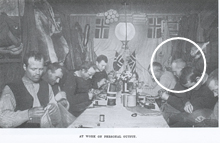
Amundsen's team working on personal kit during the winter before the trip South to the Pole. View a larger image. In order, from left to right, are Olav Bjaaland, Sverre Hassel, Oscar Wisting, Helmer Hanssen, Amundsen, Hjalmar Johansen, Kristian Prestrud, and Jørgen Stubberud. The circled gentleman is Hjalmar Johansen. Amundsen's first assault on the Pole in early spring was premature. Cold weather set in, and the party was forced to retreat. The retreat was disorderly, and nearly a disaster. Upon the return to base, Johansen publicly and heatedly attacked Amundsen, criticizing his leadership and decision making.
Amundsen, as leader of the expedition, was thus in two of the roles we identify here: he was the Target of abuse, and he was in the position analogous to what we are here calling Lead. Since Amundsen had no superior, Johansen had no alternative but to confront Amundsen directly, but he erred in making the confrontation both public and emotional. Amundsen subsequently "fired" Johansen from the expedition, in the sense that he assigned Johansen no further exploratory role. But Amundsen also modified his own approach to decision making, at least with respect to choosing the start date for the assault on the Pole. In that sense, he acted as his own supervisor, putting himself on what we today would call a "performance improvement plan." Photo owned by the Norwegian National Library. It can be obtained from of the "Nansen-Amundsen-Year 2011" Web site, hosted by the Norwegian Polar Institute, developed by Paul-Inge Flakstad and edited by Janne Schreuder. This particular copy of the photo is from Amundsen's book about the expedition, The South Pole}
In some meetings, we interrupt each other, we insult each other, we condescend to each other, and we can be bitingly sarcastic. Formally, it's the responsibility of the meeting lead or facilitator to deal with these behaviors. When they fail in these responsibilities, the abusive behavior likely continues or escalates.
In 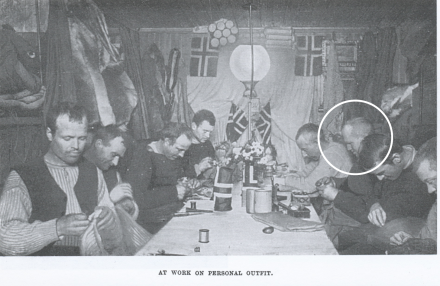 these situations, there are at least four roles. The Aggressor initiates the abusive behavior. The Target is the object of the Aggressor. The Lead has formal responsibility for maintaining decorum. Bystanders are present, but in any given incident, they aren't Targets. Often, multiple people occupy these roles, and sometimes an individual might play more than one role. But for simplicity let's assume that each person plays only one role. And I'll assume, dear reader, that you've been either a Target or a Bystander.
To end the abuse, Targets and uncomfortable Bystanders turn first to the Lead. Often, they learn that the issue is already being addressed. But what are their options if the Lead doesn't feel responsible for dealing with these issues? Or what if the Lead is unable to deal with the problem, because of incompetence or fear or whatever — what then?
If abuse is part of the culture, dealing with each Aggressor individually is of little use, because there are so many other Aggressors. On the other hand, if the Aggressor's behavior is unusual in the organizational culture, progress is possible. I'll address the cultural problem in a future issue. For now, let's examine the case in which abuse isn't part of the cultural pattern.
Let's suppose further that the Aggressors don't see their behavior as abusive, or if they do, they either don't care, or they haven't responded to private intervention. Now what?
The guiding principle is Do No Harm. In this Part I, let's first address what you cannot do.
In this scenario, the Aggressor's behavior is problematic, and the Lead is failing to address the problem of the Aggressor's behavior. Both failures are performance issues.
Only The guiding principle
is Do No Harmsupervisors can address performance issues effectively. Unless you're the Lead's supervisor or the Aggressor's supervisor, it isn't your responsibility to correct their performance issues. You can talk to the supervisor of the Lead, to the supervisor of the Aggressor, to your own supervisor, or to a Human Resources representative, but that's about it. It's up to them to address the performance issues.
This picture might seem bleak. I'm offering no magic solutions to these performance issues. But it's important to recognize that dealing with performance issues is the responsibility of supervisors, not colleagues. If you try to insert yourself into the supervisor-subordinate relationship, you will most likely complicate the problem.
Next time, we'll examine tactics you can use for the meeting itself. Next in this series  Top
Top  Next Issue
Is a workplace bully targeting you? Do you know what to do to end the bullying? Workplace bullying is so widespread that a 2014 survey indicated that 27% of American workers have experienced bullying firsthand, that 21% have witnessed it, and that 72% are aware that bullying happens. Yet, there are few laws to protect workers from bullies, and bullying is not a crime in most jurisdictions. 101 Tips for Targets of Workplace Bullies is filled with the insights targets of bullying need to find a way to survive, and then to finally end the bullying. Also available at Apple's iTunes store! Just . Order Now!
Your comments are welcome
Would you like to see your comments posted here? rbrendPtoGuFOkTSMQOzxner@ChacEgGqaylUnkmwIkkwoCanyon.comSend me your comments by email, or by Web form.About Point Lookout
 Thank you for reading this article. I hope you enjoyed it and
found it useful, and that you'll consider recommending it to a friend.
Thank you for reading this article. I hope you enjoyed it and
found it useful, and that you'll consider recommending it to a friend.
This article in its entirety was written by a human being. No machine intelligence was involved in any way.
Point Lookout is a free weekly email newsletter. Browse the archive of past issues. Subscribe for free.
Support Point Lookout by joining the Friends of Point Lookout, as an individual or as an organization.
Do you face a complex interpersonal situation? Send it in, anonymously if you like, and I'll give you my two cents.
Related articles
More articles on Conflict Management:
 Totally at Home
- Getting home from work is far more than a question of transportation. What can we do to come home totally
— to move not only our bodies, but our minds and our spirits from work to home?
 Stonewalling: I
- Stonewalling is a tactic of obstruction used by those who wish to stall the forward progress of some
effort. Whether the effort is a rival project, an investigation, or just the work of a colleague, the
stonewaller hopes to gain advantage. What can you do about stonewalling?
 The Advantages of Political Attack: II
- In workplace politics, attackers are often surprisingly successful with even the flimsiest assertions.
Often, they prevail, in part, because they can choose the time and venue for their attacks. They also
have the advantage of preparation. How can targets respond effectively?
 Rapid-Fire Attacks
- Someone asks you a question. Within seconds of starting to reply, you're hit with another question,
or a rejection of your reply. Abusively. The pattern repeats. And repeats again. And again. You're being
attacked. What can you do?
 Strategies of Verbal Abusers
- Verbal abuse at work has special properties, because it takes place in an environment in which verbal
abuse is supposedly proscribed. Yet verbal abuse does happen at work. Here are three strategies abusers
rely on to avoid disciplinary action.
See also Conflict Management and Emotions at Work for more related articles.
Forthcoming issues of Point Lookout
 Coming May 1: Antipatterns for Time-Constrained Communication: 2
- Recognizing just a few patterns that can lead to miscommunication can reduce the incidence of miscommunications. Here's Part 2 of a collection of antipatterns that arise in communication under time pressure, emphasizing those that depend on content. Available here and by RSS on May 1.
- And on May 8: Antipatterns for Time-Constrained Communication: 3
- Recognizing just a few patterns that can lead to miscommunication can reduce the incidence of problems. Here is Part 3 of a collection of antipatterns that arise in technical communication under time pressure, emphasizing past experiences of participants. Available here and by RSS on May 8.
Coaching services
I offer email and telephone coaching at both corporate and individual rates. Contact Rick for details at rbrendPtoGuFOkTSMQOzxner@ChacEgGqaylUnkmwIkkwoCanyon.com or (650) 787-6475, or toll-free in the continental US at (866) 378-5470.
Get the ebook!
Past issues of Point Lookout are available in six ebooks:
- Get 2001-2 in Geese Don't Land on Twigs (PDF, )
- Get 2003-4 in Why Dogs Wag (PDF, )
- Get 2005-6 in Loopy Things We Do (PDF, )
- Get 2007-8 in Things We Believe That Maybe Aren't So True (PDF, )
- Get 2009-10 in The Questions Not Asked (PDF, )
- Get all of the first twelve years (2001-2012) in The Collected Issues of Point Lookout (PDF, )
Are you a writer, editor or publisher on deadline? Are you looking for an article that will get people talking and get compliments flying your way? You can have 500-1000 words in your inbox in one hour. License any article from this Web site. More info
Follow Rick


Recommend this issue to a friend
Send an email message to a friend
rbrendPtoGuFOkTSMQOzxner@ChacEgGqaylUnkmwIkkwoCanyon.comSend a message to Rick
A Tip A Day feed
Point Lookout weekly feed
 My blog, Technical Debt for Policymakers, offers
resources, insights, and conversations of interest to policymakers who are concerned with managing
technical debt within their organizations. Get the millstone of technical debt off the neck of your
organization!
My blog, Technical Debt for Policymakers, offers
resources, insights, and conversations of interest to policymakers who are concerned with managing
technical debt within their organizations. Get the millstone of technical debt off the neck of your
organization! Bad boss, long commute, troubling ethical questions, hateful colleague? Learn what we can do when we
love the work but not the job.Learn how to make your virtual global team sing.Are you managing a change effort that faces rampant cynicism, passive non-cooperation, or
maybe even outright revolt?Learn how to make meetings more productive — and more rare.
Bad boss, long commute, troubling ethical questions, hateful colleague? Learn what we can do when we
love the work but not the job.Learn how to make your virtual global team sing.Are you managing a change effort that faces rampant cynicism, passive non-cooperation, or
maybe even outright revolt?Learn how to make meetings more productive — and more rare.